


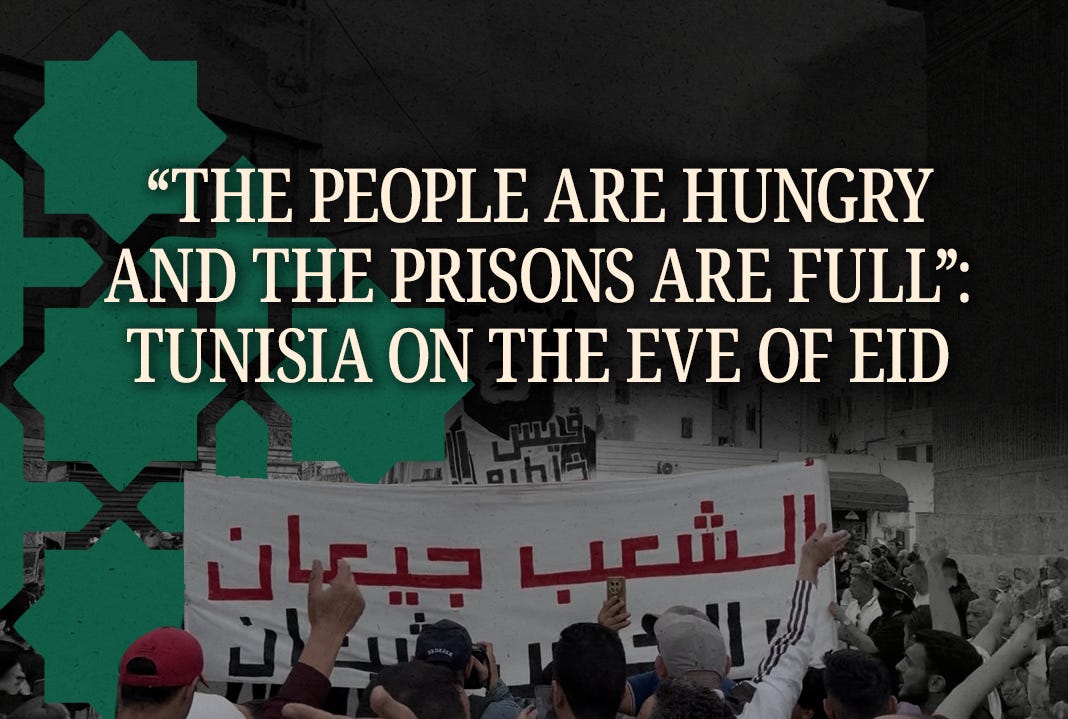
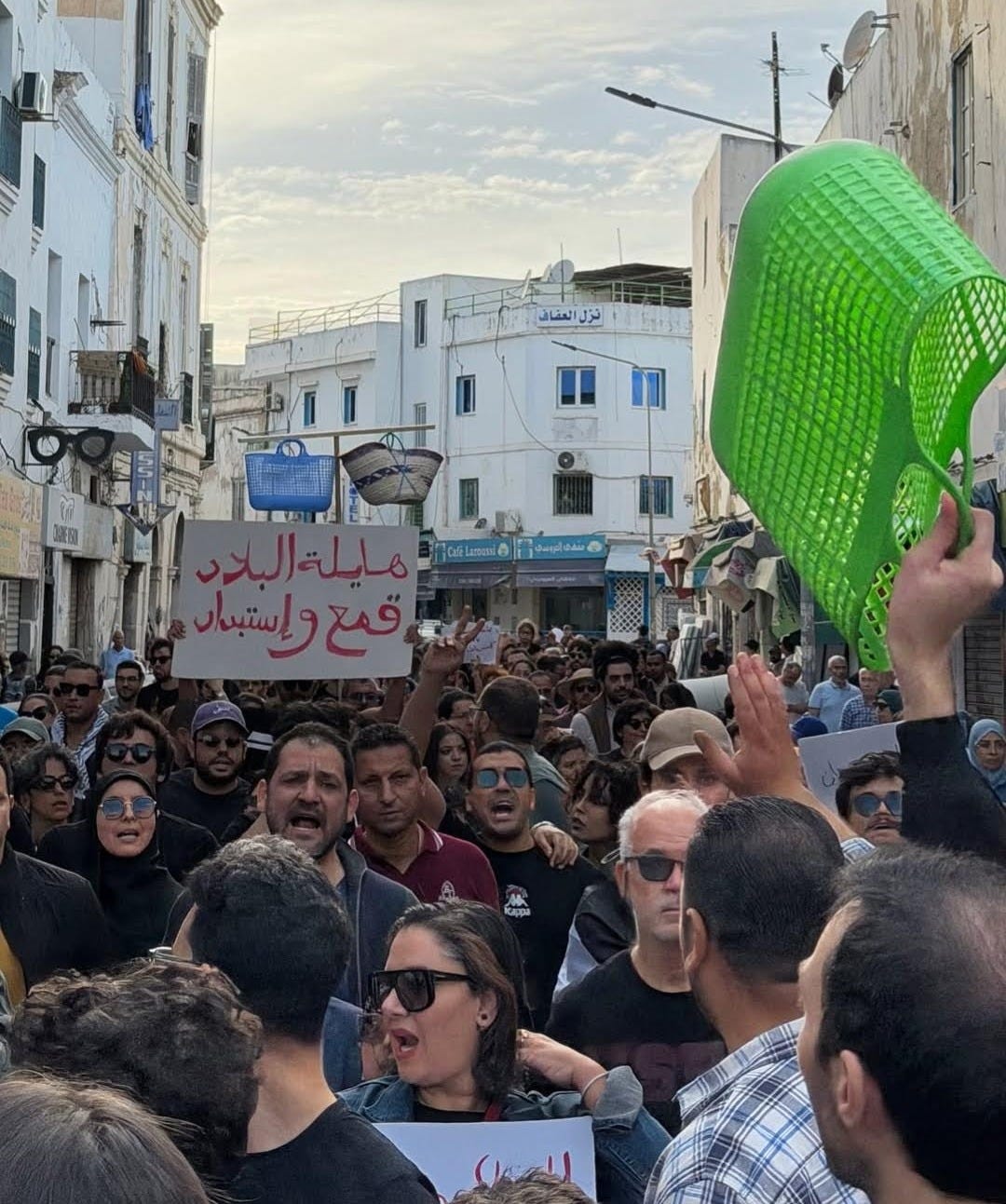
On May 16, just days before the Islamic holiday of Eid al-Adha, hundreds of Tunisians took to the streets of the capital to protest deteriorating economic conditions and what demonstrators describe as democratic backsliding. The demonstrations were the second major wave of protests in less than six months, following similar unrest in December 2025.
Tunisia has often been hailed as the only country to emerge from the Arab Spring protests as a democracy. However, a widening crackdown on Tunisian civil society, combined with the suspension of parliament and the ouster of then-Prime Minister Hichem Mechichi in 2021, has cast doubt on Tunisia’s democratic standing.
Many critics argue that Tunisia is slowly regressing toward authoritarianism, potentially relinquishing a decade of democratic progress achieved after the 2011 revolution. Since the Sousse suicide attack in 2015, which killed 38 people, Tunisia has been in a state of emergency. President Kais Saied extended the state of emergency for 11 months, starting in January 2026, granting the interior ministry sweeping powers, including banning public gatherings and monitoring the press.
According to a 2026 report by Human Rights Watch (HRW), arbitrary detention and politically motivated trials have become the norm. In November of 2025, HRW reported that 34 people from different backgrounds—including activists, lawyers, and political opponents—were sentenced to between five and 45 years in prison on vague terrorism and state security charges under what became known as the “Conspiracy Case 2.” The latter has been dubbed a “misuse” of the criminal justice system by Amnesty International’s deputy regional director for the Middle East and North Africa, Sara Hashash.
In 2024, four journalists were reported to have been behind bars by The Committee to Protect Journalists, the highest number since 1992. In 2023, a wave of arrests targeted at least 11 individuals, including lawyers, ministers, and former judges, whom Saied accused of “conspiring against the state and against the president.” While it is unclear whether future protests will take place, the absence of any signs of prospective reforms will likely generate more opposition. According to Reporters Without Borders, Tunisia’s press freedom ranking dropped by 11 places in 2025, to 129th out of 180 countries.
“We took [to] the streets for employment, freedom, and national dignity,” one of the protesters told Middle East Uncovered on the condition of anonymity. “[The administration’s] gap between rhetoric and reality could not be wider in today’s Tunisia,” added the protester.
President Saied rose to power in 2019, winning the election in a landslide. What was described as a “self-coup” in 2021 established Saied’s one-man rule. In July of that same year, parliament was dissolved, and its members stripped of immunity, followed by a suspension of the constitution. In June 2022, Saied ruled by decree, granting himself “absolute power” to dismiss judges, and fired 57 of them. Amnesty International described the move as a “deep blow to judicial independence.”
The 68-year-old former law professor effectively consolidated executive power and, subsequently, undermined the authority of an independent judiciary.
Saeid’s re-election in 2024 recorded the lowest voter turnout in Tunisia since 2011, with participation falling to just 28.8 percent. Despite the general public’s disillusionment with politics, Saeid still managed to amass 90.68 percent of the votes.
“What brought me out on May 16 is the hope for a better Tunisia and the refusal to stay silent,” said the protester. “I witnessed that hope in the eyes of merchants and neighborhood locals, who were chanting along as we passed by their streets during the protest.”
Protesters held signs reading, “The people are hungry and the prisons are full,” linking Tunisia’s worsening economic conditions to growing political repression. Others carried signs condemning rising poverty and soaring lamb prices ahead of Eid.
Many Muslims around the world traditionally celebrate Eid al-Adha by sacrificing a sheep and eating its meat. According to Lutfi Al Riahi, the president of the Tunisian Organization for Defense of Consumers, sheep prices have risen by 300 Tunisian dinars (roughly $100) compared to last year. According to the World Bank, poverty rates declined marginally, standing at 16.0 percent in 2025 compared to 16.6 percent in 2024.
“Sentiment is being most directly shaped by rising prices and decreasing purchasing power,” Adrienne Todd, a partner at the Tunis-based Dispatch Risk Advisory, told Middle East Uncovered. Todd believes that economic grievances will likely remain at the core of future protests. “While political issues were cited by protesters on Saturday [May 16], the overall populace is focused on economic pressures,” she added.
Over the past decade, Tunisia’s economy has been in dire straits. From 2011 to 2022, the purchasing power of the Tunisian dinar gradually depreciated, losing 52 percent of its value against the US dollar. It continued to decline from 2021 to 2024, losing 7.7 percent of its value. In the fourth quarter of 2025, the unemployment rate stood at 15.2 percent, a marginal decrease from the average of 15.66 percent over the past couple of decades.
Economic grievances were at the core of the Tunisian revolution that ousted Dictator Zine El Abidine in 2011. The anonymous protester does not believe any of the revolution’s goals have been achieved, blaming the system for failing to implement reforms and adding that many promises have been made by the administration, but never fulfilled.
In 2025, Tunisia’s public debt surpassed the 80 percent mark of its GDP, 2 years after Saied rejected an IMF bailout package worth approximately $2 billion. Saied stated that if the package were accepted and subsidies were eventually removed, it would destabilize the country. Saied’s rejection, however, has not led to sufficient progress to remedy economic woes, as the current situation seems to benefit the rich more than the poor.
Saied will likely stay in office until the end of his five-year term, where elections are set to take place in 2029. Whether or not further demonstrations will be held remains to be seen.
As Eid al-Adha begins tomorrow, many Tunisians are entering a holiday traditionally centered on sacrifice, family, charity, and communal celebration while facing mounting economic pressure and shrinking political freedoms. For many families, even the cost of buying a sheep for Eid has become unaffordable, turning what is usually a moment of joy and generosity into a reminder of financial insecurity and frustration. At the same time, growing fears over repression, arbitrary arrests, and democratic backsliding have deepened the awareness that Tunisia’s post-revolution promises remain unfulfilled.
For many protesters, the anger expressed in the streets ahead of Eid was not only about rising prices, but about the feeling that both economic dignity and political freedoms are steadily slipping away.
Middle East Uncovered is powered by Ideas Beyond Borders. The views expressed in Middle East Uncovered are those of the authors and do not necessarily reflect the views of Ideas Beyond Borders.
This was a little confusing. Tunisia is not “slowly regressing back to authoritarianism.” Its democratic experiment lasted 10 years and ended with a coup in 2021. Assumed this was accepted historical fact at this point.