

Can One Politician Achieve Justice For Iraq’s Yazidis?
Election victory gave Murad Ismael a platform to address the grievances of a sidelined community. Six months into his first term, he is confronting formidable barriers to deliver long-awaited change.

Another week in Iraqi politics, and Murad Ismael is frustrated. Some days, he feels “sickened” by a political system that enriches a small elite. Other days, it seems impossible to get anything done. Entering office on a wave of support in November 2025, the engineer-activist believed his win would mark a turning point for the Yazidi people. “I thought I would be that person who gets things done; I’ll be the politician who makes change.”
Six months into his first term in Parliament, he has adjusted his expectations, but not his goals. The community he represents has slipped down the agenda, supplanted by wars in Iran, Afghanistan, and Ukraine. “The international community helped initially, but then they dropped the ball before we had resolutions... Yazidi cases are really on the back burner now,” Ismael said.
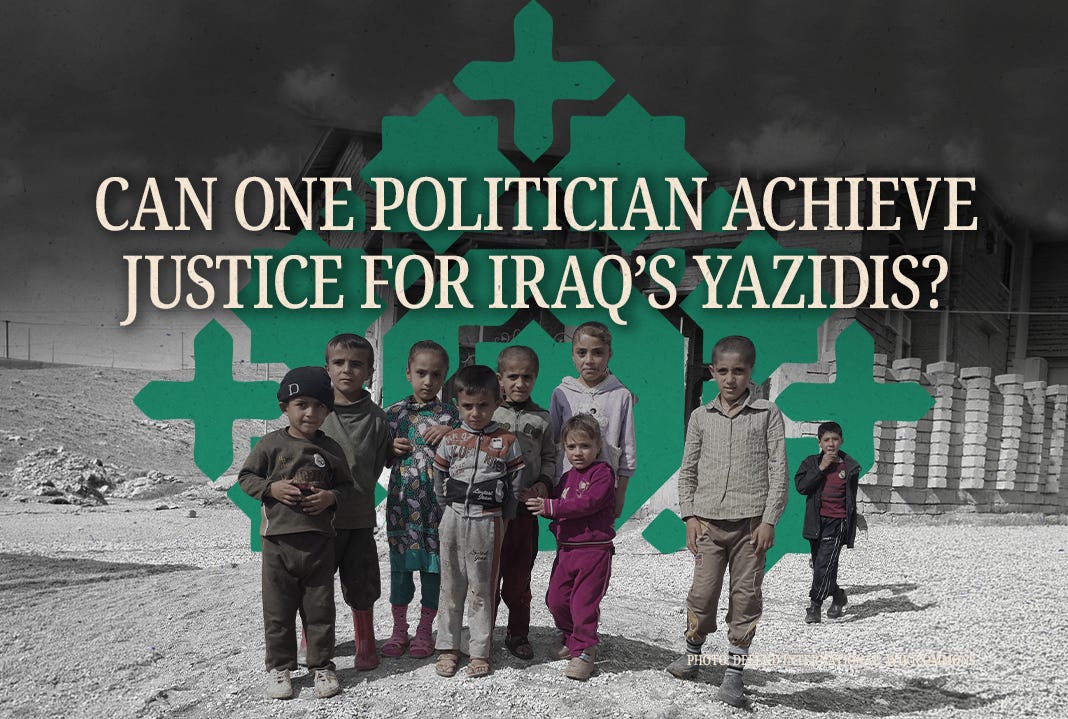
Twelve years after the ISIS genocide, few reparations that would allow families to heal have materialized. Approximately 190,000 Yazidis are still displaced, unable to return to Sinjar where the reconstruction of schools, hospitals, and other vital infrastructure has been painfully slow. Many cannot go back because their homes have been destroyed. Others fear returning to a volatile environment where different armed groups vie for control.
“I am representing a population that needs support, employment, reparations, IPD [Internally Displaced Person] returns, and reconstruction. I think people are starting to wonder after six months what Murad is doing,” he said.
These issues loom large for an entire generation that has grown up in refugee camps, where Yazidi families fear lost loved ones have been forgotten as mass graves await excavation and investigations into trafficked children stall. But in Baghdad, where Ismael advocates daily for the Yazidi cause, politicians look surprised when he describes squalid conditions and food shortages. “They don’t even know that the IDPs exist. That really hurts,” he said.
After years of campaigning, Ismael believed politics would provide a platform for policy change. Now he fears it might be too late. “I wish I was in parliament in 2017 and 2018 when the Yazidi issue was at the forefront internationally. It takes a lot of energy to bring anything related to Yazidis [before parliament] now.”
A few months after Ismael began his term in office, a period of relative stability in Iraq came to an abrupt close. In March 2026, the US-Israeli conflict with Iran spilled into Iraq, turning it into a proxy battleground.
The ensuing months saw politicians grappling with the economic devastation caused by plummeting oil exports, while civilians faced soaring food prices as attacks on Iraqi soil dragged the country into another war. “Iraq is not a functioning country…the whole system is cracking,” he said.
Ismael began his term charged with ambition. He had no intention of being another Yazidi politician who enters parliament with a “heavily Kurdish agenda.” His vision remains broader and more inclusive, “to build a balanced Yazidi policy that’s not based on hate.”
So far, this has proved difficult in the context of a regional war that is exacerbating divisions in Iraq’s political system. Modest progress becomes arduous when confronted by the fault lines between parliament’s competing parties and sects. “Sometimes even the like-minded people can’t unite because of the way Iraq’s political system works,” he said.
Ismael never intended to run for office. After co-founding the Yazidi advocacy group Yazda and leading the fight for justice in courts abroad, he was already a leading voice for survivors. His work helped to secure recognition for the genocide in more than a dozen countries and drew attention to the testimonies of survivors like Nadia Murad. In 2020, he drew on his background in the non-profit sector to launch Sinjar Academy and create opportunities for Yazidi youth unable to find work.
Then, last year, he made a last-minute decision to join the first Yazidi unified electoral coalition and the votes flooded in. He received one of the highest vote counts in Nineveh, a victory made all the more remarkable by sidestepping the traditional party machinery, patronage networks, and hefty campaign budgets that bankroll many mainstream candidates in Iraq.
Iraqi politicians backed by the major parties typically spend tens of thousands, even millions, to secure their seat in the Council of Representatives. Ismael was elected outside the quota system, which reserves seats for minority candidates, after spending less than $20,000 on his campaign. “Yazidis have waited a long time for a person to give them hope, and power, and strength,” he said.
When the results were announced in mid-November, it felt like something had finally shifted. A community that has spent more than a decade struggling to be heard had a voice they trusted in a position of power. Celebrations erupted as fireworks lit up the streets. A convoy, hundreds of cars long, blared their horns until 3am. “It felt strong,” Ismael said.
That night, he saw the faith his constituents had placed in him. Six months later, he understands what it means to carry the hopes of a bereaved community on his shoulders. “It’s an honor, but also an unbelievably heavy burden.”
Ismael is using his time in office to explore all possible avenues for justice. He is part of the working group behind the new international crimes law, which will bring genocide, war crimes, and crimes against humanity into Iraq’s legal system. The law has been slow to materialize, and he is keen to accelerate progress on legislation that will afford greater protections to minorities in Iraq. It will also afford a degree of recognition for the suffering Yazidis have endured. “Genocide is a lot of open wounds that you need to close as much as possible,” he said.
While wider reform grinds on, he keeps WhatsApp open for day-to-day demands. He wants to counter the aloof image of Iraqi MPs and moves between two offices where he is accessible to voters. “As a politician you are a member of the community that sent you here. You have to be available when they need you.”
There are days when Ismael wonders what can be achieved with “just one seat.” Other times, he believes that one man, one voice in Parliament, does matter.
This means responding to a cry for help at 1am when someone’s family member is being held at a checkpoint, or stepping in when an employee needs six months off work to recover from illness. These are the differences he can make on a daily basis, while harnessing his access and building alliances to address broader challenges affecting Yazidis as a whole.
Looking ahead, he is clear in his goals. The challenge will be finding routes to achieve them in a system that safeguards power for a well-connected elite. He is encouraged by the new Prime Minister Ali al-Zaidi’s anti-corruption crackdown, which has recovered more than $100 million in missing state funds and resulted in the arrest of senior officials, including MPs. But the corruption cases and patronage networks will not evaporate overnight, nor in the three and a half years left of his term. New to politics, he is learning how to work within a broken system, “adhering to my values while trying to get something done.”
Ismael doesn’t know whether he will run again when his term is complete. He won’t be distracted by campaigns and bids for power. His focus is on tangible change for a community that has been “let down by everybody,” while closing the gap between ordinary people and the politicians that speak for them. “A lot of the issues that Yazidis face are political issues, so they need to have strong political representation,” he said.
Six months after Yazidis chose him to “change the wave of injustice to justice,” Ismael knows the difficulties ahead. The obstacles are daunting, but he refuses to waver. “I will be the voice of my people in every instance,” he said.
Read more about Ismael’s electoral victory:
Murad Ismael’s Win Signals a Turning Point for Yazidis

Eleven years after ISIS tried to wipe the Yazidis off Iraq’s map, Murad Ismael has pulled off one of the most unthinkable victories in Iraqi politics: winning a parliament seat with no party machine, no money, and a message that the world has forgotten Sinjar. Ismael didn’t plan to run for office. But years of stalled reconstruction, mass graves left un…
Middle East Uncovered is powered by Ideas Beyond Borders. The views expressed in Middle East Uncovered are those of the authors and do not necessarily reflect the views of Ideas Beyond Borders.