


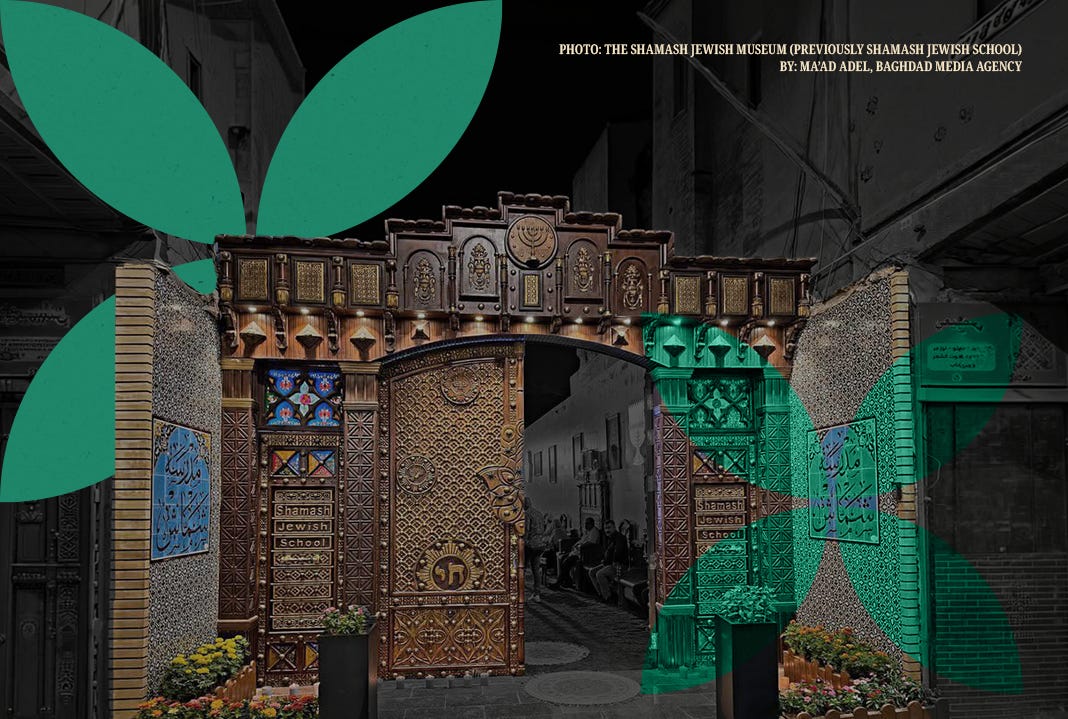
By the time Dr. Khalida Fouad Eliyahu was born in 1962, Baghdad’s thriving Jewish community was vanishing fast. Her parents, both doctors, felt they had a duty to stay as friends and neighbors fled, fearful of the mounting hostility towards the country’s ancient Jewish population.
A deadly pogrom in 1941 known as the Farhud shattered the sense of security for Iraqi Jews as armed mobs rampaged through Baghdad, killing up to 180. A decade later, following the establishment of the state of Israel in 1948 and mounting discrimination and restrictions on Jewish life, more than 120,000 left the country, most of them heading to Israel.
“They left everything because of the injustices they faced… They loved their country. I felt so sad when I went to synagogue, and I saw nobody there. It wasn’t like it was in the past. I felt very sad, and my dream since then has been to restore the presence of Jews in Baghdad,” Dr. Eliyahu, head of the Administrative Committee of Iraqi Jews in Baghdad, told The Sephardi Report.
That ambition was realized on October 30 with the launch of a new museum in the heart of Baghdad that aims to tell the story of Iraq’s Jewish community. “It’s the only museum in Iraq belonging to the Jewish community,” Ammar al-Tamimi, lawyer for the committee of Iraqi Jews that manages the community’s properties, told AFP.
Jewish community leaders led by Dr. Eliyahu have been gradually restoring their historic sites in Iraq. For years, efforts to revive the Shamash Jewish School on al-Rashid Street were stalled, first by sanctions in the 1990s and the US invasion in 2003, then by sectarian violence in 2006 and 2007 and the rise of the Islamic State group.
More recently, a period of relative stability in Iraq was accompanied by a growing hunger for culture and entertainment, particularly among younger Iraqis eager to explore their country’s history. Decades of conflict and political upheaval dominated the agenda, but today renewed interest in the stories and communities that helped shape modern Iraq is giving cultural activities momentum.
This extends to projects that might have once struggled to gain support, including initiatives designed to preserve the history of Iraq’s ethnic and religious minorities. The Shamash Jewish school, founded by Yaqub Shlomo Shamash almost a century ago, now houses Iraq’s first museum dedicated to its Jewish heritage, offering Iraqis an opportunity to learn about a community that once made up around a fifth of Baghdad’s population.
Inside, visitors browse display cabinets filled with handwritten school certificates, antique documents, and family photographs offering a glimpse into Jewish culture and society. Pictures of prominent Jewish figures adorn the walls, including Iraq’s first finance minister, Sassoon Eskell, and Dr. Eliyahu’s brother, the physician Dhafer Fouad Eliyahu, who was well known in Iraq for providing free medical care.
Most of the Eliyahu family were doctors. “My mother was a famous gynecologist, and my brother was an orthopedic doctor. I am also a dentist myself. Patients would come from all over Baghdad, Hilla and Mosul to see my mother,” she said.
Growing up, Dr. Eliyahu attended two of Iraq’s best-known Jewish schools, Menachem Saleh-Daniel and Frank Iny. She also learned Hebrew alongside other Jewish children at the Meir Tweig Synagogue, a site she now looks after in her efforts to ensure community members do not feel completely erased.
On weekends, the family would visit the Al-Wiyah club, a popular haunt for the city’s well-to-do, where the membership included Iraqi Muslims, Christians and Jews alongside British and European diplomats. Dr. Eliyahu recalls learning to swim there while her parents played cards and backgammon. It was a place where people could mingle beyond their immediate family or religious circles during an era when Jewish communities were an active part of Iraqi society.
That would change throughout the 1960s as Jews who once held positions in government, finance, law, education and medicine were gradually excluded from Iraqi life. By 1970, the Jewish community in Iraq had dwindled to around 2,500, plummeting to around 350 by the middle of the decade.
Dr. Eliyahu recalls seeing her mother crying over the news that another Jewish person had been snatched off the street and tortured or killed. She described how “they took our telephones, we couldn’t go to university or study and people’s assets were frozen.”
Today, just six Jews are believed to live in Baghdad, representing a last link to the community, which has lived in Mesopotamia for over 2,600 years. In its heyday, this was one of the largest and most culturally established Jewish communities in the world. But for decades, this legacy has been barely visible in Iraq, where most of the roughly 50 remaining synagogues and Jewish heritage sites have fallen into disrepair, or been repurposed.
Nabil Abdul Hameed, a Baghdad resident who has visited the museum twice, told Reuters that he did not believe the museum existed until he saw it himself. “I saw people’s interest in this subject, and I hope it is a seed of goodness that grows in the future, because the Jews were among the founders of this country,” he said.
“I hope those in charge will think about bringing the Jews back. The Jews have property, history and heritage. I wish they would come and take part in the revival of the country.”
Dozens of people have visited the museum daily in the last few weeks, but there has also been significant political pushback.
A cautious easing of restrictions on Jewish sites in recent years has seen Iraqi authorities quietly granting permits for the restoration of the Shrine of Rabbi Isaac Gaon in Baghdad and the Shrine of Prophet Nahum in Iraqi Kurdistan. However, powerful political factions oppose these efforts, sometimes citing the country’s criminalization of attempts to normalize relations with Israel and conflating the restoration of Jewish heritage with Zionism.
In mid-November, one of Iraq’s most influential pro-Iran factions described the museum as an “enemy foothold” in Baghdad. In a post on X, Mohammed Naji Mohammed, head of the political bureau of the Badr Organization, called the museum a “security and cultural breach that harms our national identity and existence.”
His comments came as national and international media reported a broadly positive public reception, with dozens of Iraqis visiting the museum daily to browse the black-and-white photographs and handwritten school certificates displayed alongside religious objects and other reminders of a once-vibrant community.
For now, Jews are largely unable to visit the museum due to the high security risks they face traveling to Iraq. Dr. Eliyahu hopes that the time will come as she continues her work despite multiple attempts on her life, including one that left her severely injured.
“This museum isn’t necessarily just for Jews. In fact, it is for Iraqis to learn about the Jews that used to live here. This is the heritage of our country. Everything is happening step by step and my dream, one day of course, is for the Jews to be able to come and visit the museum. However, this is already a very big step.”
You might also be interested in:
The Life of an Iraqi Jew in Exile

There’s a grand painting of Edwin Shuker that hangs in his living room. Visually opulent, it shows him praying before the tomb of the prophet Ezekiel in Iraq.
Middle East Uncovered is powered by Ideas Beyond Borders. The views expressed in Middle East Uncovered are those of the authors and do not necessarily reflect the views of Ideas Beyond Borders.