


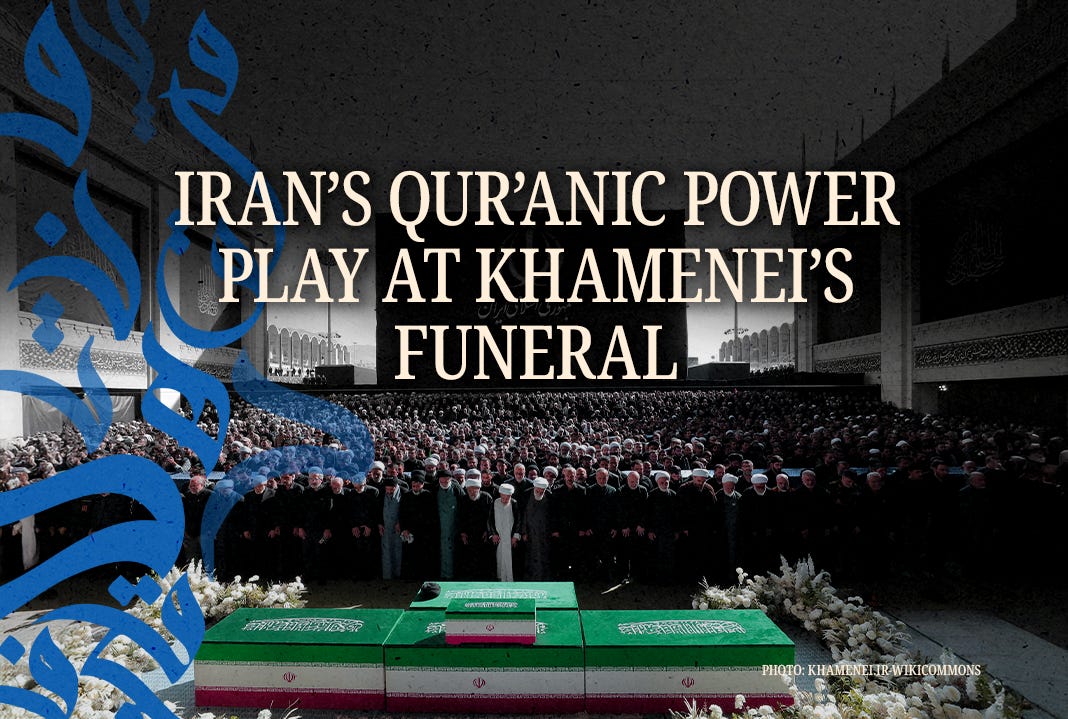
At Ali Khamenei’s week-long funeral, the body of the dead supreme leader was not the only thing being carried through the procession.
There were clerics, cameras, delegations, black clothes, grieving officials—all playing a part in the carefully curated choreography of a regime making a spectacle out of burying its most powerful figurehead. But something else was being covertly communicated. Iran used the funeral to address its guests through Qur’anic verses, seemingly selected to reinforce alliances, reward loyalty, and remind each delegation where it stood in Tehran’s regional order.
Qur’anic recitation at the funeral of an Iranian Supreme Leader is not unusual. It would have been odd if there were none. What made this ceremony different was that when different delegations entered, different verses were recited—and for a specific reason. Soon, people across the region began asking questions. Was Iran speaking in code?
No official Iranian explanation has confirmed that each verse was selected as a political message. But the regime is no stranger to coded communication, and this time the signal was hard to mistake.
Let’s start with Saudi Arabia. The verse recited before the Saudi delegation—Surat Al Nisa’, verse 13—recalled a moment when a smaller band of believers overcame a stronger enemy, a victory offered as a lesson to all who watched. The political meaning was difficult to miss. It was a reminder to Riyadh that Tehran remembers who stood where when the war came. In plain terms: we remember that you sided with the enemy.
This is often how Iran likes to levy threats. Sometimes you don’t need missiles or direct confrontation to get your point across.
Next came Qatar. The verse recited before its delegation—Surat Al Fath, verse 2—comes from a chapter associated with a compromise that initially appeared to be a concession but was later remembered as a strategic victory. For a state that helped facilitate negotiations, the implication was almost gracious by Iranian standards: thank you for helping make the agreement possible. But the victory belongs to us. Qatar was being reminded that, in Tehran’s telling, mediators facilitate history—they do not make it.
Turkey received a metaphorical cold shoulder. The verse recited before the Turkish delegation distinguished between those who join the struggle and those who lag behind, declaring that God grants a higher rank to those who fight with their wealth and their lives. Iran was telling Ankara: you watched. You calculated. You avoided the cost while others paid it. God, Tehran was suggesting, knows the difference.
Pakistan received a soft, but not neutral message. The verse associated with its delegation spoke of patience, steadiness, and remaining on God’s path. The meaning nearly supplied itself. Pakistan had stood close enough to Tehran to matter, yet cautiously enough to remain useful. Iran’s message seemed clear: remain patient, stay aligned, and do not drift when pressure rises.
Oman, too, had its place in the script. The chosen verse used the language of strength, solidarity, and a firm front. Oman is not a militia or a loud revolutionary actor, but a mediator, a subtle channel, and a state that often speaks softly where others shout. Yet even Oman was folded into Iran’s wider production. The message extended beyond mourning: the axis was meant to appear intact, disciplined, and unbroken.
Then came Lebanon. Iran’s view of the country has always been split in two. The official Lebanese delegation heard a verse about those who would hesitate if ordered to sacrifice themselves. Hezbollah’s delegation heard a line ending with “the party of God will be victorious”—a phrase that also translates literally as “Hezbollah.”
The meaning was unmistakable. The Lebanese state was portrayed as weak and hesitant; Hezbollah as loyal. The official delegation was addressed with caution, while the militia was addressed in the language of divine victory. The message was not only for Beirut, but for everyone watching: in Iran’s regional order, official governments are secondary. The groups that fight for the axis are rewarded.
Hamas was encouraged, with Iran focusing on endurance and sacrifice through a verse about men who fulfilled their covenant, both the dead and the living. It was scripture tailored to the politics of martyrdom. The message was: your losses are not the end of the struggle, but proof that the struggle must continue. Once again, in Iran’s hands, death was glorified.
This is both the power and the danger of Iran’s political language. The regime does not simply invoke religion to justify its policies after the fact. It fuses politics with religious symbolism until the two become inseparable. Rivalries are cast as divine warnings, negotiations as evidence of Iranian triumph, neutrality as moral failure, and militias as instruments of God’s will. Even death is reframed—not as an ending, but as a mandate to continue the struggle.
Saudi Arabia received a warning. Qatar was thanked for facilitating compromise. Turkey was rebuked for standing aside. Pakistan was urged toward patience and steadiness. Oman was folded into the facade of a strong regional front. Lebanon was reminded of its hesitation, and Hezbollah was given a metaphorical victory lap. Hamas was encouraged to endure.
A dead man was being mourned, but the living were being lectured.
There is something chilling in that. A funeral could have been a moment of silence and reflection, even for a man whose rule was defined by repression, war, and regional ruin. Instead, it became one last stage for the system he built, with Qur’anic verses used to reinforce its view of power, loyalty, and obedience.
Perhaps the most revealing part was not that Iran may have been sending political messages through Qur’anic verses. It was that so many people immediately understood them that way. Whether or not every verse was selected with that intention is almost secondary. The assumption itself reflects the political power the Islamic Republic has cultivated over decades.
In Tehran, religious symbolism rarely exists apart from politics. Scripture is used not only for worship, but also to frame alliances, rivalries, victories, and expectations. The funeral became another opportunity to do the same.
Khamenei may be gone, but the system he built will take much longer to dismantle. If the funeral demonstrated anything, it was that the Islamic Republic continues to view every public ceremony as an opportunity to assert dominance, reinforce alliances, reward loyalty, and signal where it believes everyone belongs—and expects each actor to play the role assigned to them.
Middle East Uncovered is powered by Ideas Beyond Borders. The views expressed in Middle East Uncovered are those of the authors and do not necessarily reflect the views of Ideas Beyond Borders.

Thank you, Issam Fawaz, for explaining to Western Christian readers the significance of the funeral messages. Are there any Iranian experts left in the American government to give their advice - if they are even asked?