


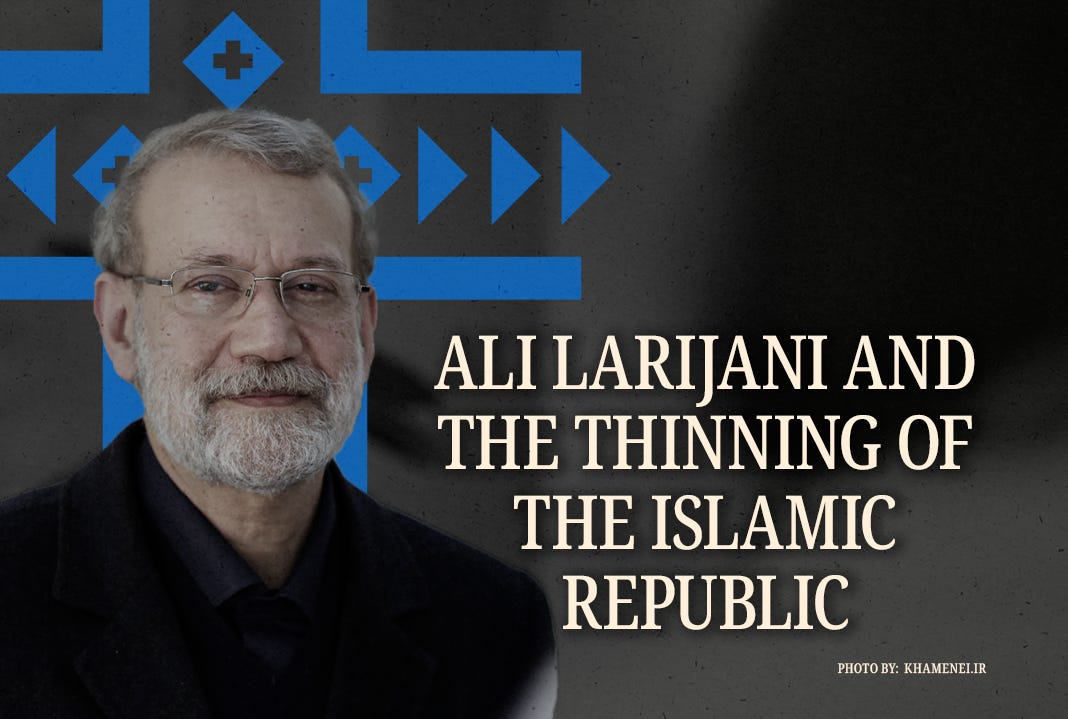
Ali Larijani spent most of his career helping build and maintain the Islamic Republic.
He was a regime loyalist who seemed to surface at every center of power. Born into a powerful clerical family, he served in the Revolutionary Guards during the Iran-Iraq War, went on to run state broadcasting and propaganda networks, became secretary of the Supreme National Security Council and Iran’s chief nuclear negotiator, later served as speaker of parliament, and remained close to the system’s core as an adviser to the supreme leader and a senior security official. In his final period, he was also reported to have been central to the January 2026 crackdown, in which tens of thousands of Iranian protesters were killed.
Larijani was killed last week in an Israeli airstrike near Tehran, along with his son and bodyguards. By then, the war had already torn through the upper ranks of the Iranian state. Supreme Leader Ali Khamenei was also assassinated in a strike on his compound in February, followed in subsequent weeks by a series of senior political and military figures, including intelligence minister Esmail Khatib, IRGC commander Mohammad Pakpour, defence minister Aziz Nasirzadeh, armed forces chief Abdolrahim Mousavi, and Basij commander Gholamreza Soleimani.
Multiple sources, including the Associated Press and the Jerusalem Post, reported that Larijani had effectively been running Iran after the earlier decapitation of its leadership. The new Supreme Leader, Mojtaba Khamenei—the son of Ali Khamenei—remains hospitalized and reportedly in a coma following an Israeli strike on the first day of the war.
As of this morning, Israel is reporting Alireza Tangsiri, a chief naval officer charged with overseeing the blockade of the Strait of Hormuz, has been killed. Iran has not commented on the claim.
The effect of these killings has been significant.
The Islamic Republic was built to survive shocks. It is, of course, a revolutionary movement designed for conflict against the West, including America. Power is dispersed across the Supreme Leader’s office, the Revolutionary Guards, the clerical establishment, the intelligence services, parliament, and a maze of councils.
On the military side, this overlaps with what the Iranian leadership calls the “mosaic defense” doctrine. The basic idea is simple: do not build a system that depends too heavily on one headquarters or chain of command. Instead, spread power, weapons, command structures, and local units across the country. If the center is hit, the rest of the system can keep fighting. The Islamic Republic Revolutionary Guard Corps (IRGC) developed this doctrine in the early 2000s to make Iran harder to defeat through airstrikes, decapitation attacks, or a conventional invasion. It relies on decentralization, redundancy, provincial commands, and the ability of local forces, especially the Basij and IRGC militias, to keep operating even if senior leaders are killed or communications are disrupted.
But as a consequence of losing so many leaders in a short span of time, the system is withering. The Israeli and American strategy is to decapitate the regime, and then to knock it back down if it tries to rebuild.
Ultimately, the United States and Israel are not likely to settle for less than regime change in Iran. The risks of a radicalized jihadist regime gaining a nuclear weapon are existential. Not only to Israel, but to the entire region and world. The Iranian regime—by indiscriminately attacking their neighbors, including Qatar, Oman, the UAE, Kuwait, and Jordan at the start of the war—illustrated that they are a rabid force, striking at anyone and everyone. Muslim or not. Zionist or not. American or not.
So far, Washington and Jerusalem have heavily degraded Iran’s navy and air force, destroyed large amounts of military infrastructure, and killed many of the men who coordinated the system from the top. Missile and drone launches by the regime have dramatically fallen since the start of the war.
The question now is whether the United States and Israel will spearhead a ground invasion of Iran or whether they will continue with air attrition and purported negotiations while waiting in hope for an internal coup or revolution.
A ground invasion was always going to be difficult. Iran is a massive and mountainous country. Any force entering Iran would have to deal with mountain ranges, long supply lines, and potential attacks from those who are still loyal to the regime. Or even those who are just anti-American.
But the prospect for an internal coup or revolution also remains uncertain. The regime has been badly damaged. But a state like this can lose ministers, commanders, and even a Supreme Leader and still keep functioning. At the end of the day, the IRGC has a lot of weapons, and the anti-regime protestors do not have any real military capacity.
One prospect is a targeted invasion at the coast to free the Strait of Hormuz and reduce any further threat to international shipping. And with Alireza Tangsiri reportedly out of the picture, this seems all the more likely.
That kind of operation would be easier to imagine—at least for now—than an imminent march on Tehran. The aim would be to seize or neutralize the parts of Iran’s military geography that give the IRGC leverage over the Gulf: islands, missile sites, drone bases, coastal batteries, naval facilities, and command nodes tied to the strait.
Such an operation would still be dangerous, of course. Iran has lost much of its conventional naval strength, but it still has mines, drones, anti-ship missiles, fast boats, coastal batteries, and dispersed IRGC units.
A regional coalition would make such an operation far more thinkable. If Qatar, Oman, the UAE, Kuwait, Jordan, and perhaps Saudi Arabia concluded that Iran had already crossed the line from a hostile power to an immediate threat, then the political and logistical burden would no longer fall solely on Washington and Jerusalem.
The military path forward is uncertain, whether through limited operations or continued attrition. But the outcome will not be decided by geography alone. It will depend on how much strain the system can absorb internally.
The Islamic Republic was built to withstand the loss of individuals. But that capacity depends on depth—on enough experienced figures to connect institutions, manage crises, and keep the system coherent under pressure. Larijani was one of those figures. His death, alongside so many others, raises the pressing question of how many more losses it can absorb before that durability begins to give way.
Middle East Uncovered is powered by Ideas Beyond Borders. The views expressed in Middle East Uncovered are those of the authors and do not necessarily reflect the views of Ideas Beyond Borders.

It all comes down to taking and holding Kharg
The Tangsiri point lands harder than the article perhaps realises. Our analysis this morning identifies a specific 2-7 day operational discontinuity created by his elimination — not a strategic shift, but a mechanical one. The corridor pre-clearance protocols, fee billing, and bilateral flag-state authorisations that kept neutral shipping moving through Hormuz required an authoritative signatory. That signatory is now gone. Indian, Malaysian, and Chinese operators are deferring transits pending explicit successor confirmation. The selective passage regime the market has been treating as stable is more fragile than it looks, and AIS data should show that before any diplomatic signal does.
The regional coalition framing in the final section is also developing faster than consensus expects. The UAE has moved beyond diplomatic language this week into what amounts to a public ultimatum — Abu Dhabi's entire economic model depends on unimpeded strait access, and every bilateral corridor deal Iran strikes with Malaysia, China, or India demonstrates that Tehran can pick winners and losers among shipping nations. That's existential for the UAE, and they don't need Washington's permission to start assembling their own coalition of the willing.
The mosaic doctrine analysis is the strongest part of this piece. The question of institutional depth — how many Larijanis the system can lose before coherence gives way — is exactly the right frame. We'd add one variable: the distinction between the IRGC's operational resilience and the civilian Foreign Ministry's negotiating capacity. Those two tracks are diverging, not converging. The IRGC is planning for a post-deadline world. The Foreign Ministry is still bargaining. How long that gap stays manageable is the real durability question.
— Phaseglass Global Intelligence