


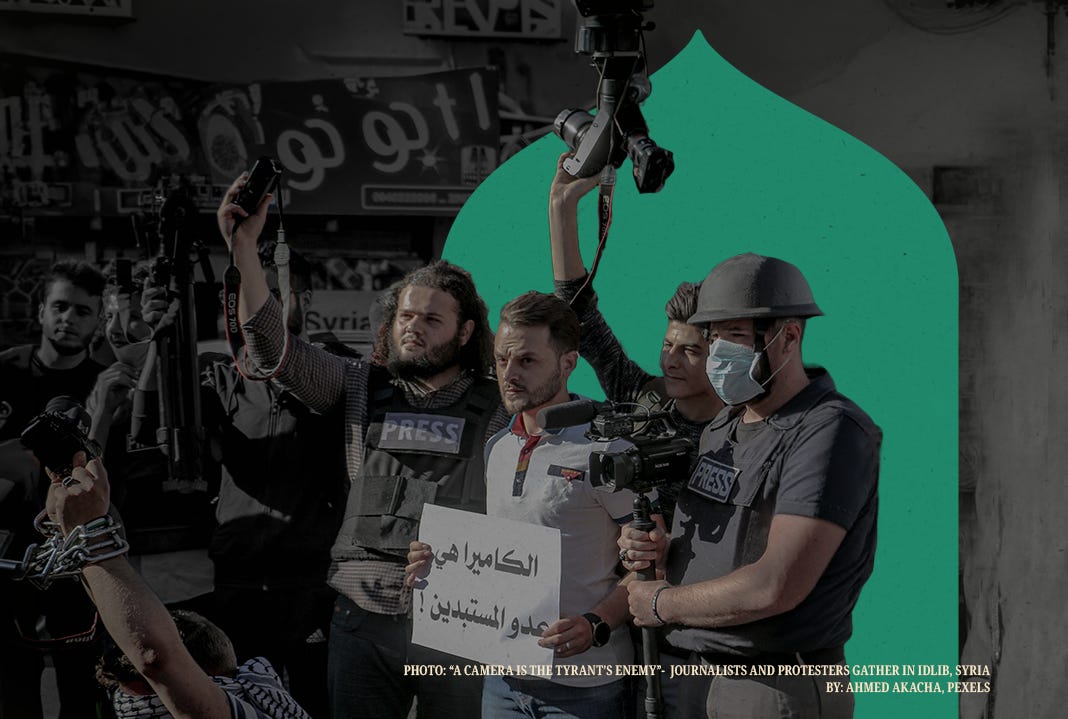
Anas AlKharboutli raises his head briefly as colleagues approach shouting his name. Fogging obscures the wound sustained moments earlier when a missile strike severed his legs. He is still clutching his camera, which would reveal a blurry photograph of the aircraft that killed him on December 4, 2024, days before the collapse of Bashar al-Assad’s regime marked the end of the Syrian civil war.
The 32-year-old photojournalist was on his way to cover the liberation of Hama with four other journalists when he sensed the danger overhead. Advising his colleagues to spread out, he raised his camera to capture evidence for the last time.
Reporters Without Borders (RSF) recorded the killing of 183 journalists at the hands of the Assad regime and its allies since the start of the civil war in 2011. AlKharboutli would be the last. Almost two years later, the risks he confronted to document government violations and the suffering of displaced Syrians have receded, but journalists say new impediments still limit their freedom to report.
In an interview from March 2023, he explained: “My project is to bear witness to the events in Syria until the end of this war. I don’t know if I’ll still be alive by then, but my goal remains to document it.”
The footage appears in an RSF documentary on journalists hunted down by former President Bashar Al-Assad. Under his rule, Syria became one of the most dangerous countries in the world for reporters. Critics of the regime were regularly detained and interrogated by the feared mukhabarat (the Arabic term for intelligence), and the fates of dozens of journalists who disappeared are still unknown.
The rebel offensive that overthrew the former dictator on December 8, 2024 dismantled this machinery of state repression. In the chaotic aftermath of his fall, journalists began pouring back into the country, taking advantage of the unprecedented freedom to expose the horrors hidden by the Syrian state.
Iraqi photojournalist Osama Al Maqdoni took pictures of cells and interrogation rooms at Sednaya Prison, known as the “human slaughterhouse” and part of a vast network of detention facilities where torture was applied on an industrial scale. Covering the first days after the fall of the regime for international media outlets, he witnessed the extraordinary vacuum left by 53 years of Assad family rule.
“I traveled freely through different cities across Syria, but there was an underlying sense of fear, knowing that I was moving through a country where there was no real authority in place,” he said. “There was a sense of joy at his removal, but it was mixed with fear, uncertainty, and anxiety about what lay ahead.”
For journalists working under Assad’s authoritarian regime, the red lines were sharply defined. Covering government abuses and institutional failures risked imprisonment, exile, or worse. Now, the boundaries have blurred as the Syrian government recalibrates its relationship with the media, proclaiming a new era of press freedom after almost 14 years of civil war.
“The spaces for work are wider; more journalists are daring to use their names, and more are daring to do investigations…but that doesn’t mean that journalists feel safe to cover any topic that is in the public interest,” said Zaina Erhaim, a Syrian Journalist working as a consultant and journalism trainer across the region.
In a year when press freedom is at a 25-year low, RSF reported a 36-place rise in Syria’s position on its World Press Freedom Index, marking the largest improvement of any country in 2026.
Progress was identified across all five of the indicators RSF uses to gather data, boosting Syria’s standing from 177th out of 180 countries and territories on the index to 141st globally, above Jordan, the UAE, Egypt, and Turkey. Despite this impressive ascent, Syria remains in RSF’s “very serious” category.
“It’s a huge achievement, and it’s important to celebrate it. But the situation is still very difficult,” said Jonathan Dagher, head of the Middle East Desk at RSF. The biggest factor behind the rise was the regime change, he added, comparing the scope of work under the current government with the “no-go zones for the press” that existed under Assad.
For Syria’s transitional government, media liberalization has become a litmus test for its commitment to a more open and pluralistic Syria. Today, media freedoms unimaginable under Assad rule have been written into the country’s new Constitutional Declaration, while Interim President Ahmad Al-Sharaa has promised “wide media freedom with few restrictions.”
In early September, Information Minister Khaled Zaarour announced the completion of a new draft media law that, according to the ministry, would guarantee journalists access to information, protect the confidentiality of sources, and replace imprisonment for media-law violations with financial penalties.
The world is waiting to see how far these promises translate into greater freedoms on the ground. Journalists and international organizations describe “genuine liberalization” but point out that the bar for improvement was extremely low. For media freedom to be guaranteed, they say, government promises must be backed by enforceable rights that let journalists access information and protect their sources.
“Under Assad, independent journalism was virtually impossible inside government-controlled Syria, and hundreds of journalists were killed, imprisoned, disappeared, or forced into exile over decades. Moving from that environment produces a dramatic statistical improvement even before strong institutions protecting press freedom have been established,” The Committee to Protect Journalists (CPJ) said.
Greater freedom of movement, less direct censorship, and far more room to report critically are among the improvements cited in CPJ’s December 2025 report, which balances this progress against the risks of reporting in a fragmented environment where dangers shift and rules remain unclear. “Journalists described freedoms they had not experienced for decades, while warning that the foundations of genuine press freedom were not yet secure,” CPJ told Middle East Uncovered.
Permits and accreditation are often cited as barriers to impartial reporting. Access to information and events can hinge on subject matter and location as well as a journalist’s gender or ethnicity, their affiliations, and the interests of the local authority in control.
Covering northeastern Syria, Kurdish journalist Akhtain Asaad has found that bureaucratic barriers can determine which stories are covered. His efforts to investigate oil-burning pits near the Al-Yarubiyah border crossing were blocked when he couldn’t obtain the necessary permits. “I am not free enough, though things are better than before, [but] the requirement for security clearances and approvals for media organizations in Syria remains an obstacle to a free press.”
Away from the checkpoints, obstacles also emerge when reporters request information. Pursuing a report on the Syrian Petroleum Company, Rasha Naddaf, a journalist with Al Jumhuriya, followed up on promises by its executive director to issue the company’s final organizational structure.
The paper contacted the Ministry of Information’s public-relations office, which referred them to the press office. “The press office said the questions were technical and referred us to the public-relations office at the Ministry of Energy, which then referred us to the Syrian Petroleum Company’s public-relations office,” Naddaf said. The company did not respond before the report was published.
“Press freedom begins with access to information, yet this right is not available in practice,” she said. “When no institution is responsible, when there is no deadline for a response, and when there is no effective right to access public information, journalism is obstructed without the need for a written censorship order.”
Naddaf left Syria in 2018, after her pseudonym was exposed. The last story she reported inside the country covered the attacks by ISIS on Suwayda, examining whether the Assad regime bore any political or security responsibility for the atrocities committed against the local Druze minority.
Her article held those in power to account at a time when questioning the state was extremely dangerous. For journalists from minority communities in particular, the government’s expressed commitments to press freedom have not yet translated into a feeling of safety or equal access to work.
A report by the Coalition of Women Journalists recounts the “precarious reality” faced by female Alawite reporters, whose gender and identity expose them to multiple layers of risk.
Lara describes the pressures of self-censorship for Alawite reporters as “intense,” and steers clear of some stories to avoid being perceived as “a mouthpiece for her sect.” Another reporter, Zein, says the pressure comes from within her community. “If I work on cases like Ghazal Ghazal, I might lose the people around me. “I cannot criticize anything in my community in a professional way.”
The coastal violence in March 2025 marked a turning point for some. One reporter, Doaa, felt able to “breathe again” after Assad’s fall because she no longer feared arrest. The massacres that killed over 1,000 Alawites changed that, and she was unable to write for three months. “My entire life stalled, and I experienced panic attacks.” She now uses a pseudonym to publish certain stories.
The practicalities of reporting can also prove more complicated for minority journalists, with identity shaping their freedom of movement, access to sources, personal safety, and how their work is perceived.
Naddaf had hoped to go back to Syria after Assad’s fall but said that, as a Druze journalist, the conditions required for a safe return do not yet exist. To feel secure, she said journalists of all backgrounds need equal protection under the law, regardless of sectarian identity, region or political position. She also pointed to the need for transitional justice and accountability for past abuses, without which new protections will be difficult to trust.
Uncertainty surrounding the future structure of Syria’s laws and the mechanisms to implement them remains a fundamental barrier to a free press. For now, repression has not disappeared; it has become more diffused, taking new forms that disproportionately affect certain reporters and outlets.
Radio Rozana is among several independent media outlets, alongside Enab Baladi and Al Jumhuriya, that are reestablishing a presence in Syria following the fall of the Assad regime. Their ability to report in Syria again clearly signals that space has opened up, but the parameters of that freedom are hard to define.
Co-founder Loujein Haj Youssef was frustrated when Rozana received a one-year license, despite paying fees to cover five. “Each time, a different justification was given for not granting the license for the requested period,” she said.
Meanwhile, reports have emerged of preferential treatment for government-aligned influencers and media outlets, which were given privileged access to officials and information. Three journalists were detained while trying to cover government clashes with Kurdish forces in Aleppo last January, while select outlets were afforded greater access to work.
The changes in Syria’s media landscape are part of a broader transition as the country emerges from decades of authoritarian rule and a divisive civil war. A new space has emerged for journalists to play a role in building a “healthy society”, but the institutions needed to uphold press freedom regardless of who is in power are not yet in place. For Syrian journalists, many vital questions remain unanswered.
The test, CPJ said, comes “when independent reporting becomes uncomfortable for those in authority—when journalists investigate security-force abuses, corruption, treatment of minorities, conflict operations, or failures of government policy.” For reporters such as Naddaf, that is not yet the case. “I do not see Syria today as a freer country for journalists, and I do not describe it simply as less repressive than it was under Assad. I see it as more arbitrary and less institutionalized,” she said.
You might also like:
Iraq Through the Lens of a Photojournalist

Two photographs capture the ethos of Osama Al Maqdoni’s photojournalism. Neither tells the whole story.
Middle East Uncovered is powered by Ideas Beyond Borders. The views expressed in Middle East Uncovered are those of the authors and do not necessarily reflect the views of Ideas Beyond Borders.