


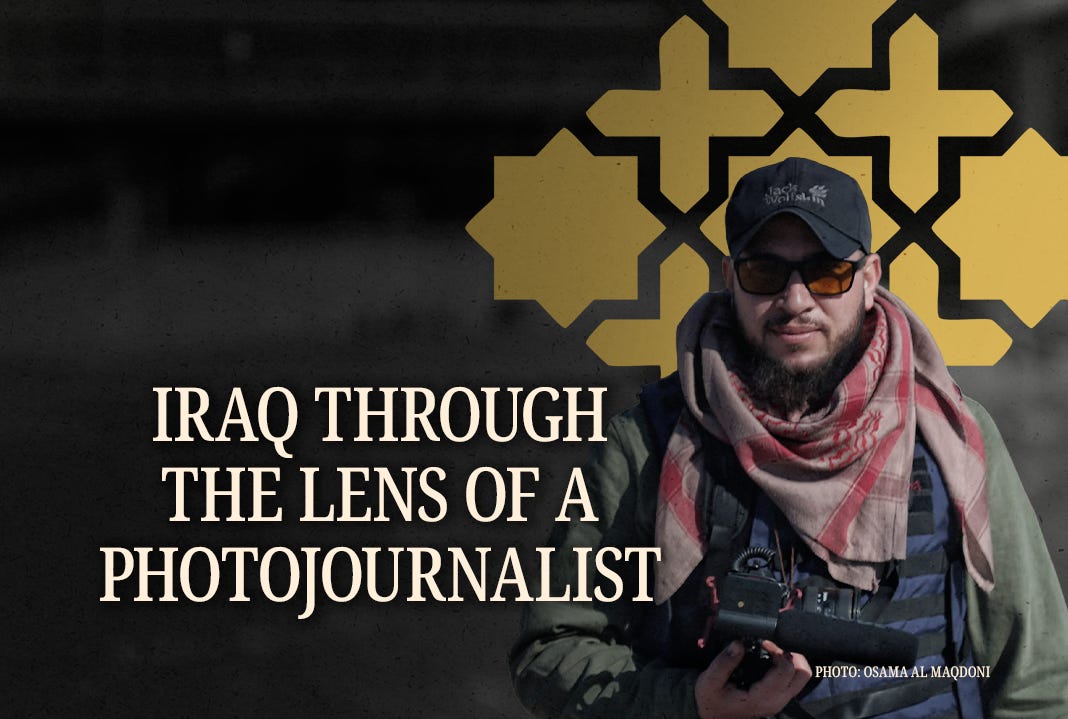
Two photographs capture the ethos of Osama Al Maqdoni’s photojournalism. Neither tells the whole story.
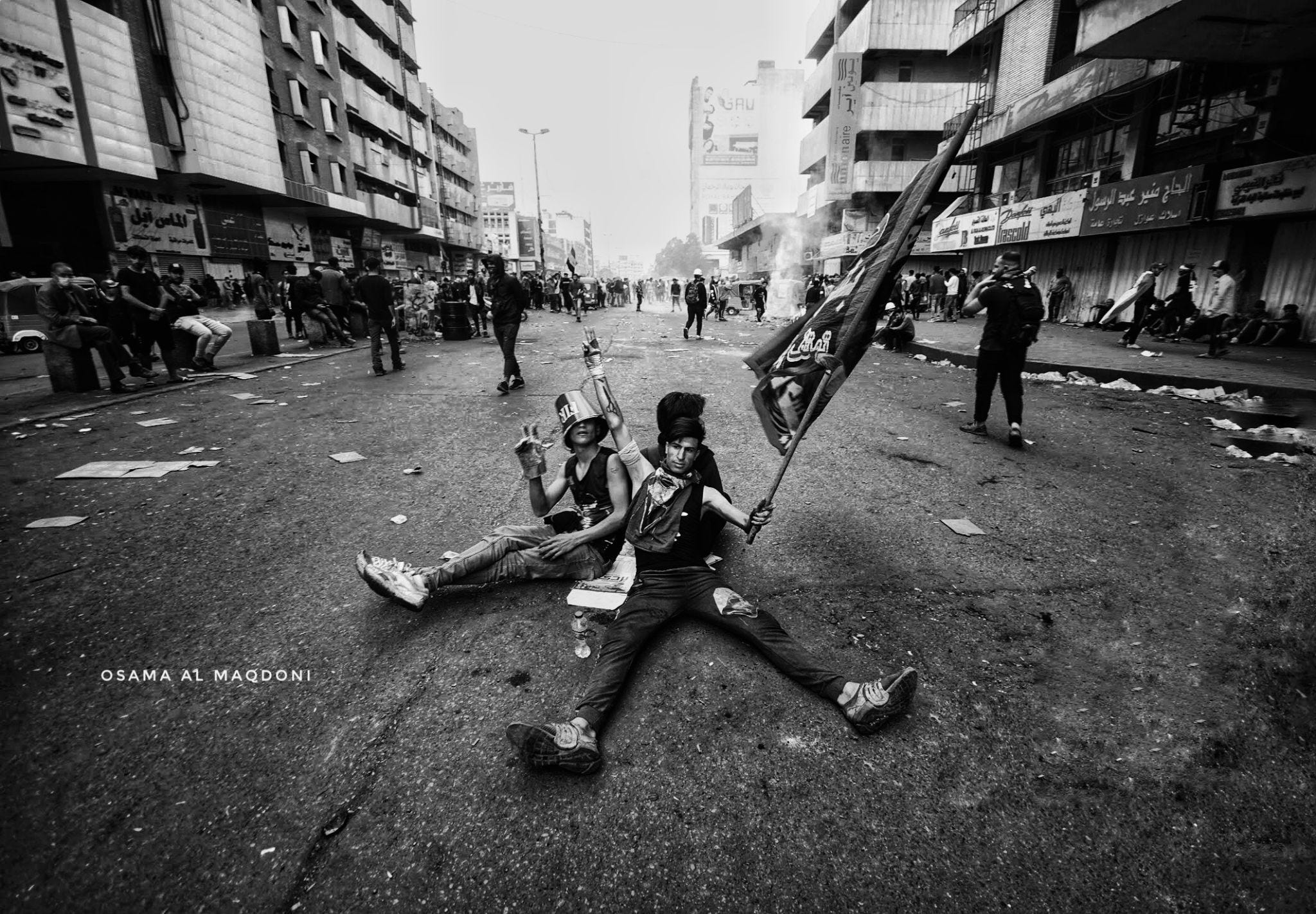
The first was taken during the October 2019 protests in Baghdad, when thousands of young people filled the streets daily to demand reform. Courage mingled with desperation in the scenes he photographed around Tahrir Square, where protesters celebrated their solidarity and lit candles for the dead amid a police crackdown that killed hundreds and wounded thousands more.
One image in particular stands out. It shows unarmed youth crowded onto a concrete barrier at the frontline separating security forces and protesters. The sky in the background is filled with smoke from tear gas canisters, but a young man still stands above the crowd, raising the Iraqi flag high over his head. Another sits on the shoulders of a friend, arms outstretched, capturing the hope and defiance of the country’s largest popular uprising since 2003. But this image only tells half the story. Moments later, more tear gas filled the street, and the menacing rattle of live ammunition sounded nearby, puncturing the momentum of the scene.
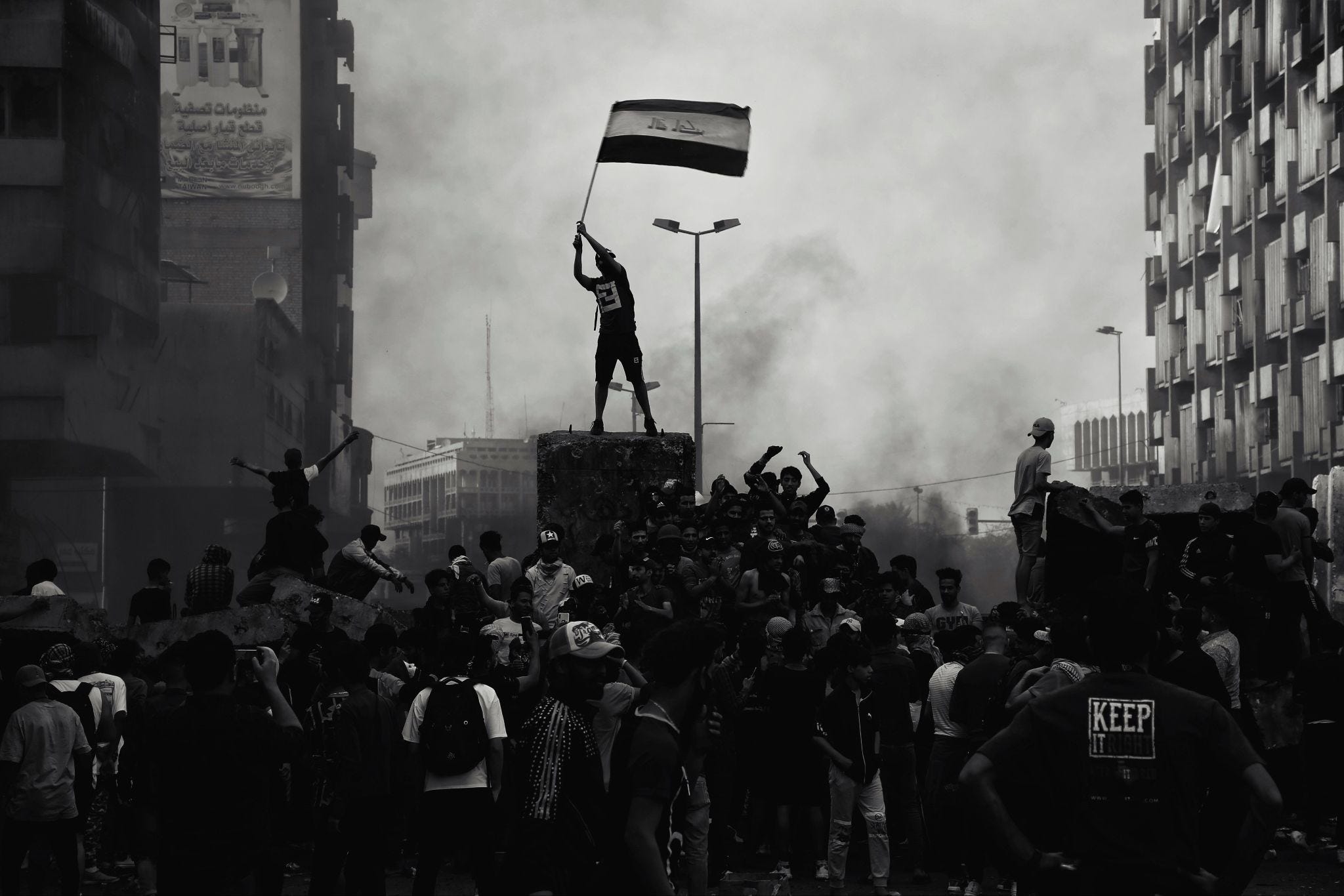
For Al Maqdoni, what happened outside the frame mattered just as much, completing the story behind the protests. “That photograph represents the contradiction that has shaped Iraq since 2003: a country blessed with enormous oil wealth and vast financial resources, yet one where millions of people continue to face unemployment, poverty, and limited opportunities,” he says.
These tensions have long provided a focus for Al Maqdoni’s lens. In a country where wars dominate headlines, he balances breaking news with humdrum reality, showing everyday life alongside dramatic events. His reporting has taken him to the forefront of conflicts and protests in Syria, Lebanon, and Iraq for outlets including the BBC, Anadolu Agency, AFP, and Getty Images. But his photographs also show people going to work, children playing in the street, families striving to maintain normality, and people living in poverty, finding ways to survive.


“I document conflict because it is an important part of reality, but I also strive to capture the quiet moments of everyday life. For me, journalism is not only about recording tragedy—it is also about showing that life continues, even under the most difficult circumstances,” he says.
Al Maqdoni intentionally chooses not to document some moments. In 2015, he was on assignment north of Aleppo, where thousands of civilians were fleeing the fighting. Humanitarian assistance was sparse, and people had to fend for themselves in cold, muddy conditions. From a rooftop, he watched a truck carrying emergency food donated by a private benefactor rumble towards the crowd.
Within moments, hundreds of people rushed forward, struggling to secure a share. “It was the kind of image that could easily become a major front-page photograph, powerfully illustrating the scale of suffering,” he says. Even so, he chose not to take the shot. “I felt that such an image, on its own, risked stripping people of their dignity and reducing them to a moment of desperation rather than telling the full story of the humanitarian failure surrounding them.”
In a 10-year photojournalism career, Al Maqdoni has photographed some of the decade’s defining events, but knowing when not to press the shutter carries equal weight. “My purpose is never to create sensationalist images. I avoid exploiting pain and moments of vulnerability,” he says.
Covering the impact of conflict on communities means he photographs people who have suffered severe trauma. Documenting these accounts is a crucial step towards holding the perpetrators of war crimes and abuse to account, but the stories he encounters are often harrowing.


For the Yazidi women who survived ISIS, the wait for justice continues more than a decade on. Producing a documentary about their ordeal brought Al Maqdoni face to face with details of the brutality they endured in captivity. “Some stories stay with you long after the assignment has ended,” he says.
In these moments, the human connection is vital, says Al Maqdoni, who faced similar challenges working on a documentary about female victims of domestic violence. “A photojournalist’s responsibility extends beyond documenting events. It also includes protecting the dignity, privacy, and safety of the people who place their trust in us during the most difficult moments of their lives,” he says.
It helps that Al Maqdoni is effortlessly friendly, with a warm smile that puts his subjects at ease. Traveling widely across Iraq, he engages with people of all backgrounds and understands different perspectives across the country’s many religious and cultural communities.
“I usually begin with simple, genuine conversations to break the ice and create a comfortable atmosphere before ever raising my camera,” he says. “Authenticity is everything. If you are humble, honest, and treat people with respect, they are far more likely to open their lives to you and allow you to tell their stories in a meaningful way.”
For personal accounts, he uses a 35mm lens because it balances the subject with the surrounding environment, making it ideal for storytelling. His camera, a Sony a7R IV, is popular with photojournalists, who prize strong low-light performance and fast shooting speed—features that matter in unpredictable, fast-moving situations.
Al Maqdoni bought his first Fujifilm camera at age 22 after working construction jobs to save up. His fascination with photography grew in quiet moments spent leafing through old newspapers and archival materials in his parents’ house. The youngest of eight siblings, he filled countless hours pouring over images of the Lebanese Civil War, the First Gulf War, the Soviet-Afghan War, and the Iran-Iraq War.
Studying these pictures prompted him to consider the role of photography in conflict zones. The U.S invasion of Iraq in 2003 confirmed his ambition to become a visual storyteller. He spent the next 10 years developing his technical abilities and learning how to tell stories through a camera lens. But when ISIS launched a major offensive across Iraq in 2014, Al Maqdoni found himself trapped between Mosul and his hometown Al-Dhuluiya.
Forced to flee, he sold his camera and left Iraq. He spent several months living on the streets of Istanbul, sleeping in public parks before a friend found him a job in the humanitarian sector. For the next three years, he worked with refugees and documented the impact of conflict on people inside Syria as millions were forced to flee their homes.
He returned to Iraq in 2017 and continued taking pictures alongside communications work with UN agencies before becoming a photojournalist full-time in 2023.
The logistical and security challenges faced by journalists in Iraq are magnified for freelancers. Each assignment requires a risk assessment, though growing up surrounded by conflict, Al Maqdoni is rarely daunted by commissions. He is used to verbal attacks or threats when covering an event for international media. “Most people do not understand that a journalist’s role is to inform and report, not to persuade,” he says.
Careful planning is crucial to secure the necessary permits and identify areas to avoid, but preparation only takes him so far. His job often relies on the ability to adapt to rapidly changing circumstances in the field. “Every assignment requires balancing the responsibility of documenting the truth with the need to protect both yourself and the people whose stories you are telling,” he says.
These lines often blur in unpredictable settings. Covering conflict zones across Syria between 2014 and 2018, Al Maqdoni found himself drawn away from work to assist displaced families and help wounded citizens before rushing back to document unfolding events.
“In those environments, the greatest challenge was simply staying alive while carrying out your job, but there was another challenge that was equally difficult: balancing my professional responsibility as a photojournalist with my human instinct to help people,” he says.
In 2020, the COVID-19 pandemic would push this tension to the limit. Covering the outbreak in hospitals, he watched the virus devastate families and claim the lives of friends and colleagues. The work was “emotionally exhausting.” Simply waking up to find himself free of infection in the morning felt like a blessing.
Seeing people suffer up close, whether in hospitals, refugee camps, or communities ravaged by war, is among the most difficult aspects of Al Maqdoni’s work. But it’s also what compels him to overcome formidable barriers in an oppressive media environment. Legal threats, intimidation, arbitrary arrest, detention, violence, and assassination are real risks for journalists in Iraq, which scored 162 out of 180 countries on the Reporters Without Borders Press Freedom Index this year.
But in those fraught, messy moments, amid the clamor of protests or the muddy chaos of an informal refugee camp, the dangers melt away. Covering the fall of Bashar Al-Assad’s regime in Syria, Al Maqdoni found himself entering the prisons and intelligence facilities that represented nearly 50 years of repression under Assad rule. “It reminded me that no political authority lasts forever,” he says.


In these moments, he is documenting history, creating a visual record of the human stories that can easily disappear when the headlines move on. “Governments change, leaders leave, but people endure. That experience reinforced my belief that societies ultimately shape their own future,” he says.
Al Maqdoni’s work in Syria attracted the attention of international media organizations, marking a turning point in his career. He is looking ahead to new collaborations, but his lens always swings back to Iraq, where everyday life shows another side to the country so often sensationalized by the press.
These are the photographs Al Maqdoni is most proud of, scenes that challenge tattered stereotypes of war-torn Iraq through city streets that bustle with life, rural villages where traditions have weathered centuries, mountain forests swathed in greenery and historical sites that date back to the first civilizations. “Many people who have seen my work have told me that it changed their perception of Iraq,” he says.
For Al Maqdoni, the essence of Iraq is not protesters raising their flags in defiance or refugee camps covering the hillsides of Kurdistan. His Iraq is captured in a simple street scene that reflects the realities of daily life in Baghdad, Mosul, or Basra. It’s where vendors sell their wares, children play outside, friends meet in cafes, and families share picnics on the riverbanks. “This image captures the real Iraq—the pain and the hope,” he says.


Middle East Uncovered is powered by Ideas Beyond Borders. The views expressed in Middle East Uncovered are those of the authors and do not necessarily reflect the views of Ideas Beyond Borders.
Beautiful. Thank you.