


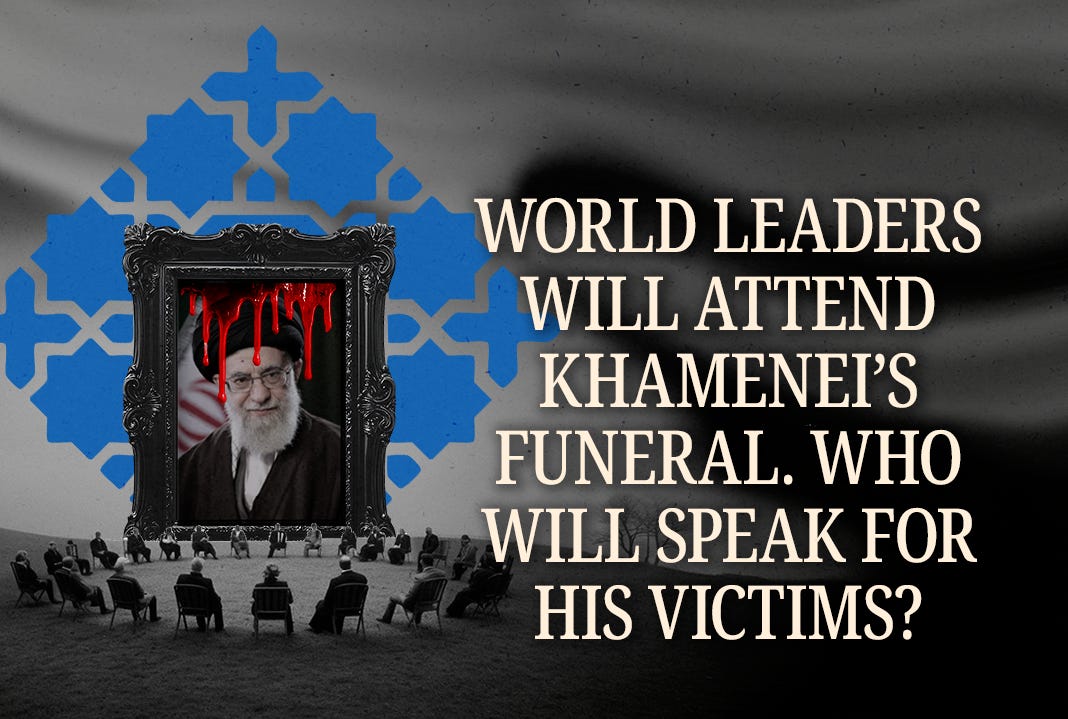
This week, Tehran is staging what it hopes will be the largest funeral in modern history. According to Al Jazeera, representatives from more than one hundred countries are expected at the seven-day farewell to Ali Khamenei, who was killed on the first day of the war launched by the United States and Israel. Pakistan’s prime minister is attending in person. Turkey is sending its vice president, China a senior lawmaker, India a deputy foreign minister and a state governor.
The processions will span from Tehran to Qom, cross into Najaf and Karbala, and end at the shrine in Mashhad, where the man who ruled Iran through fear for thirty-seven years will be laid to rest with full honors. One must admire the guests’ discipline. It takes a certain level of composure to bow before the coffin of a leader whose security forces, only months earlier, opened fire into crowds of unarmed protestors. It takes diplomatic skill of the highest order to offer condolences to a state that was, at that very moment, preparing to execute the very protesters it had arrested.
The dignitaries will speak of stability, history, and respect between nations. None of them, to be sure, will mention the innocent Iranians gunned down in January.
The guest list is instructive. Pakistan, whose prime minister stands among the chief mourners, is the same Pakistan that brokered the April ceasefire and the June memorandum of understanding between Tehran and Washington. The mediator and the mourner are one government.
According to CBS News’s live coverage, the mediators announced that the next round of US-Iran talks would be scheduled as soon as possible—but only after the funeral processions conclude. The diplomacy of the world’s great powers has come to revolve around the Islamic Republic’s calendar of mourning.
The world is waiting, hat in hand, for the regime to finish grieving.
Missing from the negotiating table is what U.N. High Commissioner for Human Rights Volker Türk laid out in April. His office recorded at least twenty-one executions in the months prior, including nine hangings tied to the January 2026 protests, along with over four thousand arrests made under broad “national security” accusations.
He cited evidence of torture, forced confessions, and staged executions. He also described a financial tracking system built to seize the assets of Iranians abroad, four hundred of whom have been branded traitors to the homeland. He described an internet shutdown that had, by then, lasted sixty-one days. Amnesty International’s May report pushed the numbers higher: more than six thousand arrests, at least thirty-nine political executions, and an internet blackout that ultimately stretched to eighty-eight days, the longest ever recorded, sealing ninety million people off from the world.
I was among those in the streets that murderous January. I marched and bled among thousands of others. I still bear the wounds from the Islamic Republic’s response to my simple desire for an ordinary life.
So when I read that officials have since claimed over three thousand lives, while independent civil society groups, operating in darkness due to the blackout, believed the number to be much higher, I don’t see just a figure. It’s personal. I remember their faces, if not during the day, at night in my nightmares. The numbers represent real people who stood shoulder to shoulder with me. I can still remember the fruity, burning onion smell of tear gas that suffocated us, the stun grenades that blinded and deafened us, and the cinders I felt under my feet when I was shot.
The regime cut the internet precisely so that the world would never be certain of the number, and the world, conveniently, has moved on to discussing shipping lanes and frozen assets. The truth is simpler, as Eurasia Review recently put it: The Islamic Republic’s factions may quarrel over negotiations, foreign policy, and setting the tone to take with the West, but they converge absolutely on one policy: preserving power through coercion.
Escalating executions ensure the system’s survival. The weaker the Islamic Republic becomes politically, the more institutionally it depends on the gallows. A House of Commons Library briefing recorded that the United Kingdom backed the renewal of the UN’s fact-finding mission on Iran, deplored the crackdown, and promised further sanctions legislation.
These measures matter, yet they are dwarfed by the moment. A fact-finding mission documents the graves; it does not prevent the digging of new ones.
A state that hangs teenagers for protesting, disappears its critics, confiscates the property of exiles, and effectively muzzles ninety million people for three months is not merely conducting routine internal governance. It is simultaneously exporting its methods, through proxies, transnational repression, and the normalization that every bowed head at this funeral.
Negotiate with Tehran if you must; wars end at tables. But any agreement that trades assets and opens straits while the executions of innocent civilians continue is not peace. At least not for Iranians. It funds the next round of hangings. The regime is showing us exactly what it values at this funeral.
The rest of the world is simply deciding how much Iranian blood it is willing to overlook in order to secure a deal.
Middle East Uncovered is powered by Ideas Beyond Borders. The views expressed in Middle East Uncovered are those of the authors and do not necessarily reflect the views of Ideas Beyond Borders.

Thank you, Husain, for reminding us of the deaths that are not being recognized in these elaborate ceremonies. I’m sorry for the injuries to your body, mind and soul.
14 millions Iranians at the funeral,on the first day,and what are they shouting?