


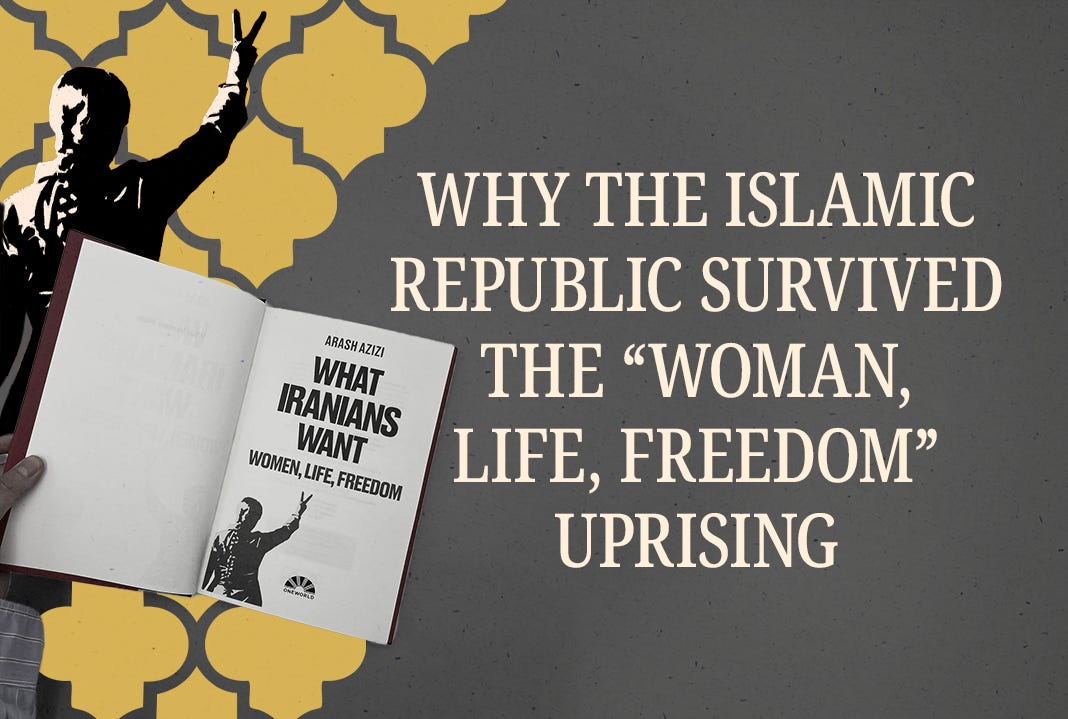
The “Woman, Life, Freedom” uprising of 2022 is already being misremembered. For many outside Iran, myself included, it arrived as a torrent of viral videos, English-language slogans, confident commentary from abroad, and the intoxicating belief that the Islamic Republic was finally collapsing. I believed that buzz in the early days. Part of it was analytical failure. Part of it was emotional. Iran occupies part of my country of birth, and like many in the region, I wanted this moment to be decisive, irreversible, and real. Wanting something to be true, however, does not make it so.
As fresh protests once again erupt across Iran, driven by economic collapse and renewed public anger, familiar narratives of imminent regime failure are resurfacing abroad. This moment makes Arash Azizi’s What Iranians Want: Women, Life, Freedom especially necessary—not as just a postmortem of 2022, but as a warning against repeating the same analytical mistakes today.
Azizi’s book is one of the few that forces readers to confront this gap between desire and reality. It rejects both regime propaganda and opposition fantasy. Instead, it explains what actually happened, why it felt revolutionary, and why it stalled. Its strength lies precisely in its sobriety.
Azizi is clear about what ignited the protests. Mahsa Jina Amini’s death in morality police custody on September 16, 2022, was the spark, but the fuel had been accumulating for decades, especially among women living under laws that criminalized ordinary life. Long before 2022, Iranian women were already resisting in quiet, daily ways. Azizi captures this with devastating clarity when he describes women sharing images of themselves “living as women, their daily routines a crime.” Resistance did not begin in the streets, but at home and in what would be seen elsewhere in the world as completely ordinary gestures.
This distinction matters. The uprising was never simply about mandatory hijab laws or a single killing. It was about a society that evolved while the state remained ideologically frozen. Azizi shows how Iranian society modernized socially and culturally long before it could do so politically. The uprising marked the moment when private grievances became public. Accumulated social change finally erupted into direct confrontation with the regime.
Years before 2022, this pattern was already visible. Azizi describes moments such as the Girls of Revolution Street, when women stood alone in public spaces waving their headscarves—without slogans, leaders, or organizations. These acts were silent, reproducible, and impossible to decapitate. It was a decentralized form of resistance by design. No permission was required. No single arrest could stop it.
Azizi does not deny the emotional force or moral clarity of what followed in 2022. Protests spread rapidly across cities, classes, and ethnic lines. Young women and teenagers, many with no memory of the revolution that created the Islamic Republic, stood at the center. In some of the most striking episodes he recounts, high school girls removed their hijabs in classrooms, confronted administrators, and tore down images of the Supreme Leader. These acts reflected a generational break with the regime itself.
The movement was leaderless by necessity and by character. It did not wait for instructions or roadmaps. It moved horizontally, driven by grief, rage, and solidarity. This leaderlessness is often romanticized. Azizi does not romanticize it. He treats it as a diagnosis.
The protests felt unstoppable precisely because they were spontaneous and uncontained. But spontaneity is not strategic, and courage alone cannot dismantle a state. The Islamic Republic survived not because it regained legitimacy, but because it retained organization and coercive capacity while facing no organized alternative capable of replacing it.
The regime did not fracture. There was no sustained general strike. Security forces did not defect at scale. No parallel institutions emerged. The gap between mass rejection and political replacement remained unbridged.
Azizi’s discussion of labor protests makes this failure concrete. Teachers, oil workers, pensioners, and other groups protested repeatedly over the past decade. They were driven by real grievances and genuine courage, but they remained sectoral and fragmented. They never synchronized into a sustained general strike capable of paralyzing the state. The problem was not anger or awareness, but a significant lack of coordination under a highly calculated oppressor.
Geography compounded the problem. Azizi traces the uprising’s early momentum to Iran’s periphery, particularly the Kurdish regions, after Mahsa Amini’s death. Protests there were intense and sustained, but also brutally suppressed and geographically isolated. This uneven distribution exposed both the depth of anger and the difficulty of sustaining nationwide organizing in a securitized state.
This is where the external narratives did the most damage. Much commentary outside Iran treated visibility as leverage. Viral footage became a proxy for power. Online unity was mistaken for organization. Moral outrage was confused with political momentum. Azizi dismantles these assumptions decisively. The regime did not fall because the forces confronting it were emotionally unified—but structurally weak.
Azizi does not dismiss the risks activists abroad face, nor does he deny the regime’s sensitivity to international exposure. He painstakingly documents how the state criminalized even indirect participation in acts of civil disobedience, including sending videos or images. The regime understood the threat clearly. It feared horizontal participation by millions of ordinary people more than it feared any individual figure. What it did not face was an organized alternative capable of taking power should the regime falter. The opposition missed the opportunity by failing to provide a viable alternative.
One of the book’s central lessons is that social transformation does not automatically produce political transition. Iranian society has changed profoundly. The state has not. Between the two lies a structural gap that emotion alone cannot bridge. Azizi’s regional awareness reinforces this point. The Middle East is filled with uprisings that shattered legitimacy without building replacements—and paid the price in repression, division, and prolonged violence.
This is the lesson many narratives avoid when we look back at 2022. Politics conducted primarily through visibility and external amplification can shape perception, yes. But it cannot substitute for internal legitimacy, organization, or coercive capacity. Representation and visibility do not automatically beget power. Azizi never needs to shout this. He demonstrates it by documenting a history in which change emerges from society but stalls at the threshold of power.
Readers searching for solutions will not find a roadmap in What Iranians Want, and that absence is deliberate. Azizi refuses comforting prescriptions. There is no countdown to collapse, no blueprint for transition, no promise that repeating the same uprising will yield a different result. Instead, the book explains why easy answers fail.
The lesson is not that resistance is futile. It is that resistance without institutions cannot govern. Iranian society revolted faster than it could organize. That mismatch explains both the uprising’s force and its limits.
The danger now is not forgetting Woman, Life, Freedom, but mythologizing it into a finished story. Turning it into a morality tale offers comfort but teaches nothing. Azizi insists on the opposite. He forces readers to distinguish between emotional truth and political reality, between what we wish were happening and what actually is.
For those of us who believed the buzz because we wanted it to be true, What Iranians Want is a corrective. It argues that real change in Iran will be slow, endogenous, and structurally difficult. Anything faster or cleaner is a damaging fantasy.
Middle East Uncovered is powered by Ideas Beyond Borders. The views expressed in Middle East Uncovered are those of the authors and do not necessarily reflect the views of Ideas Beyond Borders.
As a counterpoint one could recall the sudden collapse of Communist rule in Eastern Europe, particularly Poland, where mass dissatisfaction eventually did lead to the collapse of the regime, by a movement led by an obscure electrician from Gdansk.
One surprising thing about the recent protests in Iran is the passivity of the regime: it's amazing to see images of Teheran with throngs of women walking casually without a hijab. A reasonable interpretation is that the regime feels it is at breaking point and does not dare to exacerbate the situation by enforcing its own laws.