


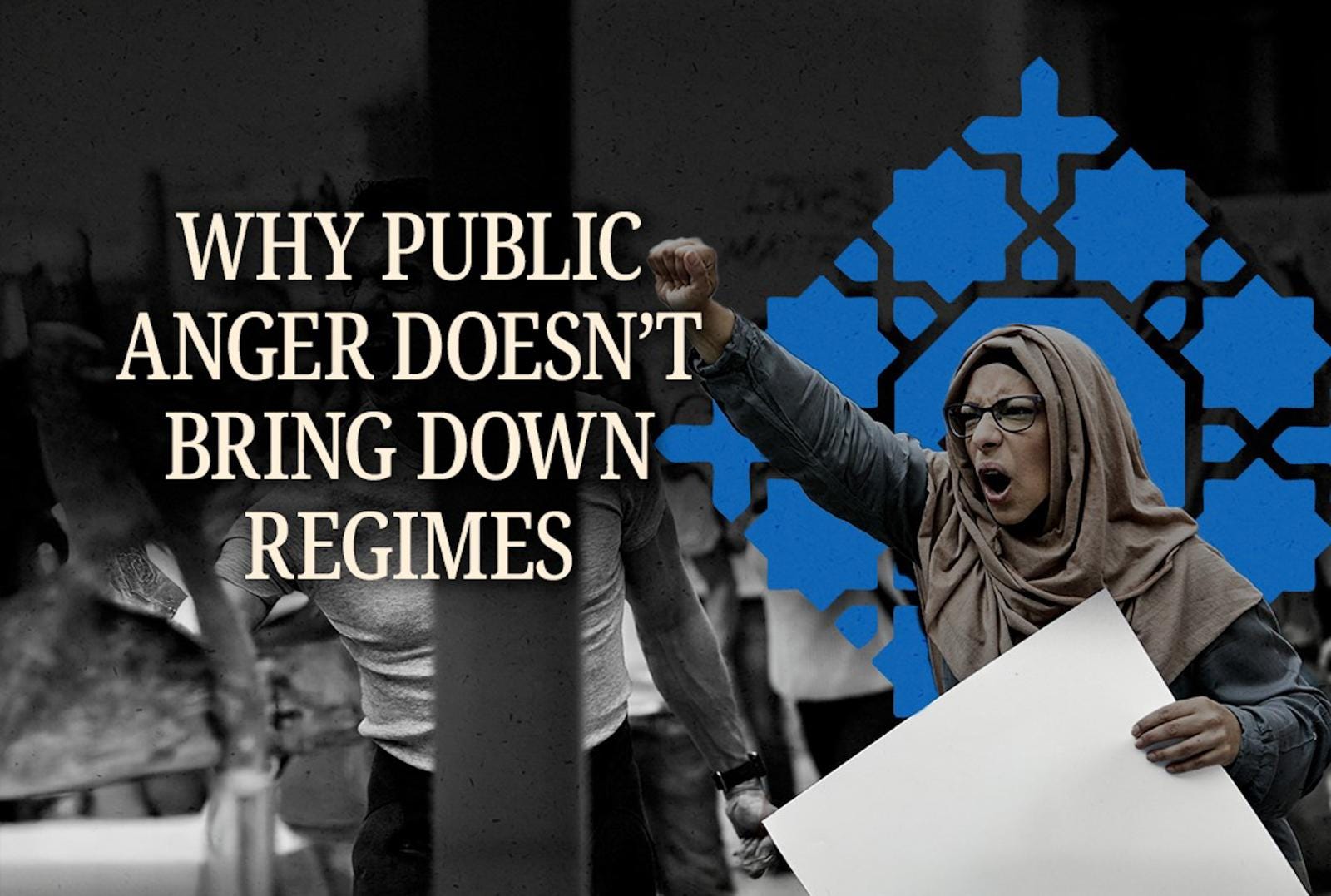
Spend enough time in human rights conferences or policy discussions on the Middle East, and you hear the same assumption again and again: if enough people are angry at a government, it will eventually fall. It sounds reasonable, and it is politically convenient, but it does not hold up in practice or in history.
Across multiple cases from Saddam Hussein’s Iraq to Bashar al-Assad’s Syria and now the Islamic Republic of Iran, this expectation has persisted despite contrary evidence. Public anger, even when deep and widespread, does not by itself beget into regime failure. The more consistent predictor of regime change is not popular sentiment but the cohesion, incentives, and beliefs of those within the system who control the use of force.
This distinction is central to understanding both the durability of regimes and the limits of external influence.
Syria is often cited as proof that extreme violence can bring down a system, but the process is usually misunderstood. Large-scale defections from the Syrian army did not come from organized opposition or outside coordination. It began with individual decisions, made in specific moments, when soldiers refused to carry out orders.
Early in the uprising, there were accounts of soldiers being ordered to fire on crowds and hesitating when they recognized people in front of them. One former conscript described seeing his own neighborhood among the protesters. Another recalled lowering his weapon and walking away—not because he had joined the opposition, but because he could no longer carry out the order. These were individual decisions made under pressure, and together they began to weaken the system from within.
The Free Syrian Army (FSA) was a loose alliance of armed opposition groups formed in 2011 during the Syrian Civil War by defectors from the Syrian military. It sought to overthrow Bashar al-Assad’s government, acting as a moderate, decentralized insurgent force supported by Western and regional powers. It emerged as a structure to organize men who had already crossed a personal threshold.
Defections are rarely ideological at the outset. They are typically driven by a combination of lines individuals won’t cross, perceived risk, and expectations about the regime’s future viability.
Iran, by contrast, has been deliberately structured to prevent such moments from cascading into systemic breakdown. The Islamic Republic has developed a layered security architecture in which responsibilities for repression are concentrated within ideologically committed units, particularly the Islamic Revolutionary Guard Corps. As Afshon Ostovar, Assistant Professor of National Security Affairs at the Naval Postgraduate School, put it, “The IRGC… is tasked with both the defense of Iran and the much more amorphous safeguarding of Iran’s theocratic system.” This mandate goes beyond conventional military functions and is rooted in political and ideological objectives.
The implications are significant. A force designed to defend a system rather than merely a state is structurally more resistant to break down. Its durability is further reinforced by the IRGC’s expansive role beyond the military sphere. It is, as Ostovar describes, “a security service, an intelligence organization, a social and cultural force, and a complex industrial and economic conglomerate.” In effect, it embeds the regime across multiple layers of society, aligning political loyalty with economic interest and institutional belonging.
The regime’s approach to dissent reflects a similar degree of institutional learning. Following the protests of 2009, Iranian security forces refined their methods of control, developing a calibrated response that combines selective repression with managed tolerance. Large-scale protests are met with organized and often forceful responses, yet the system also demonstrates the capacity to shape and channel mobilization in ways that reinforce its authority. In some instances, actors affiliated with regime institutions themselves participate in demonstrations, blurring the line between opposition and state-sanctioned expression. This capacity to manage dissent stands in contrast to the early Syrian response, where indiscriminate violence accelerated divisions within the security apparatus.
The historical case of Iraq under Saddam Hussein provides a complementary but distinct model. There, regime sustainability was achieved primarily through coercion and fear, reinforced by overlapping security institutions and collective punishment mechanisms, including reprisals against family members, the destruction of homes, and the use of detention or execution to deter dissent within entire communities.
For years, this system held not because people believed in it, but because they feared the consequences of stepping outside it. To defect was not just to risk one’s life, but to endanger one’s family. That calculation kept the system intact far longer than many expected.
And then, in 2003, it crumbled all at once.
Soldiers abandoned positions, not because they had coordinated a defection, but because the system they feared no longer appeared unflappable. I was there. I remember entire units removing their uniforms and returning home within hours, as if the entire structure had been held together by belief in its inevitability. Once that belief disappeared, so did the system.
Systems built solely on fear may suppress defection, but they are vulnerable to sudden failure once the credibility of that fear is eroded. Systems that combine coercion with ideology, institutional integration, and material incentives, as in Iran, tend to be more resilient.
Robert Ames, a senior CIA officer whose career focused on the Middle East, approached the region with a disciplined curiousity that is often missing from policy debates. He understood that influence required engagement with the actual holders of power, not idealized versions of the opposition.
Ames spent years building relationships with figures many in Washington viewed only as adversaries. He believed that understanding how they saw the world was essential to predicting their behavior. Those who worked with him recall that he listened far more than he spoke, and that he treated even his adversaries as rational actors operating within constraints.
That approach came at a cost. Ames was killed in the 1983 bombing of the U.S. embassy in Beirut, a reminder that understanding a system does not make it less dangerous. But his work powerfully illustrates that misreading how power operates in the region can be far more dangerous than engaging with it.
This lens is particularly relevant when assessing contemporary Iran. While public dissatisfaction is well documented, the critical variables, elite cohesion, control over coercive institutions, and the absence of a credible alternative center of power, remain largely intact. The IRGC and its associated networks continue to function as both a security apparatus and a socio-economic system, embedding the regime within key sectors of society.
It is also important to recognize that the emergence of an armed opposition is not solely a function of popular sentiment. The Syrian case demonstrates that such formations arise from defections within the security apparatus, not from external sponsorship or political leadership in isolation. Without armed defectors, territorial separation, and accessible supply networks, the conditions necessary for a sustained insurgency do not materialize.
In Iran, these preconditions are currently absent.
Strategies predicated on the assumption that economic pressure, public dissatisfaction, or external signaling will directly lead to regime change are unlikely to achieve the intended outcomes. While such factors may contribute to long-term stress on the system, they do not by themselves generate the internal fissures required to overthrow the regime.
A more realistic framework focuses on monitoring indicators of elite fragmentation, shifts in the behavior of security institutions, and changes in insiders’ perceptions of the regime’s durability. These variables, rather than public opinion alone, are more reliable predictors of systemic change.
The central analytical takeaway is therefore straightforward but often overlooked: regimes do not fall when they lose popularity; they fall when they lose their internal cohesion.
Until that threshold is crossed, even deeply unpopular systems can persist for extended periods, adapting to pressure while maintaining control. When it is reached, however, change tends to occur rapidly and unpredictably, often appearing inevitable only in retrospect.
Understanding this distinction is not just an academic exercise. It shapes how governments, analysts, and activists approach real-world crises. Misreading how power operates—assuming that anger in the streets will translate into change at the top—leads to flawed strategies, misplaced expectations, and, in some cases, prolonged instability and increased violence.
If change is to come, it will begin when those inside the system no longer believe it can endure.
Middle East Uncovered is powered by Ideas Beyond Borders. The views expressed in Middle East Uncovered are those of the authors and do not necessarily reflect the views of Ideas Beyond Borders.
Very clear and helpful article, thank you.
Tell it to the Shah.