


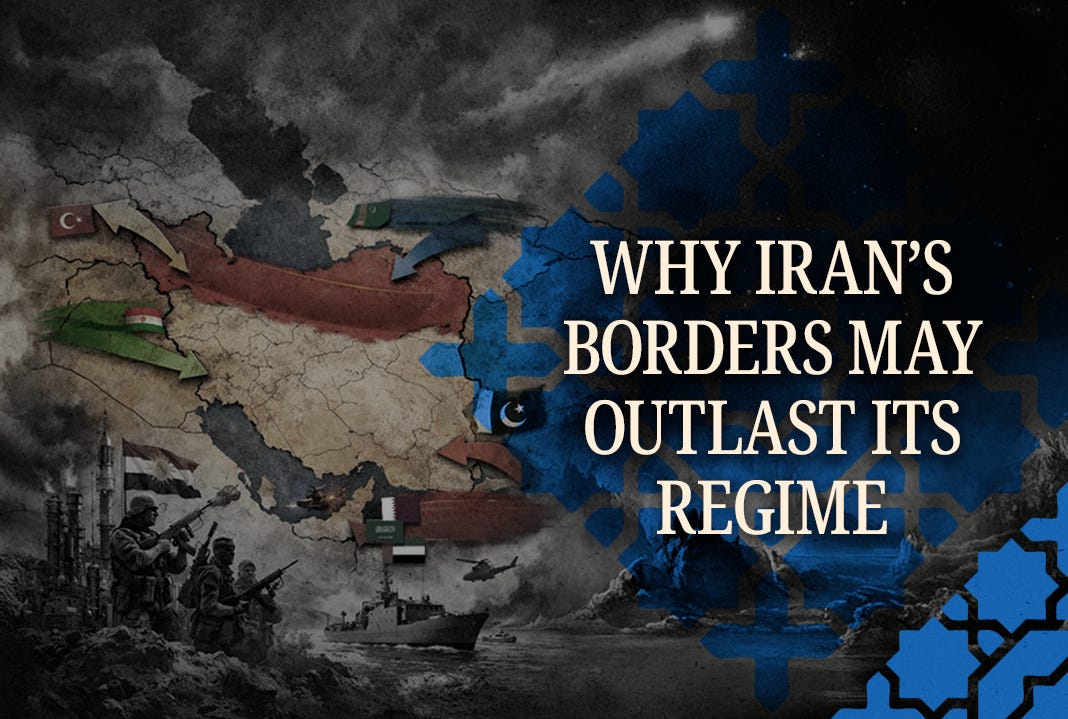
As wars spread across the Middle East and great-power rivalry intensifies, talk of redrawing borders has returned with surprising confidence. Analysts and commentators are increasingly discussing the potential for a significant restructuring of the Middle East, with discussions centering on the possible division of Iran along ethnic lines, the emergence of a more defined Kurdish state, and the continued instability of a Syria divided among rival factions.
But borders are rarely redrawn simply because regimes fall or populations rebel. They change when powerful countries and neighboring states allow it. In other words, new states do not appear simply because a population wants independence. They emerge when internal upheaval, regional interests, and the decisions of major powers all point in the same direction.
When those forces align, borders can change. When they do not, revolutions may topple governments—but the map stays the same.
This dynamic can be seen in other conflicts. Kosovo, a former province of Serbia with a majority Albanian population, declared independence in 2008 and was recognized by the United States and most European countries. Abkhazia, a breakaway region of Georgia that separated after the collapse of the Soviet Union, declared independence as well—but it is recognized by only a handful of states, mainly Russia and its allies.
The difference was not simply the will of the population. Kosovo gained broad international support, while Abkhazia did not.
The same logic explains why Syria still officially exists as a single state despite more than a decade of civil war, foreign intervention, and competing zones of control. Kurdish ambitions for autonomy, Israeli preferences, and regional rivalries have not led to a recognized partition because no major international agreement supports breaking the country apart. In fact, recent developments in northeast Syria suggest that many outside powers still prefer a re-centralized Syrian state to the risks of the permanent partition of the country.
Iran may soon test this same principle again.
Recent reports of Kurdish fighters preparing to launch operations from Iraqi territory into western Iran, combined with signs of military mobilization along Iran’s northern border with Azerbaijan, have fueled speculation that the Islamic Republic could face simultaneous pressure from multiple directions. Such developments would represent the first genuine multi-front external and internal challenge to the Iranian state in decades.
Yet even if the regime were to weaken dramatically, the fate of Iran’s borders would remain far from predetermined.
Iran is ethnically diverse. Persians form the majority, but large communities of Azeris, Kurds, Lurs, Arabs, Baloch, and Turkmen populate the country’s outer regions. Many observers, therefore, imagine territorial breakup along ethnic lines if central authority falters.
But Iran’s geography complicates that scenario.
Most of these populations lie along what might be called Iran’s northern arc—a strategic corridor stretching from Iraqi Kurdistan across the Kurdish regions of western Iran to the Azeri provinces of the northwest and onward toward the Caspian basin. Mountainous terrain, porous borders, and long-standing insurgent networks make this belt the most plausible entry point for outside forces.
But instability along this corridor would not automatically produce independent states. It would more likely trigger overlapping interventions and competing spheres of influence.
Turkey’s red line remains Kurdish territorial consolidation. Ankara has repeatedly demonstrated its willingness to use cross-border operations, proxies, and intelligence networks to prevent the emergence of a Kurdish corridor linking insurgent regions across Turkey, Syria, Iraq, and Iran. Kurdish advances inside Iran would almost certainly provoke Turkish countermeasures.
Even the Kurdish factor—often treated as the most obvious driver of territorial division—is more complex than it appears. Iranian Kurdish society is politically divided and geographically uneven, with strong nationalist currents concentrated in specific regions rather than across the entire Kurdish belt.
Azerbaijan presents a different but equally complex scenario. Nationalist narratives about “Southern Azerbaijan” have existed on the margins of Azerbaijani politics for a long time. If Tehran weakens, pressure may grow in Baku to assert influence over Azeri-majority regions across the border. More importantly, the unresolved question of a land connection to the Nakhchivan exclave has long driven Baku’s strategic thinking. While the proposed Zangezur corridor through Armenia remains the preferred solution, instability inside Iran could theoretically reopen other possibilities.
Yet outright annexation of Iranian Azeri territories would be a strategic gamble. The Azeri population in Iran is larger than the population of Azerbaijan itself, is deeply embedded in Iran’s religious and political structures, and is far more religious than Azerbaijan's staunchly secular population. Absorbing millions of new citizens could transform Azerbaijan itself into a far larger but less stable state.
Rather than seeking major territorial incorporation, Baku would more likely pursue influence or protectorate arrangements along the borders and in the region around Tabriz, securing strategic advantage without absorbing a politically complex population.
Other actors would also see opportunities in an Iranian crisis.
Another region that could draw external attention is Khuzestan, Iran’s oil-rich southwestern province along the Iraqi border. Home to a significant Arab population and the center of much of Iran’s energy infrastructure, Khuzestan is an economic lifeline and a political vulnerability for Tehran. Arab activists occasionally speak of “Ahwaz” as a separate entity, but local identities there are complex and deeply intertwined with the Iranian state. Even so, in a scenario of prolonged instability, neighboring actors could be tempted to influence events in the province—not necessarily through outright annexation, but through political patronage, proxy networks, or economic leverage. Given that a large share of Iran’s oil production and export facilities are concentrated in this region, any contest over Khuzestan would carry consequences far beyond Iran’s borders.
Control over Khuzestan has been contested before. Saddam Hussein’s invasion of Iran in 1980 began with an attempt to seize precisely this province, a reminder that Khuzestan sits at the intersection of ethnic politics, energy resources, and regional power competition. Iraq’s splintered political landscape today makes such an ambition unlikely. Yet as Ahwazi political movements begin positioning themselves amid the current crisis, prolonged instability could revive old strategic temptations around Iran’s most valuable province.
In Iranian Balochistan, local politics rarely align neatly with ideological movements. Tribal structures, cross-border trade networks, and long-standing patterns of state patronage often produce pragmatic alliances that complicate any straightforward narrative of separation. Indeed, some Baloch tribal leaders have reportedly pledged support for the central authorities even as separatist movements may seek to exploit the current instability.
The United Arab Emirates has never relinquished its claim to the islands of Abu Musa and the Greater and Lesser Tunbs, seized by Iran in 1971 at the entrance to the Strait of Hormuz. A severe weakening of Iranian authority could tempt Abu Dhabi to press its claim more assertively.
Qatar’s calculations would be economic rather than territorial. The world’s largest natural gas reservoir—the North Dome/South Pars field—is shared between Qatar and Iran. Because the reservoir functions as a single geological system, disruption on the Iranian side could allow Qatar to consolidate a larger share of its long-term value.
Yet the same actors who might exploit Iranian weakness also have strong reasons to prevent the country’s complete disintegration.
Turkey fears Kurdish statehood. Pakistan fears Baloch separatism. Gulf states fear maritime instability and the emergence of new militant actors along the Persian Gulf. Russia, preoccupied with Ukraine, would still seek to block Western geopolitical gains along the Caspian basin. China depends heavily on Iranian energy exports and would prefer a stable supplier.
This creates a profound paradox.
Many powers might welcome the fall of the Iranian regime. Almost none want the Iranian state itself to disappear.
That paradox echoes an older historical precedent. In the late nineteenth century, the Ottoman Empire was famously labeled the “Sick Man of Europe.” For decades, observers predicted its imminent demise. Instead, the empire endured long periods of instability, losing influence along its periphery while its core structures endured.
Iran today may represent a similar case—the “Sick Man of West Asia.”
The Islamic Republic is weakened. Peripheral regions could become contested. External powers might cultivate influence along the northern arc. Yet the Iranian state itself could prove far more resilient than those predicting rapid partition expect.
In the emerging multipolar world, borders are rarely redrawn cleanly. More often, they blur, entrench, and reassert themselves through messy negotiations among competing powers.
The Islamic Republic may fall, but like the “Sick Man of Europe” before it, Iran may prove far harder to dismantle than the obituaries of its regime would suggest.
Middle East Uncovered is powered by Ideas Beyond Borders. The views expressed in Middle East Uncovered are those of the authors and do not necessarily reflect the views of Ideas Beyond Borders.