


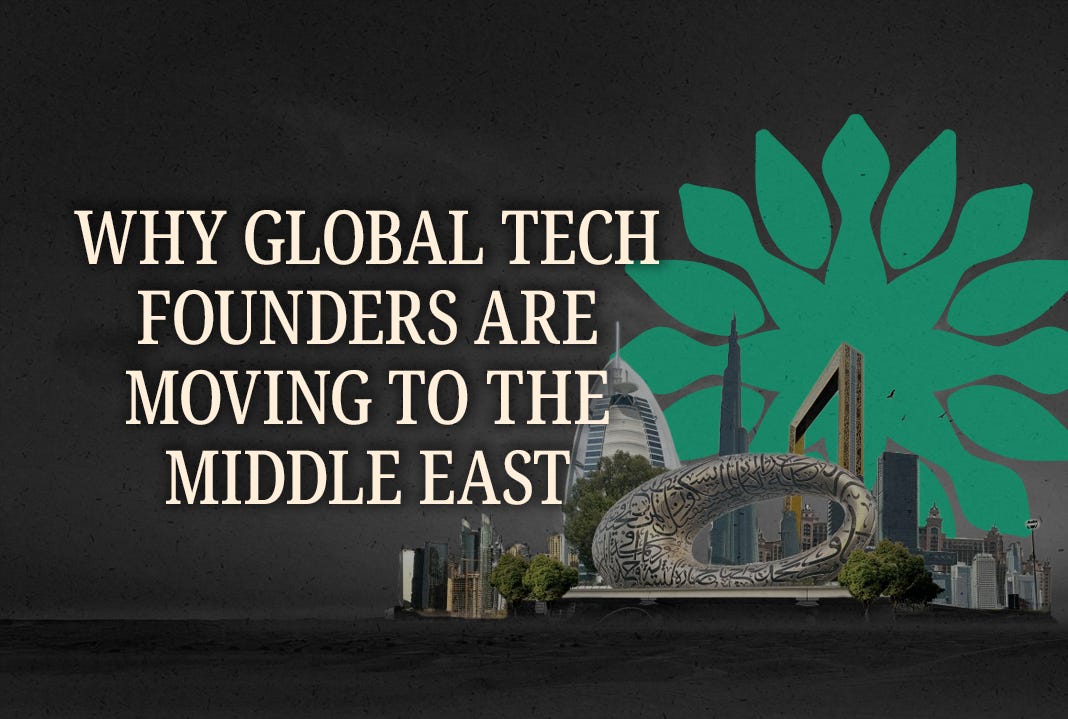
Over the past eighteen months, my clearest view of what the future has in store has not come from the streets of Paris, where I am based, but from the glow of screens linking Western Europe to the Gulf. I have spent the better part of the last year in the digital trenches of the Middle East venture capital ecosystem. If you are still reading legacy media reports about “oil wealth,” you are looking at a relic of a region that will soon cease to exist.
We are witnessing a great migration of technological intellectual property and human capital—one of the defining shifts of the twenty-first century. A few years ago, the narrative focused on whether the Middle East could attract talent. Today, the more relevant question is how fast startups can scale once they arrive.
I frequently meet seasoned entrepreneurs—people who built their first companies in the pressure cookers of Europe—who are now packing up their lives to plant seeds in the desert. They are anchoring their futures in rising power centers like Dubai, Abu Dhabi, Riyadh, and Manama.
In many traditional Western tech hubs, innovation has increasingly become a battle of attrition against aging infrastructure and a culture of regulatory cynicism. Founders are exhausted from fighting for basic approvals. When I speak to them as they land in the Gulf, they describe a system in which decision-makers are accessible, and approvals move quickly.
Here, the government does not act as a distant referee but as a sovereign co-founder. Whether through the breakneck pace of Saudi Arabia’s Vision 2030 or the UAE’s regulatory sandboxes, the state is actively de-risking technology entrepreneurship.
That speed, founders are quick to note, requires constant engagement with regulators and a careful reading of political context. In the UAE, for example, multiple entrepreneurs pointed to fintech licensing frameworks that moved from pilot to full implementation in under a year—an unthinkable timeline in most of Europe.
This environment has produced one of the most active and competitive early-stage investment landscapes I have seen in years. While the global tech winter forced much of the West into a defensive crouch, the Gulf used that time to lay foundations.
Founders here are leveraging a blank slate to leapfrog entire generations of technology. They are building decentralized finance rails where traditional banks never reached, and AI-driven logistics systems for cities that did not exist five years ago. With no legacy infrastructure to protect, there is little to slow the adoption of the new.
There is also a kind of modern “Silk Road” alchemy unfolding—something unique to this moment. By relocating to the Middle East, global founders position themselves at the geographic command center of the Emerging South. From Riyadh or Dubai, teams can reach South Asia, East Africa, and Southeast Asia within hours—regions where much of the world’s next middle class will emerge.
Increasingly, tech teams blend global best practices with deep local market knowledge, often led by founders who grew up in the region and trained abroad. The result is products that are globally competitive yet locally affordable, fueled by regional capital with unusually long investment horizons.
Among the hundreds of founders I have met online, the prevailing sentiment is one of post-cynical optimism.
In the West, technology is often cast as the villain of the social narrative. In the Middle East, it is the hero and the engine of national transformation.
That psychological shift may be the most powerful magnet of all.
The Middle East is no longer merely a consumer market for Western technology. It has become one of the world’s most important testing grounds for what comes next. From investment flows and hiring patterns to the relocation of founding teams, the region is maturing into a durable ecosystem for innovation—one likely to shape how technology evolves far beyond the region.
Middle East Uncovered is powered by Ideas Beyond Borders. The views expressed in Middle East Uncovered are those of the authors and do not necessarily reflect the views of Ideas Beyond Borders.
