


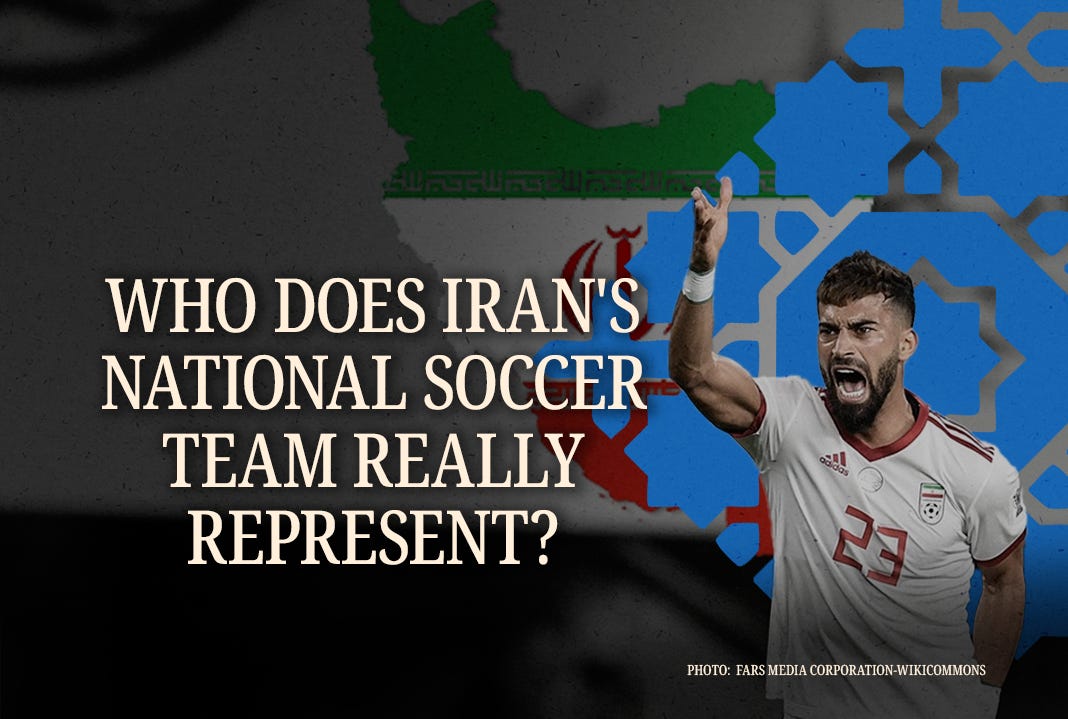
At this year’s FIFA World Cup, millions of people around the world watched Iran’s national soccer team take the field wearing the colors of the Islamic Revolutionary Guard Corps (IRGC): green, white, and red. They marched beneath the regime's flag, sang its anthem, and presented themselves as representatives of more than 90 million people whom the Islamic Republic exploits and oppresses.
But for millions of Iranians, both inside the country and across the diaspora, one question hovered over every match: Who do they actually represent?
Can athletes truly claim to represent sportsmanship, humility, respect, integrity, and inclusion on a national stage while publicly embracing the very regime responsible for imprisoning, torturing, and killing their own nation’s people and diaspora across the globe?
As a former Iranian women’s national soccer player, I don’t think so. I was banned for life after being photographed playing soccer with male friends in Switzerland without wearing a hijab. Due to the regime’s harassment, I was forced to seek asylum in 2017.
So I speak from experience when I say that this team does not represent the Iranian people. It represents the Islamic Republic.
After one of Iran’s group-stage matches, midfielder Ramin Rezaeian was asked about the ongoing human rights situation inside Iran. His response was familiar—something I have heard many times before from authoritarian sympathizers. He described it as an “internal matter,” insisted that foreigners should not interfere, and suggested that Iranians were capable of solving their own problems.
That argument might sound reasonable if the issue were a mere domestic political disagreement. It is not.
When a government shoots peaceful protesters in the streets, executes political prisoners after sham trials, systematically tortures detainees, and criminalizes the most basic freedoms—including the right of women to choose how they dress— it ceases to be an internal matter and becomes a universal human rights crisis.
No government should be able to invoke sovereignty as a shield against crimes committed against its own citizens.
Since the “Woman, Life, Freedom” movement began, the Islamic Republic has brutally suppressed peaceful demonstrations. It has imprisoned Nobel Peace Prize laureate Narges Mohammadi and targeted dissidents abroad. It has sentenced young protesters to death. Families continue to search for justice while the world is asked to look the other way.
When members of Iran’s national team dismiss these atrocities as nobody else’s concern, they are helping protect the regime from international scrutiny under the guise of defending Iran’s sovereignty.
On the same international stage shared by the rest of the democratic world, pawns like Rezaeian use the national platform to chant “Death to America” and “Death to Israel” on American soil, and praise deceased Supreme Leader Ali Khamenei—who bears responsibility for over 40,000 innocent lives lost. Is FIFA holding them accountable? Does FIFA support the values the Islamic Republic claims to represent?
There is another reason so many Iranians reject the idea that this team represents them. The Islamic Republic does everything in its power to silence and repress freedom wherever it can—even beyond its own borders. Its players insist Iran’s human rights crisis is an “internal matter,” yet the regime has no hesitation making American freedom of expression its business. At this year’s World Cup, Iranian officials formally urged FIFA to prohibit Pride-themed events and rainbow flags, attempting to export the regime’s intolerance onto the world’s biggest sporting stage.
Women in Iran are not allowed to enter stadiums freely. For years, they have been barred from attending soccer matches simply because they are women. Those who have tried to challenge this ban have been arrested, jailed, and even tortured.
And yet, FIFA still chose to host the team representing the regime.
FIFA says politics should not interfere in sport. But everyone knows that Iranian sport, especially soccer, is fully under the control and supervision of the terrorist-designated IRGC and the security apparatus of the Islamic Republic.
And the real cost is borne by the athletes who refuse to become mouthpieces for the regime.
During the recent nationwide protests, thousands of Iranians lost their lives. Among the victims were numerous athletes who should have been celebrated, not buried. Female soccer player Zahra Azadpour, soccer player Mojtaba Torshiz, and professional women’s referee Sahba Rashtian are among the names remembered by many Iranians as victims of the regime’s brutality.
Today, hundreds of male and female athletes remain imprisoned. Many report being tortured. Some continue to face the threat of execution simply for supporting peaceful protests or expressing dissent. They sit behind bars while others wearing the national jersey enjoy the privilege of competing before global audiences.
This is FIFA’s failure.
During the Woman, Life, Freedom movement, Iranian athletes, activists, former players, and human rights organizations repeatedly appealed to FIFA. They asked FIFA to recognize that the Islamic Republic’s systematic repression could not be dismissed as ordinary politics, and to stop granting the regime the legitimacy afforded to any other national federation.
FIFA refused. Instead, it retreated behind the language of political neutrality.
Neutrality can be a principled position. But when an organization that regularly invokes inclusion, respect, equality, and human dignity declines to respond to systematic repression, that neutrality begins to look less like impartiality and more like acquiescence.
FIFA President Gianni Infantino has repeatedly demonstrated that the organization’s stated principles are flexible whenever political convenience demands it. The world’s governing body for soccer has shown remarkable willingness to overlook the realities facing Iranian athletes while continuing to provide the regime with one of its most valuable international platforms.
This raises uncomfortable questions, not only for FIFA, but also for democratic governments that continue to separate sporting participation from political accountability.
The Islamic Republic has always sought to export not only its ideology but also its methods of intimidation. Whether targeting dissidents abroad, threatening journalists, or attempting to shape international sporting events according to its own repressive worldview, the objective is always to normalize authoritarianism wherever possible.
History teaches us that sports have never been morally neutral. The international community has previously excluded governments because of apartheid, racial discrimination, and aggression. Why should systematic executions, torture, and state repression be treated differently?
When athletes willingly participate in authoritarian propaganda, they assume a role that extends beyond sport. They become ambassadors for a regime seeking international legitimacy.
Iran’s true representatives are not the men standing beneath stadium lights in the national jersey. They are the women who remove their compulsory hijabs despite knowing they may never return home. They are the parents carrying photographs of children killed for demanding freedom. They are the imprisoned athletes who refused to surrender their conscience.
They are the soccer players who walked away from the national team rather than become instruments of dictatorship. They are the journalists, artists, lawyers, students, workers, and ordinary citizens who continue to risk everything for the belief that Iran deserves to be free.
They are the ones who carry the dignity of the Iranian nation. If anyone represents Iran, it is them.
Iran’s national soccer team was eliminated from the 2026 FIFA World Cup. The more enduring loss belongs to the mothers still searching for justice, to victims like Mahsa Amini and Nika Shakarami, to the countless unnamed Iranians whose lives were stolen by state violence, and to the imprisoned athletes, disappeared soccer players, and families shattered by executions.
FIFA had an opportunity to stand on the right side of history. Instead, it chose institutional caution over moral clarity.
Iran’s national soccer team represents a regime that has spent decades using sport as an instrument of political legitimacy. FIFA had an opportunity to distinguish between representing a nation and legitimizing a dictatorship. Instead, it chose to treat the Islamic Republic as just another participant in the world’s most popular sport. Until that changes, the tournament will continue to offer authoritarian regimes something far more valuable than points or trophies: international legitimacy.
Middle East Uncovered is powered by Ideas Beyond Borders. The views expressed in Middle East Uncovered are those of the authors and do not necessarily reflect the views of Ideas Beyond Borders.

It's a really hard question. In sports crazy South Africa, barring the country from international competition certainly sent a message to white citizens - the only ones able to vote - but after the initial shock had worn off the sports boycott had no on-going effect. Later, when unofficial cricket tours by Sri Lankan and West Indian cricketers were organised, I think this contributed to an opening of minds because here were people who would not have the vote in SA, giving the all-white SA teams a tough time (whites not so supreme after all!). I don't know if these lessons can transfer to Iran; at least in SA a privileged 20% of the population could vote to change the government.