

While the World Watches Iran, War Erupts on the Durand Line
Airstrikes, drone attacks, and border clashes have pushed Pakistan and the Taliban into their most serious confrontation in years, reviving a dispute over a colonial-era border neither side accepts.

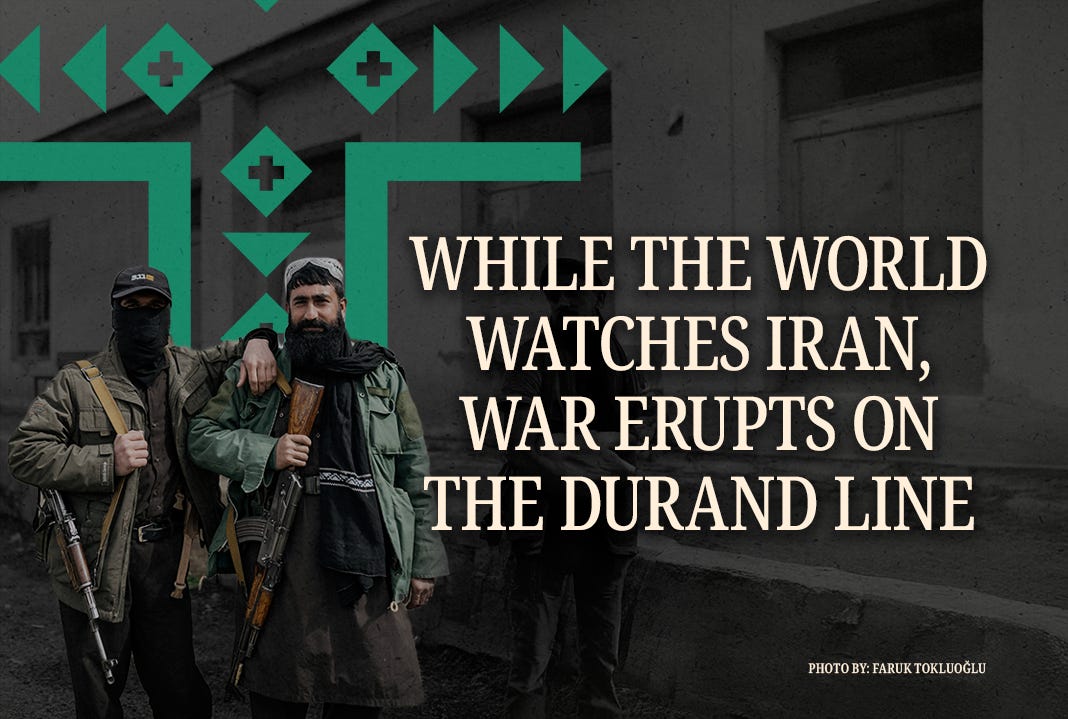
Shoaib was preparing for Suhor during Ramadan when the calm of dawn was interrupted by the all-too-familiar sounds of war. “We started the day with the deafening roar of explosions and the relentless rattle of gunfire echoing across the capital,” said the 26-year-old from Kabul. “My family sat in shock with the realization that there are no ‘safe zones’ when the heart of your country is under direct assault,” he added.
Last month, on February 22, Pakistani airstrikes hit Nangarhar province, wiping out an entire family and leaving behind a grieving father and his young son. Images of the aftermath spread on social media before officials could verify or explain them. This has become a key part of the conflict: it is fought on X as much as along the Durand Line, and much of what appears online cannot be independently confirmed.
The roots of the current war run deep and predate even the Taliban itself.
The Durand Line, a 2,611-kilometer border drawn by British diplomat Sir Henry Mortimer Durand in 1893, split the Pashtun tribal homeland between present-day Pakistan and Afghanistan. Afghanistan has never officially recognized it as a real border, despite Amir Abdur Rahman Khan signing the agreement in return for a British subsidy. Pakistan insists it is legitimate. This tension has never been resolved—only managed, suppressed, or used as leverage by whoever was in power in Kabul. The Taliban, a predominantly Pashtun movement, also rejects the line. They see the tribes on both sides as one people, divided by a decision made by outsiders.
Since the Taliban took power in 2021, there have been at least 75 clashes between the Taliban and Pakistani forces along the disputed border. The fighting has grown more intense each time. A ceasefire mediated by Qatar in October 2025 quickly disintegrated, and talks led by Turkey and Saudi Arabia yielded only brief pauses. The main reason for the current crisis is Pakistan’s claim that the Taliban is sheltering the Tehreek-e-Taliban Pakistan (TTP), a group that has carried out deadly attacks in Pakistan at an ever-increasing rate since 2021.
The Taliban denies this accusation. However, experts agree that the two groups are closely linked. The Taliban and the TTP have worked together in Afghanistan, and the TTP’s first leader was once part of the Haqqani Network, one of the Taliban’s most feared factions. And the Taliban is known to stand by its allies. After September 11, they refused to hand over al-Qaeda leader Osama Bin Laden even when facing a U.S. invasion. This loyalty is not accidental but rather and integral part of how the Taliban operates.
Pakistan warned about its intentions to strike for weeks. In February 2026, the country faced a week-long attack by the Balochistan Liberation Army, resulting in a suicide bombing at a Shia mosque in Islamabad that killed 36 people, and a TTP attack on a checkpoint in Bajaur that killed 11 soldiers and a child. After trying diplomatic interventions, Defense Minister Khawaja Asif said Pakistan’s “cup of patience had overflowed.”
On February 21, Pakistan launched airstrikes on what it said were TTP training camps in eastern Afghanistan. Five days later, the Taliban struck back. On February 26, Afghan forces attacked Pakistani military posts along the Durand Line. The next day, Khawaja Asif declared a state of “open war” with Afghanistan. Pakistani jets then hit targets across the country, including Kabul, Kandahar, Paktia, and Nangarhar. This was Pakistan’s largest attack on the Afghan capital and its first airstrikes on the Taliban’s southern stronghold since 2021.
The Taliban said it carried out drone strikes on Pakistani cities like Abbottabad, Swabi, and Nowshera. Pakistan’s information minister said all drones were intercepted and there were no casualties. As usual, both sides disagree on casualty numbers. Social media makes it even harder to confirm what really happened, as it spreads propaganda from both sides before the facts are clear.
What we do know for sure is that, according to UNAMA, at least 70 civilians were killed and 478 were injured in Afghanistan between October and December 2025, before the latest fighting broke out. The deaths of women and children in Nangarhar are real. The Taliban quickly photographed and shared these images to rally support for a government that has spent four years oppressing the same people it now claims to be protecting.
The use of drones is especially important to note. In August 2025, Middle East Uncovered first reported on the Taliban’s secret drone program, which aimed to develop armed drones after learning from wars in Ukraine and the Middle East. Many people dismissed the idea at the time, thinking the Taliban could not pull it off. Now, with the fighting along the Durand Line, the program is being used for the first time. This should not have come as a surprise.
Afghans have largely fallen into three camps in response to the fighting, reflecting the deep divisions and psychological strain created by four years of Taliban rule.
The first group supports the Taliban’s actions. They argue that Pakistan attacked a sovereign country, killed Afghan civilians, and the Taliban is defending its people. This view is easy to understand emotionally. Pakistan has bombed Afghan territory, and the images of dead families are real. The anger is real, too.
But this argument asks Afghans to forget, or even forgive, the thousands who have been killed, kidnapped, tortured, stoned, publicly flogged, and raped under by Taliban members in the past four years. It asks Afghan women, who have been shut out of schools, universities, parks, and public life, to now support those who are actively oppressing them. It asks the families of journalists languishing in Taliban prisons to feel sympathy for their captors. No amount of construction work by the Taliban, such as paving roads or fixing buildings, can make up for their sins. The idea that Taliban military action against Pakistan is really defending the Afghan people falls apart when you ask: which Afghan people?
The second group takes a more logical view. They say this is not Afghanistan’s war. Ordinary Afghans, who have no say in the Taliban’s decision to shelter the TTP, are suffering because of a political choice made in Kandahar. The Taliban has little reason to help Pakistan fight the TTP, since doing so could cause rebellion within their own ranks or push TTP fighters to join ISIS-K, a Taliban rival. Protecting the TTP is a strategic decision, but civilians in Nangarhar and Kabul pay the price, not the leaders in Kandahar. This war could have been avoided. It could still be stopped. If the Taliban halts support for the TTP, the fighting might end quickly.
The third group may be the most risky—not because of the facts, but because of wishful thinking. These Afghans, including some living abroad, believe Pakistan’s military campaign could mark the start of the Taliban’s downfall. They hope Islamabad will support resistance groups, weaken the regime, and free Afghans from their current suffering. Critics describe this view as naïve or politically irresponsible, noting that Pakistan’s actions are aimed at countering militant threats, not dismantling the Taliban government.
Pakistan’s goal is clear and limited: to destroy militant safe havens and stop weapons from reaching the TTP. The Taliban was once a useful ally for Pakistan during the war against the Afghan Republic, but that is no longer the case, and Pakistan has lost its influence. Now that the conflict in Afghanistan is over, the Taliban does not need Pakistan’s support. Importantly, Pakistan’s strikes have not targeted any top Taliban leaders. There is no plan to remove the Taliban or change the regime. Pakistan is not fighting for Afghan women or democracy. It is acting for its own security, and once that goal is met or if the cost becomes too high, it will pull back. Afghans hoping Islamabad will free them are likely to be disappointed.
For more than 26 years, Pakistan has been the main supporter of the Taliban. Its intelligence services helped build, fund, and protect the movement during two decades of American intervention. Pakistan let Taliban leaders plan from Quetta and Peshawar and used the Haqqani Network as a strategic tool. It blocked every peace effort that could have led to a stable Afghan republic, because some in Pakistan’s leadership saw a strong Afghanistan as a threat. These actions have never been those of a true friend.
As the conflict along the Durand Line worsens with no end in sight, diplomatic efforts to contain the fighting have made little progress so far. China recently stepped in through its special envoy for Afghanistan, who spent several days engaging both Islamabad and Kabul in attempts to mediate and push for an immediate ceasefire. Beijing urged the two sides to restart dialogue, emphasizing that disputes between neighboring countries should be settled through consultation rather than continued military escalation. So far, there are no signs of progress, and Pakistan’s aerial campaign continues.
The Taliban’s actions in this crisis follow a pattern the world should recognize: an expansionist mindset by a terrorist group, alliances with other foreign militant groups, refusal to compromise with stronger neighbors, and emotional responses that put civilians at risk. The Taliban has long distrusted Pakistan, despite their alliance. Now that the war in Afghanistan is over, they do not need Pakistan’s support, so Islamabad has lost its influence. But losing leverage is not the same as having complete freedom, and the Taliban is confusing the two.
The historical comparison is uncomfortable but clear. In 2001, the Taliban had a choice: hand over Osama bin Laden or face invasion by a superpower. They refused, saying their code of hospitality, Pashtunwali, would not allow them to give up a guest. Within weeks, their government imploded, and they fled. Now, the Taliban is making a similar choice by protecting a foreign militant group, putting Afghan civilians at risk, and confronting a nuclear-armed neighbor supported by international law.
Nearly a month into the fighting, there is still no clear path to de-escalation.
The Taliban’s first government lasted five years before it fell because of its own poor decisions. The second government has been in power for less than five years. The real question is not whether the Taliban has learned from the past; their actions show they have not. The real question is how many ordinary Afghans will suffer for choices made in Kandahar without their input.
Middle East Uncovered is powered by Ideas Beyond Borders. The views expressed in Middle East Uncovered are those of the authors and do not necessarily reflect the views of Ideas Beyond Borders.
One of the dumbest borders in the world
Your reporting is biased. You do not mention the one million Afghans who lived for centuries in Pakistan whom Pakistan has expelled. And more trespassing of human rights and international laws from Pakistan's side.