


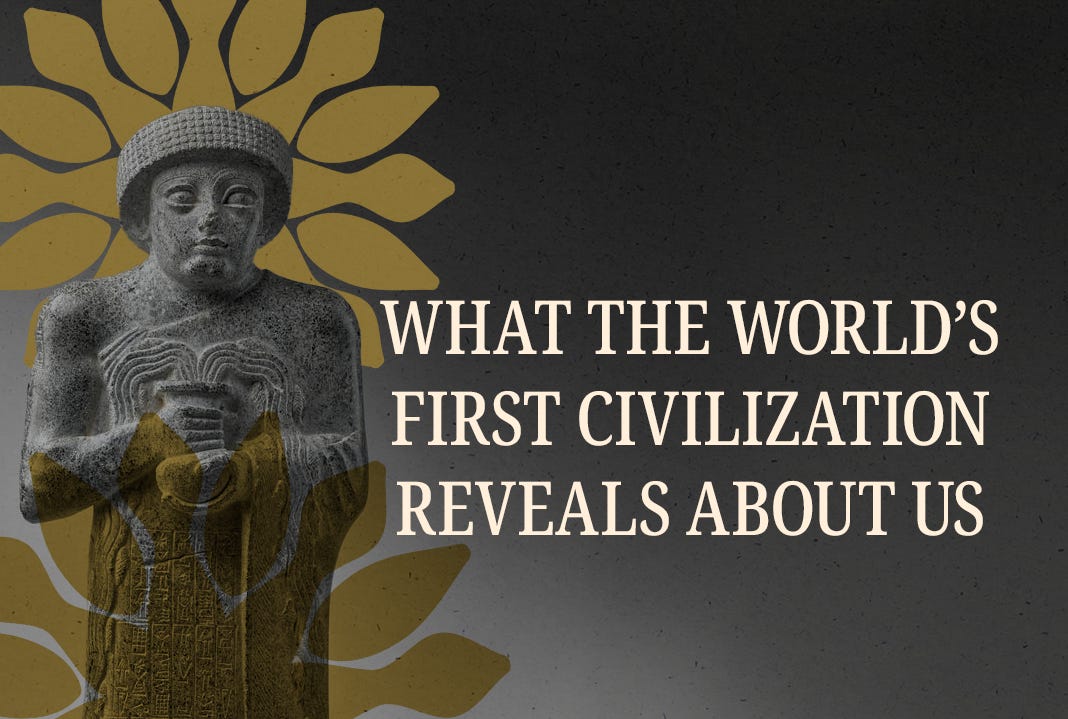
On a warm night in 554 B.C., a partial lunar eclipse hovered above Babylon. King Nabonidus, anxious under its shadow, took it as a divine signal and sent his daughter to become the high priestess of the moon god Sîn. “The past was always present in Mesopotamia,” Moudhy Al Rashid writes in Between Two Rivers: Ancient Mesopotamia and the Birth of History, a book that unearths not only ancient rituals but the very psychology of civilization itself. Nabonidus’ act, Al Rashid notes, was “a deliberate remembrance,” and a political performance of history. In that single gesture, he fused power, faith, and memory, three forces that have ruled humanity ever since.
Al Rashid’s prose moves like an archaeologist’s hand brushing the dust from a relic. She begins with the oldest cities, Uruk, Ur, and Babylon, where the clay itself became the first archive of the human soul. “Clay remembered what humans could not,” she writes, and that simple sentence captures the awe and terror of her book. The invention of writing, she reminds us, was not born from poetry but from the need to record debts, rations, and taxes. Bureaucracy preceded beauty. The first lines ever written were not hymns to the gods but ledgers for kings. Yet in her hands, even those ledgers become lyrical. She describes a dog’s paw prints pressed into a tray of drying bricks in the city of Ur as “a happy accident that survived millennia.” A female scribe named Amat-Mamu, whose handwriting appears on tablets across forty years, becomes “a whisper of continuity in a world of empires.” Each story she tells translates archaeology into the human experience.
When Al Rashid recounts how the priestess Ennigaldi-Nanna curated ancient relics from past kingdoms, labeling them in cuneiform, she pauses to suggest that this may have been “the world’s first museum.” A single clay cylinder described an artifact fifteen centuries older than itself. “History,” she writes, “was not a subject the Mesopotamians studied. It was a space they lived inside.” In her telling, Mesopotamia is both the cradle of civilization and a warning to all of us who would follow. The same ingenuity that gave birth to writing and mathematics also built hierarchies of command and control.
“The state was an act of imagination,” she writes, “and imagination required order.” Her insight is timeless: the administrative mind that tallied grain was the same one that codified law and justified brutal conquest.
Al Rashid’s argument then turns subtly subversive. Civilization, she implies, did not begin with wisdom but with fear, the fear of chaos, of hunger, of forgetting. The first myths and laws were attempts to impose meaning on a world that refused to make sense. “War made the state, and the state made writing,” she observes, echoing the political theorist Charles Tilly. But in Mesopotamia, those abstractions were literal: clay tablets stamped by reed pens hardened into the first documents of power. Her book challenges the modern reader to see continuity rather than distance.
She writes, “The gods watched over the king, and the king watched over the people,” and one cannot help but think of our own secular priesthoods, algorithms, surveillance systems, and bureaucracies that promise safety in exchange for obedience.
Just as the Sumerians built ziggurats to touch the heavens, we build data towers to touch the infinite. “The tools have changed,” Al Rashid seems to whisper, “but the impulse remains the same.”
Where she differs from the traditional historian is in tone. Her writing is neither detached nor nostalgic. It is elegiac, almost devotional. She refuses to portray the ancients as primitives; she sees them as our first philosophers, engineers of meaning. “To write,” she observes, “was to control time.” That line alone could be carved above the entrance of every archive and server farm on earth.
As an Iraqi reading Between Two Rivers, I felt both pride and melancholy. Pride, because this land gave the world its first written word and its first library. Melancholy, because we are still living in the ruins of our own genius.
When Al Rashid writes that “the past was always present in Mesopotamia,” she could just as easily be describing Iraq today, a nation haunted by its own memory, rebuilding and relapsing in an endless dialogue with its former selves.
Her sensitivity to this inheritance gives the book a personal gravity. She writes not as a foreign scholar but as someone who feels the soil beneath her argument. When she describes a Sumerian lament, “My city is destroyed, my temple burned,” it feels like a headline from modern Mosul or Nassryiah. History here is not distant but cyclical, reverberating through time. And yet she refuses despair. The book’s triumph lies in its empathy. “Clay may remember,” she writes, “but so do we.” Al Rashid reminds us that the very act of studying the past is a refusal of oblivion. Her Mesopotamia is not merely the cradle of civilization but its conscience.
What she excavates from the mud of the Euphrates is not just the birth of writing or law but the birth of longing—the longing to be seen, to endure, to make sense of our impermanence. When she describes a king rebuilding a temple “to restore what was lost and to prove that nothing is ever truly gone,” she might as well be speaking of our modern urge to archive everything, to immortalize ourselves in data and pixels instead of clay and stone. But if her book offers a warning, it is this: memory without mercy becomes a prison. The Mesopotamians understood the danger of forgetting, but perhaps they never learned the virtue of letting go. The same is true of us.
Between Two Rivers closes with a simple, haunting line: “The past is not gone; it waits.” In those words lies the heartbeat of the entire book. It is not nostalgia, but a summons. The ancient kings of Ur and Babylon wrote to defy death. Moudhy Al Rashid writes to remind us that history is alive, watching, waiting for us to listen.
Middle East Uncovered is powered by Ideas Beyond Borders. The views expressed in Middle East Uncovered are those of the authors and do not necessarily reflect the views of Ideas Beyond Borders.
Your introduction to Al Rashid’s book about the world’s first civilization entices one to discover its illuminations about its many mysteries and secrets. With family from Baghdad, her book doubtless will prove engaging on many levels.