


“What It’s Like To Be” takes readers inside the lives of people working in remarkable and often demanding professions across the Middle East. Each installment offers an intimate look at the realities shaping their daily world. Look for WILTB in your inbox every Sunday morning.
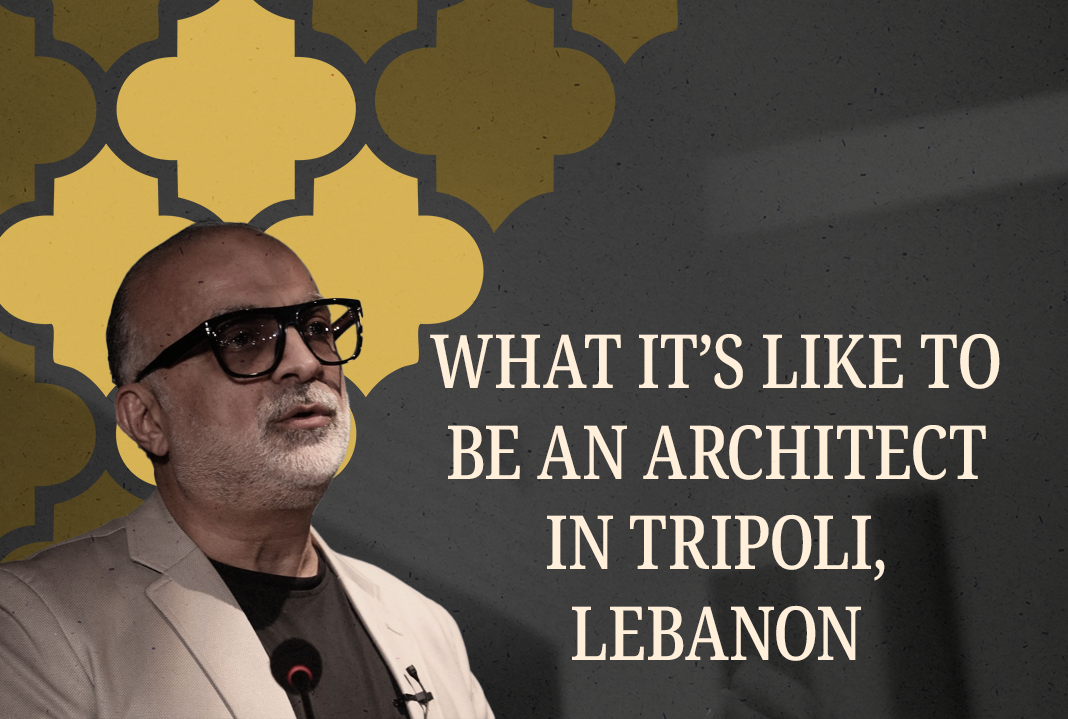
In spare moments, Wassim Naghi likes to step back in time. Slipping between the buildings of the old city in Tripoli, he winds through labyrinthine passageways that open onto historic mosques, hammams, and a medieval caravanserai.
His family heritage is written into these walls, where vaulted ceilings, hidden courtyards, and carved stonework summon the atmosphere of earlier days.
“I live with all my senses. The smell of the souq, the scenery of this place makes me feel I was living in those times,” he said.
The old souq is busiest in the evening as shoppers jostle around stalls selling roasted nuts, vegetables, perfumes, and fresh meat. Naghi, 57, knows them all. An expert in historic buildings, he has restored many sites in the old quarter, reviving vital heritage that has faded with time.
As a professional architect, he has worked on projects across the region, but only feels rooted when he returns to Tripoli and wanders through its 700-year-old marketplace. This is where architecture comes alive, restoring his faith in a place that feels forgotten.
“You can sense the spirit of the city, feel its urban fabric and the social bonds of the people that lived here,” he said.
The last half-century has been tumultuous in Lebanon. Top of his class in university, Naghi had high hopes for his career, but working in a country beset by crises has thwarted his ambitions. “In some ways, the war was never over…. Since 2005, we have never had a long period of prosperity and stability,” he said.
Nevertheless, he chose to return home from Abu Dhabi in 2004, where he worked on some of the most prestigious projects in the region, including the Emirates Palace Hotel and the World Trade Center Abu Dhabi. “It was not my playground of creativity and design,” said Naghi, who spent the COVID-19 lockdowns studying and recently secured his PhD in Architecture and Landscape Sciences.
Visiting the old souq reinforces his mission to rescue Tripoli’s urban heritage from the ravages of modern decline. Recent decades have taken their toll on the Mediterranean city, where unrestrained development has consumed public spaces with construction projects that prioritize profit over design.
Once a commercial center with a busy port, the city’s wide streets and spacious seafront recall the promise of a more prosperous era. But poverty, corruption, and conflict have gutted Tripoli, crowding out memories of its 1960s heyday.
Vintage photographs on café walls offer a glimpse of this time, when ambitious modernization projects were planned across the country. This was a golden age in Lebanon, when the banking sector blossomed, and tourism boomed.
A vibrant movie scene emerged in Beirut, where five-star hotels became bywords for jet-set glamour. In the bars of The Saint Georges Hotel and The Phoenicia, international film stars rubbed shoulders with writers, and intellectual freedom flourished.
But it was Beirut’s lesser-known cousin, Tripoli, that would host a grand new exhibition ground to turn Lebanon into a regional hub for tourism and trade.
In 1962, the celebrated Brazilian architect Oscar Niemeyer was chosen to design a modernist marvel that would drive development in Tripoli and position Lebanon on the global stage. Best known for his work on Brasília, the Pritzker Prize-winning architect planned a concrete masterpiece that would rival exhibition grounds across the region.
But it was never finished.
Construction dragged on for over a decade, stalling shortly before completion. Frustrated, Niemeyer wrote to the Lebanese government urging progress, but in 1975, the Lebanese Civil War broke out. As fighting continued for years, the project was abandoned, its sweeping arches and concrete curves left to crack under the hot sun.
Half a century later, the fairground has become a “wasted dream” and a symbol of broken promises amid decades of decline.
“The site is screaming, but nobody’s listening,” said Naghi, who monitors the degradation of its concrete structures, which require vast sums of money to fully restore.
Yet even in this dilapidated condition, he sees its potential. In 2019, Naghi founded the Niemeyer Heritage Foundation-Tripoli to safeguard the site, today known as the Rashid Karami International Fairground.
The foundation’s first step was to secure legal recognition of the fairground’s cultural value and protect it under national legislation. Then they set about establishing it alongside other architectural wonders worldwide.
In January 2023, after eight years of work, the fairground was inscribed on the UNESCO World Heritage List, acknowledging its value as one of the most representative pieces of modern architecture in the Arab states.
The foundation celebrated this success with a steel bust of Niemeyer, unveiled in November this year. It overlooks the entrance, where Naghi is preparing plans to restore one of the 15 structures on site. “It’s the first time Niemeyer has been present here for more than 50 years. Many Tripolitans hardly know his name,” he said.
Today, the fairground lies empty, its concrete ruins ignored by passersby. Some say it’s a dead place, cursed by former landowners evicted from the site. Others, like Naghi, see romance in its plight. “It leaves you to imagine how it should really look,” he said.
This is how he likes to work, with imagination and insight. Architecture, Naghi believes, must be authentic and original, not curated or compiled. He warns against the collage approach that’s becoming common with AI. “Good architecture starts with blank paper,” he tells the university students he teaches.
Sensory experiences fuel Naghi’s creativity. He designs to music, connecting the mood to lines on the page. “I visualize myself walking through the finished building, feeling proud of the quality of the space.”
It’s a profoundly human process that draws on skills and perspectives shaped by decades of design. This is not something AI can mirror, at least not yet, he said.
Nor can it unlock the potential of places like Tripoli’s abandoned fairground to breathe new life into their environment. Naghi has been coming to the site since childhood, wondering how its story might unfold. Now he is reclaiming its potential as the centerpiece of a city that has been denied opportunities to evolve.
“Good architecture is a magnet for investment… once this place is vibrant, it will create jobs, boost the economy and attract visitors to Tripoli,” he said.
Spending time in Tripoli’s old souq and its abandoned fairground forge emotional connections for Naghi that can’t be conjured online. These are places where stories from the past and opportunities for the future mingle, inspiring him to fight for a city that has long been sidelined.
The feelings they summon are an expression of architecture’s magic, an intangible element that can’t be defined. It’s what Niemeyer achieved with a space that, over 60 years later, has achieved recognition as a modernist masterpiece. “I have been visiting Niemeyer’s fairground all my life,” Naghi said. “Every time I go, it feels like the first time.”


Middle East Uncovered is powered by Ideas Beyond Borders. The views expressed in Middle East Uncovered are those of the authors and do not necessarily reflect the views of Ideas Beyond Borders.