


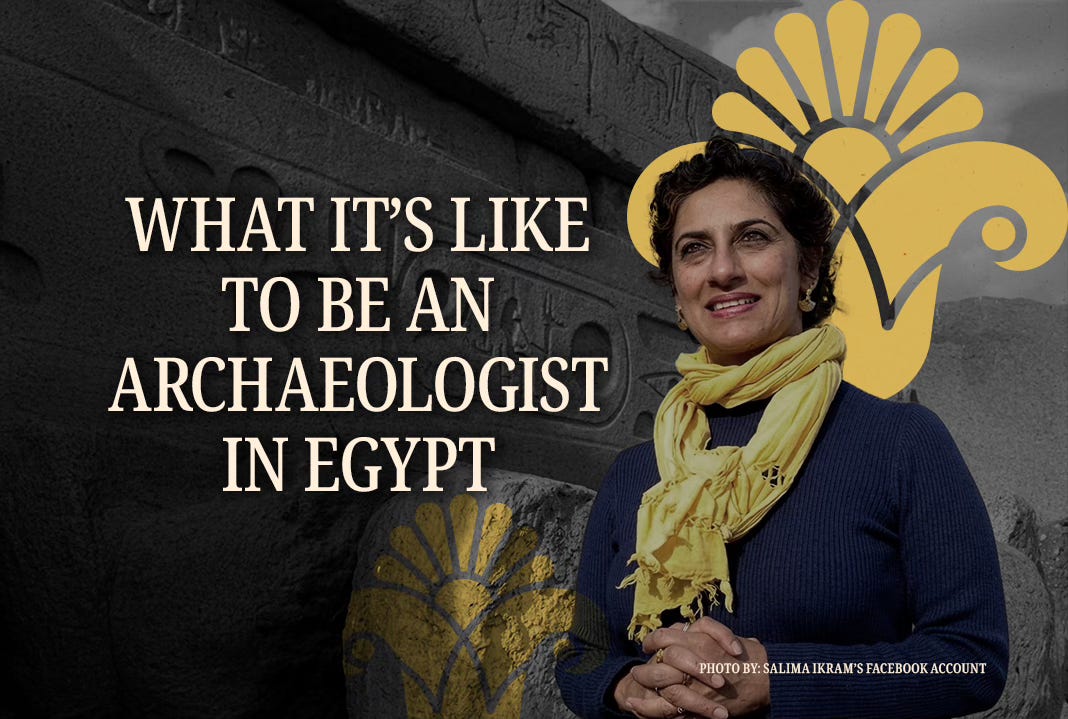
Perched on the side of a pyramid, Dr. Salima Ikram looks completely at ease. A photograph on her website captures the archaeologist in her element —“crawling down holes and popping out of pyramids.” Even when expeditions go awry, this is where she feels most herself.
“Some of my colleagues are more sedate,” says Ikram, whose voice is slightly hoarse after a month-long illness from inhaling too much mummy dust. She’ll be back to excavating burial chambers and examining remains as soon as her lungs clear.
Occasional setbacks are worth it for working on “extraordinary projects” and making discoveries that reshape our understanding of how people lived 5,000 years ago. Even after 43 years in the field, Ikram remains in awe of the achievements of the Bronze Age. “Almost everything about the Ancient Egyptians is interesting, absorbing, and inspiring… One wants to hang out with them more,” she says.
Ikram’s love affair with Egyptology began in childhood. On her first visit to Egypt at the age of nine, she was captivated by the civilization that built the pyramids and developed hieroglyphic writing.
This began an “endless quest” to immerse herself in a civilization spanning more than 3,000 years. It’s a journey that has shaped her both mentally and physically—falling off cliffs and breaking her pelvis are just some of the tolls on her body—but it’s all part of a career that “makes you open to adventure and less set in your ideas,” she says.
The specimens she studies are ancient, but even across millennia, they feel present. “History is part of a shared past… we learn about ourselves too,” she says, pointing to the way her specialism—human, animal, and food mummies—helps trace the origins of society today.
It’s often the smallest details that resonate the most. Examining the mummy of a mother with her baby tucked into the crook of her knee feels intensely poignant to Ikram. “It’s these moments that remind us of our common humanity,” she adds.
Quiet moments of reflection are interspersed with the excitement of discovery, but the process can be painstaking. Weeks of fruitless searching, as pressure mounts and funds dry up, are compounded by sweltering heat and flies at dig sites. “Sometimes I could do without the bats,” Ikram says.
Yet these discomforts seem negligible when the cry goes up announcing a new discovery. There’s a lot left to find. More than 200 years of archaeological activity have uncovered less than a third of Ancient Egypt. Estimates suggest that 70 percent remains below the sand, hidden beneath modern cities and Nile mud.
In particular, worker settlements, offering a window into the lives of everyday Egyptians, have been overlooked in favor of royal tombs. The world has long been enthralled by the tantalizing potential of priceless treasures buried with the Pharaohs, fuelled by sensational discoveries across the decades.
The most famous of these was in 1922, when British archaeologist Howard Carter opened the doorway to a burial chamber sealed for three millennia. Many royal chambers have been plundered by thieves across the centuries, including by the ancient Egyptians themselves, but Tutankhamun’s tomb was discovered intact.
More than 5,000 objects were found alongside the boy king, who died aged 18 or 19, possibly from malaria and a leg injury. Extraordinary treasures emerged from the site in the Valley of the Kings near Luxor, including Tutankhamun’s death mask, now considered a masterpiece of Egyptian art. “Before, people would admire Greek and Roman art, and the Egyptians were thought primitive,” Ikram says. Suddenly, the world was mesmerized by Egypt.
The craze known as “Egyptomania” or “Tut-mania” went global as ancient Egypt became a dominant theme in fashion, art, and architecture. Interest was heightened by the ‘curse of the pharaohs’, a rumor fabricated by journalists denied access to the tomb. “The Times had a monopoly, so they made it up,” Ikram says.
A century on, archaeologists have compiled a detailed understanding of Ancient Egypt, fed by more groundbreaking discoveries in the years since. For Ikram, everything is open to question as fresh finds revise our understanding of the age. In her specialist field, studies of mummification materials have revealed a more complex process than previously thought, with resins and oils imported from abroad indicating early global trade networks that were previously unknown.
These scientific inquiries are matched by the thrill of archaeological finds in the field. On a rescue-archaeology mission in Sudan in the 1990s, Ikram and her team excavated at speed in front of bulldozers that were building a new road. When a pair of tumuli was discovered intact, Ikram opened the doors to burial mounds that had been undisturbed for 2,500 years.
“I could smell the incense that was burned as part of the burial ritual. Moments like that are extraordinary,” she says.
She compares archaeology to detective work, analyzing clues to test different theories until one fits. Not all evidence is equal, however. Deciphering the paintings in a tomb can feel like looking at someone’s social media feed. “It’s what you choose to put in there,” Ikram says.
But taken together with other evidence, including the food a body was buried with, the condition of the bones, and the materials they were wrapped in, it’s possible to build a picture of the life lived thousands of years ago. At times, a feeling of familiarity echoes across the centuries. “Things that mattered 4,000 years ago to human beings are still the same things that matter to us today,” Ikram says.
Understanding these motivations and how they shaped Egyptian society has been her life’s work, though it didn’t seem achievable to everyone. Even in a country with the only surviving wonder of the ancient world, her early aspirations to be an archaeologist were considered far-fetched. “My father said you are never going to get a job. What on earth are you doing? But much to everyone’s surprise, I made a career of it.”
Over the years, she has met many people who shared her ambition to become an archaeologist, only to abandon the dream in favor of a reliable income. Many of those who did persevere also teach, like Ikram, to sustain their research.
At The American University in Cairo, where Ikram is a professor in Egyptology, she sees the same pattern play out. There is a lot of interest from students, but parents worry they won’t find paying jobs in the field. Many who major in Egyptology go on to work in business or finance, she says.
Teaching eats into the time she can spend on digs—two and a half weeks is the most she can commit to on-site, but living in Egypt means she is on hand when her expertise is needed, including for television projects.
Advising on films and documentaries, including The Mummy, allows her to bring ancient Egypt to a wider audience and meet interesting people. Describing the attraction of digging in tombs to actor Morgan Freeman, she told him, “Being an archaeologist means that you never have to grow up, and the past is always part of the present.”
She was referring, she says, to playing in the sand and crawling down holes, a process that is both thrilling and unnerving. Bumping down tomb shafts in the dark, unsure of what waits below, fear temporarily takes hold. Then she passes the halfway point, and curiosity triumphs, pushing her deeper into the past to uncover the secrets of Ancient Egypt and share them with the world. Each discovery builds on knowledge gathered across two centuries, with the potential to revise history in ways not yet imagined. It’s an enticing prospect that renders the bats and the bruises irrelevant, when, as Ikram puts it, “suddenly you excavate something and ideas that have been written in stone for at least 100 years have to be tossed out of the window in light of fresh new evidence.”
Middle East Uncovered is powered by Ideas Beyond Borders. The views expressed in Middle East Uncovered are those of the authors and do not necessarily reflect the views of Ideas Beyond Borders.