


This piece marks the launch of our new series, What It’s Like To Be, which takes readers inside the lives of people working in remarkable and often demanding professions across the Middle East. Each installment offers an intimate look at the realities shaping their daily world. Look for WILTB in your inbox every Sunday morning.
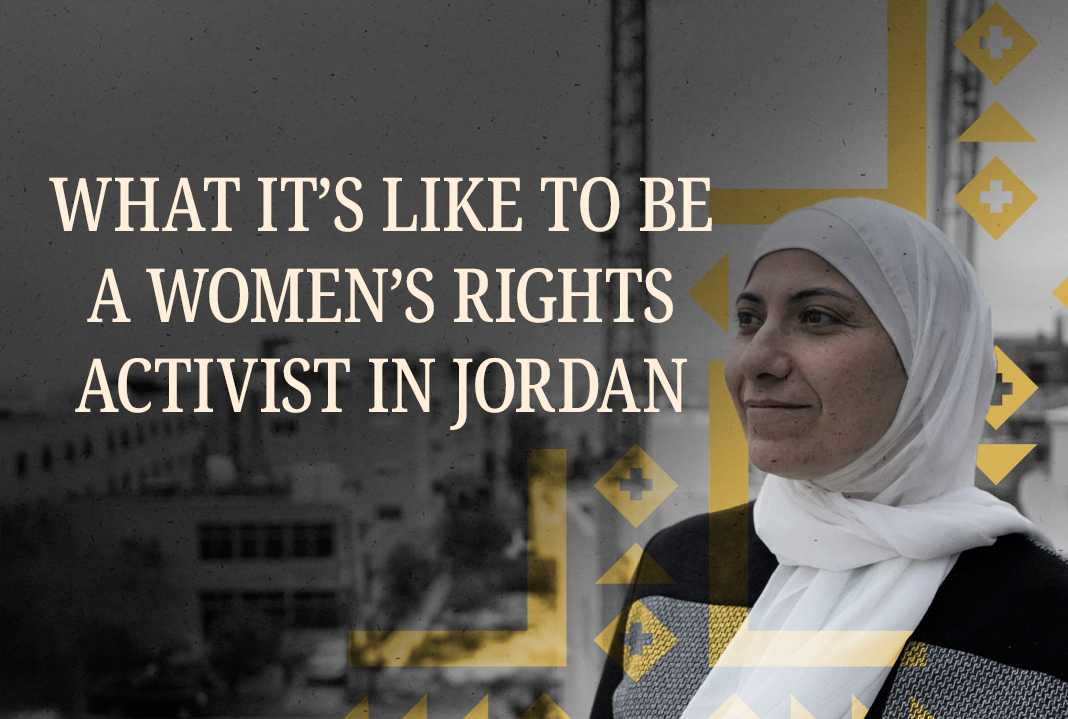
“Equal opportunities are bad for women—it’s better they stay at home,” is a claim Areej Sumreen has confronted countless times, but after two decades as a women’s rights activist in Jordan, a long-awaited shift is underway.
She sees it in schools and universities, where young women are unafraid to speak up. “Before, women didn’t understand their rights, and they were scared to report violence due to social stigma,” said Sumreen, a protection manager at the Institute for Family Health, a nonprofit that focuses on healthcare services and capacity-building in Jordanian communities.
“Now women and girls say what they want for the future.”
Social, economic, and cultural barriers continue to impact women’s lives in Jordan, but a new generation is increasingly emboldened to challenge patriarchal norms. Activists like Sumreen have noticed the shift as stronger laws, greater representation, and a deeper understanding of women’s rights reshape society.
“Women today are empowered to make changes in their communities, and they can participate more actively as decision makers,” she said.
While campaigners across the region report on the worrying rollback in women’s rights, the momentum in Jordan is towards progress.
Recent breakthroughs have eased restrictions and opened up opportunities for Jordanian women and girls. In particular, the updated Law on Protection from Domestic Violence in 2017, which established a family protection department to handle complaints and brought about the long-demanded repeal of Penal Code Article 308, allowing rapists to escape punishment by marrying their victims.
A rise in female political representation is helping to drive these reforms. Increased quotas ensure more seats for women in Parliament and local councils, with almost 20 percent of parliamentary seats held by women in the 2024 elections.
This is only slightly above the regional average and significantly lower than in countries like the UAE, where women hold 50 percent of seats, but it’s part of a wider shift as more Jordanian women participate in the political process.
“As a woman in the Middle East, it’s wonderful to see more females in these positions,” Sumreen said.
Women also hold more leadership roles in business, though female labor force participation remains low overall at 14 percent. While the work-life balance remains skewed against women, new measures are making it easier to juggle a career and family life.
Recent updates to the labor law have increased paid maternity leave from 70 to 90 days and made flexible working hours more accessible. Employers are also required to provide suitable childcare settings in certain circumstances.
Better collaboration between the women’s rights community and the government sector is one of the factors powering this progress. “There’s more coordination between agencies. The government today is more focused on solutions than challenges,” Sumreen said.
Encouraged as she is, there’s still a long road ahead. Jordanian women, like their contemporaries around the world, face obstacles from unequal pay and sexism at work to unaffordable childcare and restrictive social codes.
Is life better for women in the West? Are they happy? Sumreen wants to know because she has spent her career campaigning to remove the obstacles so that Jordanian women and girls can thrive on their own terms—at home, at school, and at work.
At times, this has meant getting creative. One year, she launched self-defense classes for survivors of gender-based violence. Rates of gender based violence were surging during the COVID-19 lockdown, and she wanted to boost confidence and encourage more women to access their rights.
But the idea fell flat—the prospect of women learning to fight flouted every social code. “People saw it as women learning to beat up their husbands, and no one wanted to join,” Sumreen said.
Then a few women signed up. As word spread, they hired more trainers to keep up with mounting demand.
Self-defense moves were only part of the lesson, Sumreen explained. The real impact was helping women find the psychological strength to manage the threat of violence and loosen its hold over their lives. “I was very proud of this program. It started from nothing and went on to empower women and girls to improve their economic situation, too,” she said.
These are the positives she focuses on to mitigate the setbacks. Confronting Jordan’s entrenched patriarchal system and challenging longstanding stereotypes around the role of women can be dispiriting, and victories are hard-won.
It’s the human obstacles that frustrate Sumreen the most—when people exploit vulnerable women for personal gain. “There are many double standards in human rights; some people lose their principles,” she said.
On those days, she draws on her background as a clinical psychologist to manage stress and focuses on the broader goal. At the start of her career, she worked long hours and weekends, pushing herself to burnout in the service of the cause. These days, she knows she can help more women when rested and restored.
And in a year marked by shrinking aid budgets, Sumreen has needed all her energy to navigate work-related challenges. “I believe in our capacity to do this job. It’s our responsibility to support vulnerable women so they can rebuild their lives,” she said.
The dive in global humanitarian funding following the closure of USAID and cuts in government aid budgets has hit Jordan hard, forcing women’s rights groups to curtail projects and reduce staff. “When you start to serve people and suddenly a project stops, it’s not just a difficult day; this breaks us,” Sumreen said.
So far, her team has managed to avoid cutting projects, instead rearranging resources and finding alternative sources of funding. It’s a stressful time as the women’s rights community struggles to reassert itself, but Sumreen believes that Jordan will advance, even as aid organizations retrench.
There is too much at stake to falter now, just as opportunities are opening up. “Jordan is making a real effort to improve the lives of women and girls,” she said.
Looking at the young people entering her field, Sumreen is confident the momentum will continue. “They are a very aware generation. Students in universities build their knowledge early and speak up loudly about their rights,” she said.
The freedoms she sees opening up for Jordanian women and girls were unimaginable 20 years ago when Sumreen began her career, so who knows what might be achieved another decade on.
Middle East Uncovered is powered by Ideas Beyond Borders. The views expressed in Middle East Uncovered are those of the authors and do not necessarily reflect the views of Ideas Beyond Borders.

Glad to see Jordan is making progress. I realize patriarchy and mysogyny are problems everywhere but these issues are particularly acute in the Muslim world and desperately need to be addressed. If Muslims ever want to break free of the neocolonial shackles that have trapped them, the best place to start is by empowering Muslim women to take control of their lives.
As I argued in the piece below in reference to Iran - it’s not just about doing the right thing but ending the cycle of violence and instability that has gripped the Muslim world for centuries. Given our horrific track records, I don’t think Muslim men should be allowed to hold any political power but since that isn’t realistic, I’ll settle for ensuring women are given half the positions of authority in Muslim societies.
https://open.substack.com/pub/mirrorsfortheprince/p/israels-attack-on-iran-highlights?r=v623r&utm_medium=ios