


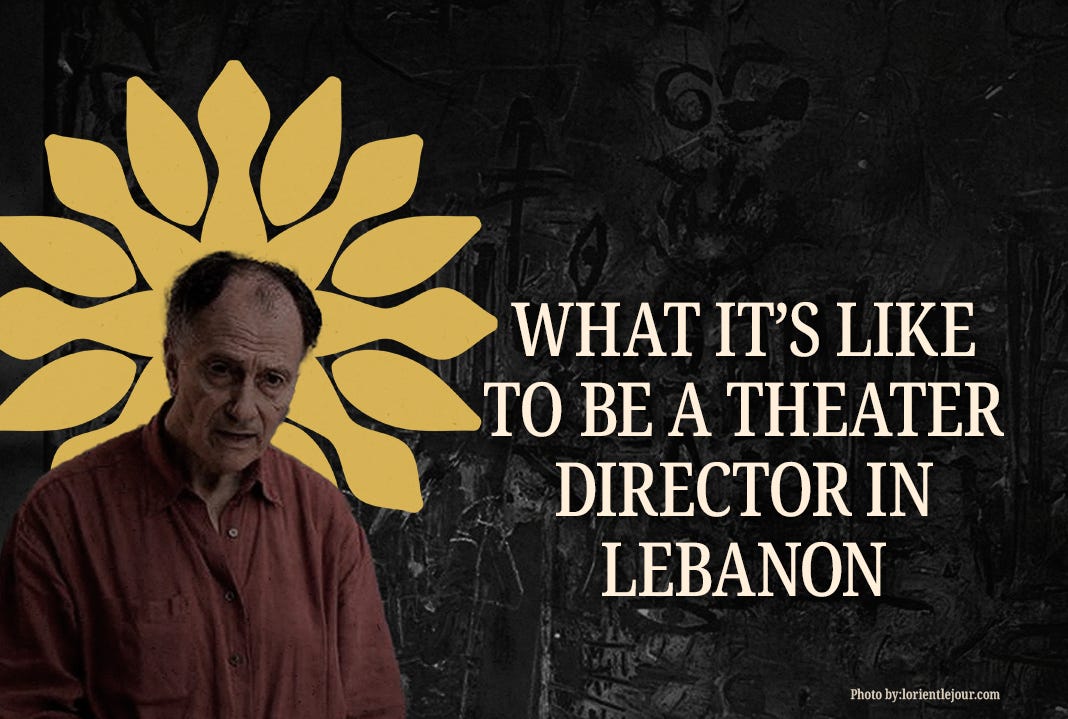
At 79, Paul Mattar has a new idea. He doesn’t know whether it will work. Like much of his creative output, “it’s experimental,” and the audience will decide.
As an actor, composer, singer, playwright, and theater director, Mattar has explored many modes of expression, but he has spent a career searching for a form that’s free from constraint.
It has taken him from the star-studded stages of Golden-Age-Beirut and the cabaret halls of 1960s Paris to bombed-out venues across war-torn Lebanon. Yet even as he swapped national theaters for shelters and school halls, Mattar was frustrated by the same invisible barriers in his art.
“Everything in theater is prepared and fixed in advance. As an artist, I want to feel free,” he says.
Now, Mattar believes he has found a way to unite artist and audience in a common voice. These days, Mattar is “bored” with theater productions. He wants an authentic art form that mirrors the audience’s reality, not a mouthpiece for the writer or a stage for performance.
“I’ve seen my country invaded, its cities destroyed, my economy collapsing. We need real stories that chronicle Lebanon’s history in the words of people living it.”
He’s happy to begin with his own.
The shy second son of middle-class parents, it was Mattar’s talented elder brother who seemed destined for the stage. “I was creative, but it was not obvious to everyone, especially my parents,” he says.
Mattar was happy to stay in his brother’s shadow. The two shared a room and went to the same school. When his brother Pierre took guitar lessons, Mattar learned by watching him play.
It was Pierre who put his younger brother forward for his first role. Mattar auditioned and landed the part, performing alongside professional actors in a 1966 production called Les requins aux Presque, or “As close as possible to the sharks.”
Working at the newly opened Théâtre de Beyrouth (Beirut Theater), he met acclaimed playwright and director Roger Assaf, who helped the aspiring actor find a foothold on Lebanon’s burgeoning modern theatre scene.
The 1960s are often described as Lebanon’s Golden Age, but Mattar disputes this. For him, it was the early 1970s, up to the outbreak of war in 1975. “That was when Lebanon started to be heard in the world,” he says.
This was the height of Lebanon’s Belle Epoque, when the arts blossomed during a period of prosperity. Theater, once the preserve of a wealthy elite, was becoming accessible as literacy accelerated in the 60s and 70s. “We were discovering something we had never had in Lebanon—the power of theater,” Mattar says.
Plays were performed in every available space to accommodate the outpouring of new work. Grand hotels, including The Phoenicia and The Normandy, transformed ballrooms into stages while schools, churches, and town squares hosted smaller productions.
“It was very exciting. I was very lucky to live through this period,” he adds.
The Beirut Theater attracted a vibrant community of thespian talents. Together, they pioneered a bold era of contemporary drama that celebrated Lebanese writers over international productions and creativity over conformity.
Mattar’s mentor, Assaf, saw theater as an extension of popular culture and wanted plays that reflected the issues of the day. Landmark productions like Jalal Khoury’s Juha on the Front Lines and Ousama Aref’s Idrab al-Haramieh spoke to Lebanese audiences and cultivated the interactive spirit of the age.
Artistic expression flourished as playwrights broke new ground with daring productions that challenged social norms. Assaf’s work would push the democratic spirit of Lebanon, then seen as a bastion for free speech in the region, to its limits.
In 1969, his production of Majdaloun, written by Henry Hamati, was shut down by the Lebanese military three days into its run at the Beirut Theater. The plot confronted controversial subjects, addressing the Palestinian armed presence in southern Lebanon as a consequence of the Israeli occupation.
In a moment of triumph for creative freedom, Assaf, his co-director Nidal Ashkar, and the cast walked with the audience to the Horseshoe café on Hamra Street and continued their performance. But the play, which criticized the state’s inertia and called for domestic revolution, tapped into tensions that would continue to rise.
Politically charged works like Majdaloun resonated powerfully as the atmosphere darkened in the months leading up to civil war. The earlier climate of buoyant intellectualism and free experimentation gave way to a more urgent and ideologically driven theater as the stage became a vehicle for resistance against political forces that were propelling the country into conflict.
“The civil war didn’t stop us. On the contrary, it pushed us to perform more but in new, different ways,” Mattar recalls.
Recently returned from a period in Paris, where he acted at Théâtre de la Ville and composed songs for concerts and cabarets, Mattar was ready to forge something new. Inspired by the spirit of the music hall, he staged free performances in intimate venues, bringing audiences closer to productions that were “marginal, weird, unspecific.”
It was liberating to work in the mini-theater format. He felt free to experiment and wrote a play that merged Shakespeare’s Timon of Athens with a tale from One Thousand and One Nights. People would sit, sip drinks, and feel part of productions. “It was one of the most interesting experiences of my life,” Mattar says.
This lasted a few years before war broke out and consumed the country’s cultural spaces. For a while, Mattar composed songs about conflict, trying to make sense of the tragedies unfolding in the streets around him. Then he gave up. “There were too many.” He turned back to acting, curating a performance for children that could be staged across the country.
With a simplified set and a cast of three actors, plus puppets, crammed into the back of a tiny VW Polo, they drove from village to village, performing in every available space, sometimes under fire. During one performance for children with disabilities, they only just managed to get the audience to safety as shelling began.
By the time the war ended in 1990, most of the country’s cultural spaces lay in ruins. Yet even as he mourned their loss, Mattar saw the need for something new. “The Civil War changed artistic creation. For a while, nothing else in life existed outside the war,” he says.
When someone offered him a dirty, underground space that was lying empty, Mattar seized his opportunity. Working alongside actress and producer Jocyane Boulos, he oversaw the emergence of Le Monnot Theatre, where he would serve as director for more than two decades.
Friends questioned his decision to move from West to East Beirut, but Mattar was more interested in using art to dismantle the barriers that segregated the city during war. “When you are offered a stage, you have to go.”
And soon, audiences were coming from across the city, as the artistic community drifted back, ready to make sense of the last 15 years on stage.
Mattar is proud of his work at Le Monnot Theatre. On their 20th anniversary in 2017, he counted over 1,000 performances, showcasing diverse talents and genres that helped revive Beirut’s theater scene.
Today, it is recognized as one of the city’s most enduring creative spaces and a symbol of cultural revival in post-war Beirut. But for theater veterans like Mattar, there are qualities that can never be reclaimed. The exuberant spirit of Lebanon’s theatrical renaissance has vanished. Passing the ruins of the Beirut Theatre in Ain el-Mreisseh, a lump catches in his throat. “I lived the most beautiful moments of my life in this place, and now there is nothing.”
That age of artistic experimentation has given way to a more globalized, trend-driven culture. “The performances we staged in these theaters were different. Today they all look the same,” he says.
He now feels that there are more direct and urgent ways to tell stories than on the stage. Tracing his career from the heady optimism of 1960s Beirut, through the trauma of war and the crises that have engulfed Lebanon since, he has found a form that finally makes sense. “For me, storytelling is the solution,” he explains.
Mattar is planning a storytelling festival that will elevate the audience, dispensing with the artifice of theater in favor of a stripped-back, raw form. He hasn’t decided on a name, but he wants to reflect life in real time, relayed by authentic voices. “The history books are biased,” he says. “I want our history to be chronicled by Lebanese people. We need to hear them talk.”
Middle East Uncovered is powered by Ideas Beyond Borders. The views expressed in Middle East Uncovered are those of the authors and do not necessarily reflect the views of Ideas Beyond Borders.
What stands out to me is the importance of preserving history through the voices of those who actually lived it. In societies shaped by war and political upheaval, firsthand experience adds a dimension that conventional historical accounts can easily miss. These voices are not merely memories; they are part of the historical record.
— Wahidullah Noorzai
Former Senior ANCOP/ANP Officer | Field Strategist | Military & Security Analyst