


“What It’s Like To Be” takes readers inside the lives of people working in remarkable and often demanding professions across the Middle East. Each installment offers an intimate look at the realities shaping their daily world. Look for WILTB in your inbox every Sunday.
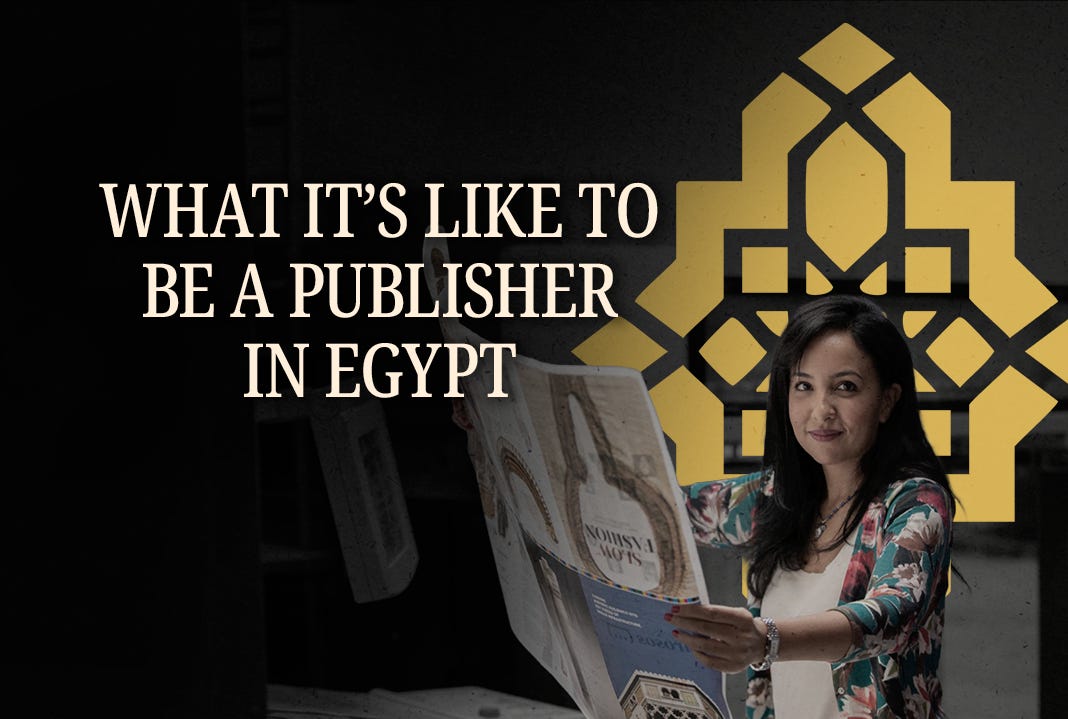
Two months after launching Rawi magazine, Yasmine El Dorghamy faced a challenge few publishers anticipate. As the first issue hit the stands, uprisings broke out across the Arab world, reaching Egypt on January 25, 2011.
Somehow, Rawi, a boutique heritage magazine that documents Egyptian history, art, and culture, survived this turbulent start. In the years that followed, its audience grew, resisting the shift towards digital-first publishing as traditional magazines closed and Egyptian media moved online.
“The readership has never been a problem. It’s just expensive to produce,” says El Dorghamy, whose passion for history drove her to devise a title that would bridge the gap between academic research and the general public.
“I felt like there was a big disconnect between the world of people producing the knowledge and people who are consuming it,” El Dorghamy says.
Now published annually in English and Arabic, Rawi unpacks Egyptian history for ordinary readers, delving into topics and time periods that have been glossed over by mainstream media.
El Dorghamy wakes each morning, “excited about the things I’m going to read and write about today”—an enthusiasm that permeates the pages of her publication.
She started small, launching the first issue in late 2010. A glossy magazine dedicated to history and heritage was unusual in Egypt, but El Dorghamy felt confident. “There was a real need for it,” she says.
Two months later, the country spiraled. Large-scale protests erupted across Egypt, prompting the overthrow of long-time Egyptian President Hosni Mubarak.
Sustaining a fledgling title amid national chaos proved “extremely challenging,” but El Dorghamy has spent her life adapting to changing circumstances.
The daughter of a diplomat, she moved every few years throughout her childhood, living in Japan, Greece, Turkey, Mexico, and Sweden before settling in Egypt. She credits her fascination with history and culture to this early exposure, but making friends and maintaining her grades in school were difficult.
Each time she was uprooted, El Dorghamy built on the resilience that would prepare her for the “endless uphill climbs” publishers face in a fraying media landscape. “My default mode is to expect things to be difficult. When they are easy, I start to worry,” she says.
So, as political upheaval and economic turmoil gripped the nation, she threw her energies into crafting a second issue that would chime with the public mood. Stories explored topics such as looting and the unrest’s impact on antiquities, connecting current affairs to the country’s ancient past.
“I managed to survive,” she says.
El Dorghamy spent the next few years carving out a space for Rawi with historical deep dives packaged for a contemporary audience. Articles were light on jargon and engagingly written. “I always made sure the language was accessible she says.
As she built a team around her, the magazine developed a reputation for striking design. Determined to incorporate “fun and whimsy,” El Dorghamy looked to the past for creative freedom and variety.
“Editorial design has lost its joy over recent decades,” she says. “The industry standard has become very austere.”
Good design, El Dorghamy believes, is where print retains its edge, offering a tangible experience that digital platforms can’t replicate. Rawi has a strong digital presence, using multiple platforms to share stories and anecdotes, but while other publications moved fully online, Rawi’s identity remained rooted in print.
“A phone screen can never compete with a beautifully printed book,” she says.
The shift from traditional print models to digital-first media has transformed the publishing landscape in Egypt, where a young, highly connected population drives the demand for online content. Broader economic challenges and the rising cost of paper have made magazine production increasingly expensive, accelerating the decline of publishing in Egypt, historically the cultural giant of the Arab world.
Two years ago, El Dorghamy decided to relaunch Rawi as a coffee-table book. Her distribution manager had stopped working in magazines—“he said they no longer exist in Egypt”—and her local newsstands were only selling books.
“That’s when it hit me,” she says.
In 2025, she published the first edition of Rawi, investing in her belief that books will always be a cornerstone of Egyptian culture. “The magazine may be perceived as something archaic, but the book isn’t. They’ve become very expensive in Egypt, but people still respect books the way they always have.”
A book also felt like the right medium for the product Rawi had become. Early editions were lighter and covered a cross-section of Egyptian culture, but in 2016, that changed.
At the time, the art market in Egypt was thriving, but there was very little coverage to accompany the evolving scene. Several people had suggested Rawi tackle the subject, so El Dorghamy plunged herself into research that would result in a bumper issue.
“The eighth edition on modern Egyptian art got out of hand,” she says. “But it turned out this was exactly what people wanted.”
Other hefty issues followed—focusing on Egyptian cinema, Egypt’s culinary history, and the 7,000-year evolution of Egyptian fashion. El Dorghamy immerses herself in every theme, discussing stories with journalists, reading the latest works by academic contributors, and debating angles with editors.
Brainstorming sessions result in noisy WhatsApp groups and Dropbox folders filled with ideas. Even when the magazine runs to more than 200 pages, it feels like they have to “slice Egyptian history very thin.”
El Dorghamy aims to balance the advice of her editors, who insist she has to “kill your darlings,” with her desire to tell the long story of Egyptian history, illuminating lost chapters and forgotten tales. “There’s a lot of focus on Egypt’s ancient history, but we have about 3,000 years separating us from that period,” she says.
This willingness to foreground less trendy topics and resist AI-style summaries resonates with readers of all ages, from university students who turn to Rawi for research and academics who use it as a teaching tool, to ordinary Egyptians leafing through the pages of their country’s past.
One of El Dorhmany’s proudest moments came early on, when she learned that a waiter had stashed his café’s copy of the magazine and covered it in sticky notes. “The guy had hidden it for himself to read cover to cover. I thought it was wonderful,” she says.
There have been many highlights since. The day she learned sales of Rawi in a popular bookshop had outstripped The Da Vinci Code, the best-selling novel by Dan Brown, or when the magazine went on sale at The British Museum in London and The Louvre in Paris.
Unfortunately, these successes don’t translate into profits at the newsstand. El Dorghamy is “not a salesperson” but has to devote considerable time to fundraising. Economic turmoil, currency devaluations, and regional conflicts have made that job harder, but “there are still a lot of very enlightened individuals and entities and foundations that have supported Rawi and kept it going over these years,” she says.
Meanwhile, the Rawi team is finding ways to diversify. They recently produced the catalog for the Suez Canal Museum, and she has expanded into the art space, curating exhibitions that tell the physical stories of print editions.
Working alongside artists and gallerists has inspired new ways of presenting complex historical material for different audiences. El Dorhamy recently curated The Medical History Gallery at Al Nas Hospital, a visual journey through the history of medicine and healing in Egypt. She recognizes that while some people like sitting with a book or scrolling online, others prefer walking through a space and experiencing the information firsthand.
Looking ahead, she will continue to experiment with formats and audiences, but Rawi remains rooted in print, despite the challenges that commitment brings. “I refuse to compromise,” she says. “The day I let go of Rawi will be when I’ve completely given up on life, and thankfully, there are people who won’t let me.”
Middle East Uncovered is powered by Ideas Beyond Borders. The views expressed in Middle East Uncovered are those of the authors and do not necessarily reflect the views of Ideas Beyond Borders.