


“What It’s Like To Be” takes readers inside the lives of people working in remarkable and often demanding professions across the Middle East. Each installment offers an intimate look at the realities shaping their daily world. Look for WILTB in your inbox on Sundays.
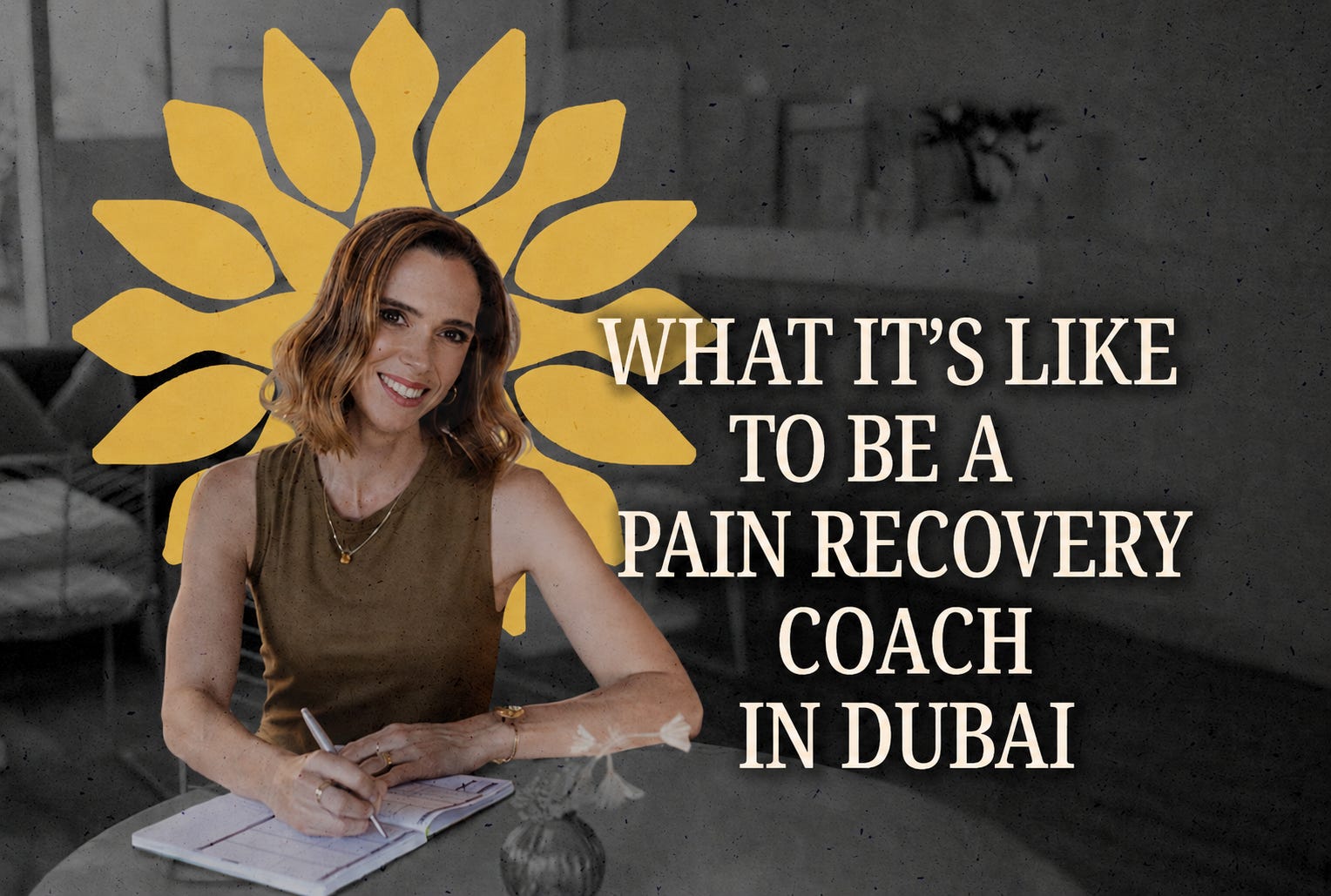
The pain always arrived with stress. Leaving England for Dubai. Packing up the family villa before another international move. Putting the children to bed each night. “My back would flare at 7:15 p.m. on the dot, always,” says Gemma McFall. Sometimes the pain was so severe that someone else had to step in.
Her back problems began a week before she moved to Dubai with her husband in 2010. While performing at a dance conference in London, she felt a sharp click as something in her back gave way.
Leaving London and saying goodbye to family and friends, her discomfort intensified. It would be eight years before she freed herself from these pain episodes. “If we had stayed in England, it would have just settled, but I was so anxious about the move,” the 43-year-old says.
Arriving in Dubai, she went down a route familiar to many bad back sufferers, bouncing from treatment to treatment in search of respite. The city’s booming healthcare scene presented a dizzying array of remedies, and she progressed from TENS machines, to doctors, to physiotherapists, to muscle relaxants, to epidural injections in her spine.
Then, in her desperation, she found a doctor abroad willing to perform surgery.
It wasn’t until years later that she read a book about the mind-body connection and understood her mistake. The classic signs were there. Her pain was not fixed, but resurfaced in different areas of her back. It was also inconsistent, continuing to flare up during stressful life events.
McFall had always pushed herself to be a high achiever, pursuing athletic challenges and a demanding career as an HR director. She is also a self-described people-pleaser and perfectionist, traits that make her more susceptible to neuroplastic pain, when the brain misinterprets safe signals from the body as dangerous.
The good news, she discovered, is that this pain is caused by learned neural pathways rather than ongoing tissue damage. It can therefore be unlearned and reversed by retraining the brain.
It would be a while before McFall grasped the full significance of her discovery. After years of suffering and chasing treatments, she had uncovered a completely different way of understanding pain. It would not only banish her chronic bad back. It would also allow her to help others overcome problems from migraines and shoulder pain to Irritable Bowel Syndrome and tinnitus.
“Once you realize the pain is emotional, not physical, the edges start to soften, and you no longer spiral,” she explains.
Not everyone responds with relief. “It’s a hard pill to swallow—hearing that the pain you have endured for years could have been fixed all along,” McFall adds.
As a pain recovery coach, she sees the debilitating physical and mental effects of persistent pain, which can also lead to depression, anxiety, and sleep issues. Gradually, people’s lives get smaller, and they stop doing the activities they once enjoyed.
The strain is felt by the entire family. “It’s really hard to live with somebody who has pain,” says McFall, who often hears partners express guilt for carrying on with their lives.
McFall’s first step with a new client is to ensure there are no signs of an underlying medical condition that requires standard care. Conventional medicine has historically focused on identifying structural or biological causes, such as arthritis or disc problems. However, there is growing recognition that pain is influenced by interactions between the nervous system and emotional states. For some people, persistent pain can continue long after an injury has healed because of changes in how the brain and nervous system process pain signals.
Many find this can be reversed when they realize their pain is neuroplastic and learn to manage the emotional triggers that prompt it. “Their recovery blows me away every time,” McFall says.
In a recent episode of his podcast, British physician and television presenter Dr. Rangan Chatterjee talks to Dr. Howard Schubiner, author of Unlearn Your Pain, about the science behind neuroplastic pain.
They discuss how all pain is created by the brain as a protective mechanism. This can be a warning due to physical injury, or a response to emotional trauma and anxiety.
Exposure to stress or fear can cause the brain to become hypervigilant and turn up the volume of physical symptoms that may have healed long ago. This is evident from the way that a person can be injured without experiencing pain, or experience pain without injury, says Dr. Schubiner, whose work aims to expose the “myth” that chronic pain is irreversible and incurable.
“In structural pain, there’s clear tissue damage so your brain creates pain to help you protect the area... In neuroplastic pain, there’s some sort of perceived danger but no real injury. Both types are real. You are feeling pain. The difference is in the treatment,” he explains.
Back in 2017, McFall was desperate. The pain was intolerable, and basic tasks were becoming impossible. Even lifting her children into high chairs required support. “I was googling how people with disabilities look after small children,” she says.
She sent her MRI scan to a surgeon in Singapore, who agreed to operate. Her “aha moment” would come years later, when she understood that “abnormal” findings on MRI scans can be common signs of aging rather than an explanation for pain. “We get sent for MRI scans very quickly these days and once you see signs of damage, the brain panics and sends more pain signals,” she says.
Her journals from that time reveal the regimented exercise routine she followed to strengthen her back. “I can see that the harder I was trying to get rid of the pain, the worse it was getting. The exercises were not helping at all because they were putting my brain into fight or flight mode.”
At the last minute, McFall’s insurance company blocked her operation, questioning the surgeon’s justification for the procedure. Instead, they sent her case notes to three specialists for a second opinion. All three returned different verdicts on her condition. “That’s when the alarm bells started to go,” she says.
The family had just moved again, this time to Sri Lanka. As her husband started a new job, McFall packed up the family villa and finished her notice period at work while caring for two small children. By the time she arrived, her stress levels were soaring. Still, she enrolled in an executive coaching course, unwilling to let her career stall.
She learned about the mind-body connection from a book recommended by her teacher. “I felt I had found this magical secret,” she recalls.
As she took on clients to coach, McFall realized she could help people with more than their careers. “I worked with three people who had chronic pain. All three had such good outcomes; I thought, I have to do this.”
Returning to Dubai after five years, McFall decided against resuming her HR career. Coaching was already a crowded field, so she specialized, training with SIRPA in the UK and the Pain Reprocessing Therapy Center in the US before introducing the concept to a region where it was relatively unknown.
“In Sri Lanka, coaching was a new phenomenon, but I quickly realized that in Dubai, when you tell people that you’re a coach, they roll their eyes because everyone is doing it.”
Still, Dubai was the ideal environment to launch a new business. In the five years they spent abroad, visa regulations had relaxed, and the city’s entrepreneurial scene was buzzing. The challenge for McFall was standing out from the crowd.
She engaged with the city’s entrepreneurial communities, participating in panel events and networking in the medical sector to raise awareness around the mind-body approach to pain. “My kids joked that I should be a pain influencer,” she says.
At first, it felt like there was little room for low-tech treatment methods in Dubai’s state-of-the-art medical landscape. “Everyone has insurance, so they just keep going to different doctors. Why pay for something alternative?” she says. More recently, however, the growth of wellness centers and holistic treatments has begun to shift attitudes.
“People get the fact that the body shows physical symptoms from suppressed emotions. Everyone knows a migraine can be because of stress, but now they are also realizing that things like IBS, fibromyalgia, chronic fatigue syndrome, back pain, and other conditions could be due to stress or pressure.”
Now, when a physio refers a patient to McFall for treatment, they have more faith in her methods. “Mental health is on the map,” she says.
In some cases, it can be as quick as one or two sessions. One client’s chronic pain ceased immediately. “The discovery call was enough. He was so grateful he left a video testimonial on my website,” McFall laughs.
She finds it most rewarding when people are able to resume the activities they love. One 77-year-old woman was forced to give up a ballroom dancing career before she learned to reprocess her pain. Now she is back to performing in competitions and is the lead dancer.
Helping parents of young children feels especially meaningful to her. One patient, a man in his early thirties balancing a demanding senior role with family life, had lived with back pain since childhood. Watching people like him return to the lives they want to live again “gives me goosebumps,” she says.
McFall knows how good it feels to be liberated from pain. She spends her weekends cycling around Dubai, swimming at the beach and camping in the desert. She has trained herself to respond calmly when stress surfaces, resisting the panic spiral that fast-tracked her pain.
Her client base is international, including a growing number of people from the Middle East, where back and shoulder pain and migraines are among the most common symptoms. “We’re not trying to get rid of the pain; we’re trying to get rid of the fear around the pain,” she says.
These days, bedtime is no longer a source of stress in McFall’s house. There’s no stabbing sensation along her spine when the kids play. Instead, she turned the most stressful time of day into a game, driving the children to bed on an imaginary train and harnessing the brain’s immense power to govern her body. “I wish more people understood they have control over their brains,” she says. “I wish they knew that pain pathways can be unlearned.”
Middle East Uncovered is powered by Ideas Beyond Borders. The views expressed in Middle East Uncovered are those of the authors and do not necessarily reflect the views of Ideas Beyond Borders.