


“What It’s Like To Be” takes readers inside the lives of people working in remarkable and often demanding professions across the Middle East. Each installment offers an intimate look at the realities shaping their daily world. Look for WILTB in your inbox every Sunday.
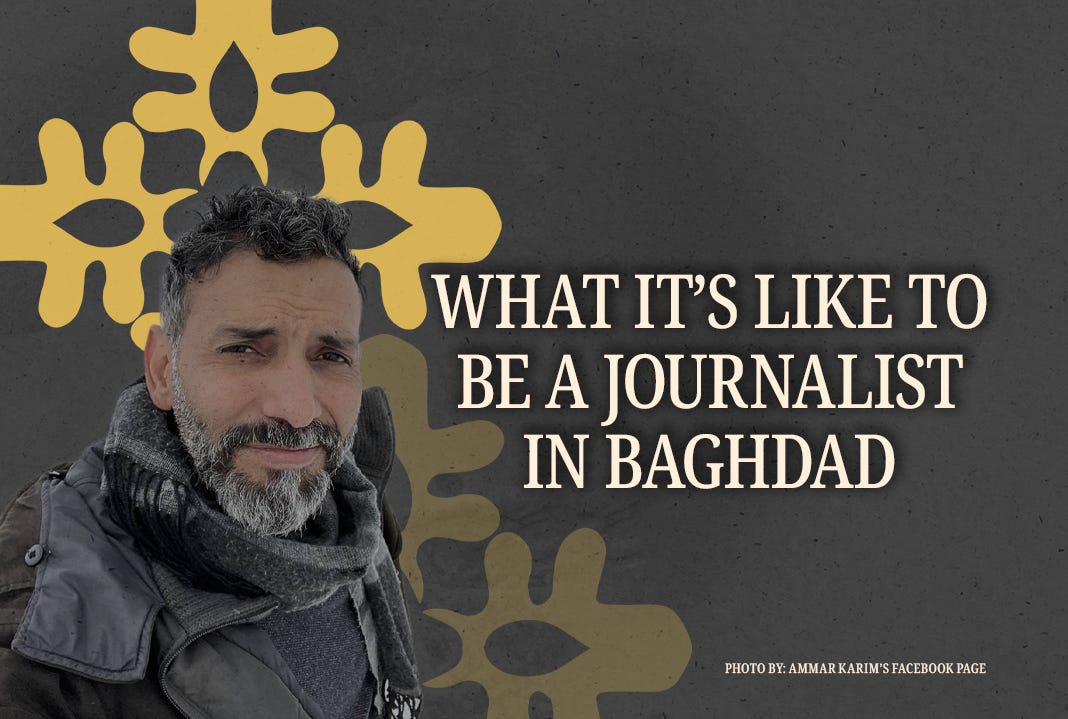
Between 2006 and 2007, when the bloodshed peaked in Baghdad, Ammar Karim went out every night. Crossing the city was dangerous after dark, but he went anyway, heading for the small café in Zayouna, where his friends sought a sliver of normality in those febrile years after the US-led invasion of Iraq.
One worked in the defense ministry, another at the oil ministry. There was a company contractor, an academic, and Karim, bringing them breaking news from that day. “I came loaded with information, until they asked me to stop,” Karim recalls. “They were trying to live peacefully, away from all this violence.”
It was 2007, and Iraq had become a hellscape of car bombs, sectarian clashes, and spiralling death tolls. A fresh wave of violence had followed the execution of former Iraqi dictator Saddam Hussein, prompting a surge in US combat forces across Iraq. The conflict seemed never-ending, seeping into all areas of life as civilian casualties climbed during one of the deadliest years of that decade.
Karim worked all hours, covering events in Baghdad for the French news agency L’Agence France-Presse (AFP). “For two years, we reported the same story again and again—how another body had been found in the street or pulled from the river.”
The chaos was constant, but reporting on it could be unpredictable. After the fall of the Ba’athist regime in 2003, censorship had eased, and local police began cooperating with journalists. It made helping families locate the bodies of loved ones easier, Karim says. Then, insurgent groups began targeting police stations, and communication broke down. “At some point, the police became so aggressive. They were under daily attack, losing their men and relatives,” he says.
The country, straitjacketed into submission under Saddam Hussein’s ruthless rule, had erupted. From AFP’s sprawling office in the city, the team sent 10 to 20 alerts each day, racing to cover the barrage of attacks that pounded Baghdad at all hours. Still, it was better than life before, says Karim. There was freedom, and the sanctions that starved the population had lifted, but his country was drowning in chaos. “I thought Iraq could never survive those times,” he adds.
Just three years into his career, Karim should have been a cub reporter. Instead, the war fast-tracked him into the role of a seasoned correspondent. While doing ad hoc translation work for the US Army, he crossed paths with AFP bureau chief Sammy Ketz and saw an opportunity to pursue his interest in politics. “I was so optimistic that this country, one day, would be better,” he recalls.
Around him, foreign journalists converged on the city, many making their names in the war that was tearing Iraq apart. “I never saw any shame in that. I help every journalist who comes here,” says Karim, who set up the Foreign Journalists Institute, drawing on his contacts at the interior ministry to assist international media in the country.
Now 47, he has continued to advise and support journalists throughout his career, drawing on a huge network of contacts across Iraq. “Sometimes journalists cross a line, but I always assume it’s not intentional,” says Karim, who has helped secure the release of detained reporters in the past. “We are not a big community, so we have to protect each other.”
He knows too well the risks that accompany this work. Like any veteran reporter in Iraq, Karim can reel off a list of close calls: fleeing masked gunmen on a motorbike, bullets whistling past his ear, sheltering from a shootout at the Imam Ali Shrine in Najaf as insurgents opened fire.
Other stories are more painful to tell.
The murder of his friend Hisham el-Hashemi still haunts Karim. He eventually found the words to express his grief in a moving story on the respected security analyst, who was shot dead in a car outside his home in 2020. The attack came during another period of intensified violence, when armed actors operated with impunity across the capital.
“I warned him about the consequences,” Karim says, describing the fear he felt for his friend, who had openly criticized the Iran-backed groups that operated outside state control. “Hisham loved Iraq. He was trying to get the country out of the influence of Iran,” Karim adds.
El-Hashemi’s death came as a shock to the media community. He had been a trusted friend and sounding board, advising with extraordinary clarity on the complexities of Iraq’s shifting security situation. “He was a soft, gentle person, and smart—the only security expert writing honestly about what he researched,” Karim says.
News of the murder sparked public outrage and prompted then-Prime Minister Mustafa al-Kadhimi to respond to the wave of assassinations and kidnappings of Iraqi activists that followed the 2019-2020 Tishreen protest movement. Journalists, too, were being targeted as militia men stalked the city, ticking people off kill lists then vanishing into the night.
Friends messaged to warn Karim to maintain a low profile. He had already lost friends, relatives, and colleagues in the bloody frenzy that surrounded the protests when more than 600 demonstrators were killed by security forces and armed groups. Now he wondered whether he could find any hope in a country that had dispensed with one of its sharpest minds in a seemingly endless cycle of violence.
El-Hashemi was “one of the finest, most principled men I have ever known, whose honesty and dedication struck fear in the hearts of Iraq’s masked, armed boogeymen,” Karim wrote. Driving to his house that night, blinking through tears at the sight of blood pooling beneath the driver’s window, something in him broke. “I lost my confidence in everything about life,” he says.
Karim leads a large WhatsApp group where journalists share tips and resources. It was where he first read, disbelievingly, of his friend’s death. Usually one of the most active voices in the chat, he fell silent, ignoring the steady stream of alerts each day.
In Iraq, many media outlets are owned by or aligned with political parties or factions that promote their backers’ agendas. Members of the chat come from across the country and span the political spectrum. He knew that some of them could have affiliations with the group that sent men on motorbikes to shoot his friend.
“There is very little neutral journalism in Iraq,” he says.
In recent years, this has begun to change as social media and AI create space for independent journalists to publish without party backing. During the Tishreen protests, social media became the primary source for real-time updates as local channels brushed over state violence towards protesters.
As a democratizing influence, Karim welcomes this shift, but he worries about the quality of future journalism. “People are not writing anymore…this will change us,” he says.
As someone whose life has been shaped by stories, he shudders at the thought of AI-generated reporting. Covering Iraq as a journalist for 23 years has been frightening, and at times traumatizing, but it also affords privileged access to people, places, and information that help him understand his country and the people in it.
Looking back, it has shown him another side to the nation so often portrayed as corrupt and violent by foreign media. One recent freelance job saw him escort British actor and TV presenter Michael Palin for the Into Iraq travel documentary. “We covered a lot of very good things about Iraq, that no one has been able to show—a lot of beautiful things in this country that need to be seen.”
Until recently, a tentative optimism had emerged in Iraq. Security conditions eased, and a period of peace paved the way for new developments in infrastructure, industry, and entrepreneurship. An article in The Economist last year called Baghdad “the world’s surprise Boomtown,” citing the influx of foreign investors reshaping the increasingly stable Iraqi capital.
A sense of possibility reminded Karim of the days after Saddam Hussein’s fall. Growing up under the strict censorship of the Ba’athist regime, he never dreamed of becoming a journalist. “We were completely isolated.” Then the dictator fell, and there was freedom in the chaos that followed. For a brief period, a different future emerged. It was enough to keep Karim in Iraq, while friends and colleagues moved abroad as the country unravelled.
Over the next two decades, that hope would dissipate, and he would consider leaving Iraq for good. He never did.
Now, after a brief period of stability, regional turmoil threatens to plunge the country back into conflict following the US-Israeli strikes on Iran. “Every few years, we are back to wartime,” Karim said. “Iraq is not a very lucky country; even if it’s not our war, it still feels like it’s our war.”
Already, Iraq is at a boiling point. Its status as a proxy battleground between Washington and Tehran has seen it attacked from all sides as pro-Iran groups target US assets in Iraq, including the US embassy in Baghdad. The US has also carried out attacks against these groups in Iraq. Karim has watched this play out before and fears the worst. “I don’t think this war will end in a good way. Our airport is under fire, our oil companies are under fire, and I think when Israel and America finish with Iran, we will be next, unfortunately,” he added.
For more than two decades, Karim has reported on a country that repeatedly edges toward disaster and then pulls back again. As tensions rise once more across the region, he continues to watch the same patterns unfold, knowing that if Iraq is drawn into another conflict, he will be there to document it.


Middle East Uncovered is powered by Ideas Beyond Borders. The views expressed in Middle East Uncovered are those of the authors and do not necessarily reflect the views of Ideas Beyond Borders.