


In the entrance hall of the Egyptian Museum, a large screen takes viewers behind the scenes, where conservators are hard at work. Eid Mertah smiles when he sees the crowd gathered. “They watch the film, then go into the galleries to search for the object. It makes me feel happy and relieved to see people appreciating the work you have done for them and future generations,” he says.
Their enthusiasm reminds Mertah of his first visit to the Egyptian Museum in Cairo. It was a school trip that would shape the course of his career. Peering into glass cabinets housing treasures from the tombs of pharaohs, he found himself captivated by golden antiquities that glinted with secrets from a distant age. He longed to get closer—to touch and hold them so he could better understand the stories they carried.
That opportunity arrived sooner than expected. In 2015, a few years after qualifying as a conservator, Mertah was chosen to participate in the conservation of the golden funerary mask of Tutankhamun, widely recognized as a masterpiece of Egyptian art. “It was a once-in-a-lifetime experience that will never come again. I started with my career highlight,” he says.
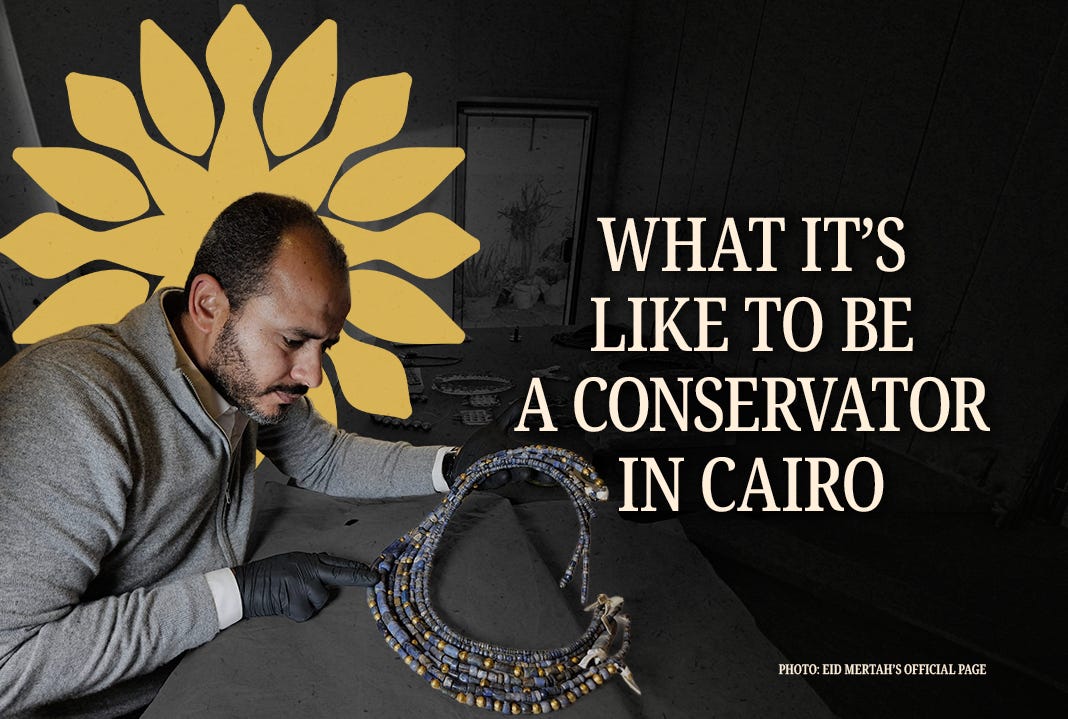
Now a conservator of archaeological materials at the Egyptian Museum in Cairo, Mertah, 36, has worked with hundreds of antiquities, including many from the tomb of Tutankhamun, the third-to-last pharaoh of Egypt’s 18th Dynasty. His career has taken him to archaeological sites across the country and exhibitions around the world, where he has restored objects ranging from painted wooden coffins and gilded shrines to bronze statues of Osiris and delicate papyrus scrolls. Each object presents its own challenges, but the guiding principle remains the same: work slowly and document every decision. “There is no space for mistakes,” he says.


The past decade has seen rapid advances in conservation methods, revealing hidden information in pieces after decades on display. Mertah is most proud of his work on Osiris statues from the first millennium BC.
Modern techniques, including portable X-ray fluorescence (pXRF) for elemental analysis and microscopy for surface examination, revealed traces of Egyptian blue, gold leaf, glass, and Lapiz Lazuli. After removing a thick crust of dirt, he uncovered facial features and decorative details from the statues, which were often given as offerings to the Egyptian god of the dead to secure a person’s passage to the afterlife.
A rush of excitement accompanies these discoveries. “You feel relieved when you bring something new for the audience and the object,” Mertah says. Working on priceless antiquities is a huge responsibility, but “you need to trust yourself.”
Mertah proceeds like a doctor, operating under the oath to ‘do no harm.’ He begins with a thorough analysis to determine the treatment direction. Everything from the object’s original condition to the methods and materials used must be meticulously mapped to provide a permanent scientific record for future research.
These days, conservators rarely make mistakes, but older methods have caused long-term damage. When papyrus scrolls were unearthed at burial sites in recent years, Mertah was able to restore those in good condition and stabilize pieces affected by insect and biological damage.
Environmental impacts are unavoidable, but many papyri found in the nineteenth and early twentieth centuries were severely degraded by acidity in the glue and cardboard supports used to display them. Fixing clumsy conservation work is time-consuming and “very frustrating,” Mertah says.
In the past, pieces were routinely scraped for samples, a practice that’s all but banned today as non-invasive modern technologies help secure the future of ancient treasures. Non-destructive techniques like multi-spectral imaging and portable X-ray fluorescence (pXRF) allow conservators to visualize microscopic details and identify an object’s composition.
The conservator’s aim is to preserve the object in its original form, but sometimes intervention is necessary to prevent further decay or fix previous errors. “It’s easier to deal with an object that has never been touched than to intervene when it has already been restored,” Mertah says.
New discoveries often emerge when pieces travel abroad. Mertah frequently collaborates on international exhibitions, which involves the often-overlooked but deeply delicate work of transporting collections overseas.
Packing ancient artifacts takes a team of specialists who carefully dismantle the objects and reassemble them on the other side. “We start with the easiest,” says Mertah. “We don’t always know what we’re going to find.”
This work taps into an internal dilemma for conservators. Alongside a duty to protect and preserve is the need to share ancient artifacts with the world. But public interest is secondary for Mertah. “You always care for the object before anything,” he says.
That’s why he supported the decision to move the Tutankhamun collection to a new facility in Giza. “It’s better for the objects—conditions at the new museum are of the highest standard.”
The Grand Egyptian Museum is the world’s largest archaeological facility for a single civilization. At its launch last November, the Tutankhamun collection was prominently positioned with the golden mask, throne, chariots, sarcophagus, and jewelry presented through a thematic and chronological narrative that guides visitors through the king’s life, death, and burial assemblage.
The presentation aims to evoke, as closely as possible, the original spatial arrangement of the objects, as they were when British Egyptologist Howard Carter discovered Tutankhamun’s tomb in 1922. At the time, more than 5,000 artifacts were brought to light, but only now is the complete collection on public display.
Watching the collection leave the Egyptian Museum, where it has been housed since Carter’s men transported it from the site in Luxor, was a poignant moment for Mertah, but other treasures still keep him occupied.
Despite re-homing many of its pieces to other institutions, the old museum still holds the world’s largest collection of Egyptian antiquities. The building is a piece of history in its own right, dating back to 1902, when it became the first purpose-built national museum in the Middle East. “We call it the mother of all the museums because every museum in Egypt has objects from here,” Mertah says.
Plans are underway to rearrange displays. “Now we focus on developing the Egyptian Museum to say it still exists. We still have the biggest collection of Egyptian art in the world, and we are trying to present it to the public in the right way,” Mertah says. Walking through these halls, he remembers his 12-year-old self gazing in wonder at relics from the boy king’s rule. Tutankhamun was just eight or nine when he ascended the throne. For the young Mertah, he was “a star” whose civilization achieved extraordinary feats. Now, as an adult, he is still trying to get closer to the ancient Egyptians, preserving artifacts that have survived for millennia so humanity can learn more about the fascinating people behind them.
Middle East Uncovered is powered by Ideas Beyond Borders. The views expressed in Middle East Uncovered are those of the authors and do not necessarily reflect the views of Ideas Beyond Borders.
An insightful article highlighting the significant role of archaeologist and restoration specialist Dr. Eid El-Barqi in preserving our cultural heritage and historical identity. His work goes far beyond archaeology and restoration; it plays an important role in safeguarding our collective memory and keeping our heritage alive for future generations. My sincere appreciation and respect for his dedication and invaluable contribution to preserving our history and civilization.