


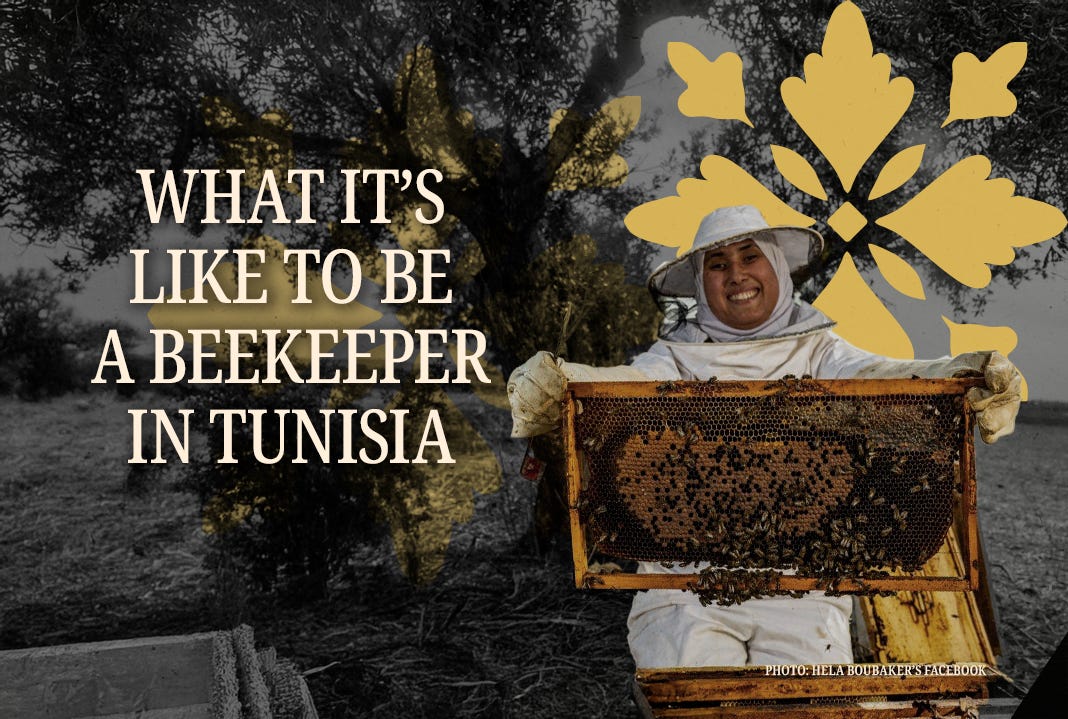
Hela Boubaker knows instantly when her bees are upset. The pitch of their buzzing indicates all is not well in the hive. A beekeeper must be attuned to dozens of these subtle noise variations. “I know if they are hungry, or the queen is sick, or if there is a lack of food in the area, and they need to be moved. It’s like a mother with her babies. I see these bees as my kids,” says Boubaker.
Her decision to work with hives followed a harrowing incident at her sister’s wedding in 2018. As guests laughed and chatted at the venue near their home in Manouba, Tunisia, the scent of sweet foods and juices attracted a swarm of bees. “It was summer, when it’s not easy for them to find food. They were probably stressed and hungry,” she says.
Everyone was stung, including Boubaker, who is allergic to bee venom. She spent the next few days in the hospital on oxygen, recovering from the attack.
The experience stirred something in Boubaker. Studying environmental sciences at university, she understood the risks facing bees in the wild, where estimates suggest that one in ten species faces extinction.
In Tunisia, where more than 300,000 hives are tended by around 13,000 apiarists, beekeeping is integral to the farming economy. Boubaker saw how her skills could benefit both bees and the communities that keep them. “I took it as a challenge to save bees,” she says.
Over the next few years, she developed a multi-pronged approach that would combine an emerging interest in beekeeping with her scientific background. Using the proceeds from her hives, she launched a project to support apiarists in rural Tunisia while developing digital devices to advance hive health.
Today, the 29-year-old owns 280 hives and visits them whenever she can. “Bees can detect whether you’re happy or sad. Instead of talking to my husband or father about what’s stressing me out, I go and speak to the bees,” she says.
Between her responsibilities as a beekeeper, her university studies, and an ongoing project to develop a non-invasive device for the extraction of bee venom, Boubaker’s days are full. But her hard work has already paid off.
In 2021, she was approached by the Ministry of Agriculture to lead a team tasked with developing beekeeping in Tunisia. They were intrigued by the news reports about her work in rural communities, helping local women become beekeeping entrepreneurs.
Boubaker teaches these women the art of beekeeping and connects them with buyers for honey and venom. One kilo of honey sells for around $30, while bee venom, valued for cosmetic and medicinal purposes, fetches around $60 a gram.
Hives cost around $150 each, but with careful upkeep, they provide a steady return. A single hive can produce three to four kilos of honey per year and around 200g of venom every three months—enough to support a family.
“These women are really grateful. They feel more worthy now that they are contributing financially and working on their own,” she says.
Boubaker visits a different village every day of the week, spending at least 3 hours on the road. The work is not for profit, and she often supplies their equipment herself. “It’s the way I have been raised. My mother was always deep in debt but insisted on helping others,” she says.
In these rural communities, patriarchal values prevent many women from seeking employment. Life is tough, and opportunities are scarce for mothers like Fatma, whose husband was reluctant to let his wife work.
Boubaker’s commitment and family-minded approach gradually reassured him, and Fatma now generates a stable monthly income. She is among 23 female beekeepers and 15 men benefiting from Boubaker’s support through an Agricultural Development Group (GDA), one of more than 2,700 such collectives across the country.
Boubaker’s GDA assists rural women across multiple income-generating activities, including beekeeping, farming, and business development. Since launching, she has forged ties with local authorities, regional institutions, and government ministries to open up fields that have traditionally been dominated by men.
Beekeeping is one such profession. “When I decided to enter the field, everyone was against it,” Boubaker recalls. Only her parents were supportive. Over time, friends and relatives witnessed the success of her project and saw the impacts unfold.
A government drive to support beekeeping in Tunisian communities, where the tradition often dates back generations, has enhanced her work. Every loan Boubaker secures from the bank is bolstered by a government subsidy, along with capacity-building initiatives, easy access to forage areas, and field visits available through local programs like hers. “Of course, the sector is not easy, but there is continuous encouragement,” she says.
Tunisia is already known for high-quality, natural honey. Now, Boubaker wants to raise the profile of its bee venom, often referred to as “bee gold” due to its potent composition and intensive harvesting methods. Research suggests that bee venom may offer a wide range of possible health benefits, from reducing inflammation to treating chronic illnesses.
“I intend to invest to make myself, Tunisia, and the rural women I work with remarkable players in this domain,” she says.
While most systems for extracting bee venom are manual and battery-operated, Boubaker’s Bee Venom Collector is a smart device that offers remote hive monitoring and accurate data on venom extraction in real time.
The machine stimulates the bee gently to extract venom without causing harm. It also assesses the bees’ mood. A stressed queen lays fewer eggs, while hungry worker bees become aggressive and prone to robbing other hives. Understanding these signals is crucial, says Boubaker. “The machine analyzes 36 bee sounds to detect whether the queen is stressed or happy, so we know when to stop extraction and when to resume it.”
It also contains a GPS tracker in case the hive is stolen.
Hive theft is common in Tunisia, where climate change presents new challenges for beekeepers. Some apiarists have resorted to stealing hives after losing their livelihoods to rising temperatures and fires. Police patrols have reduced crime rates in recent years, but creative solutions are needed to help beekeepers adapt.
This is where Boubaker’s approach comes full circle. She plans to make her device available at an affordable price to improve honey bee health and boost business for beekeepers in Tunisia as they confront a changing climate.
By 4am every morning, she is already on the road. The closest hive location is a 200-kilometer round trip, and she needs to get back in time for university, before working on the patent for her Bee Venom Collector in the evening. Finding time for her own bees is difficult, but these are the moments when she pauses and reflects on her work. In the eight years since bee stings landed her in the hospital, she has changed dozens of lives, including her own.
“I’m proud of my personal development,” she says. “I changed from Hela, the shy girl who only does what other girls are doing, to Hela, who founded a company and now helps other women achieve their potential.”


Middle East Uncovered is powered by Ideas Beyond Borders. The views expressed in Middle East Uncovered are those of the authors and do not necessarily reflect the views of Ideas Beyond Borders.