


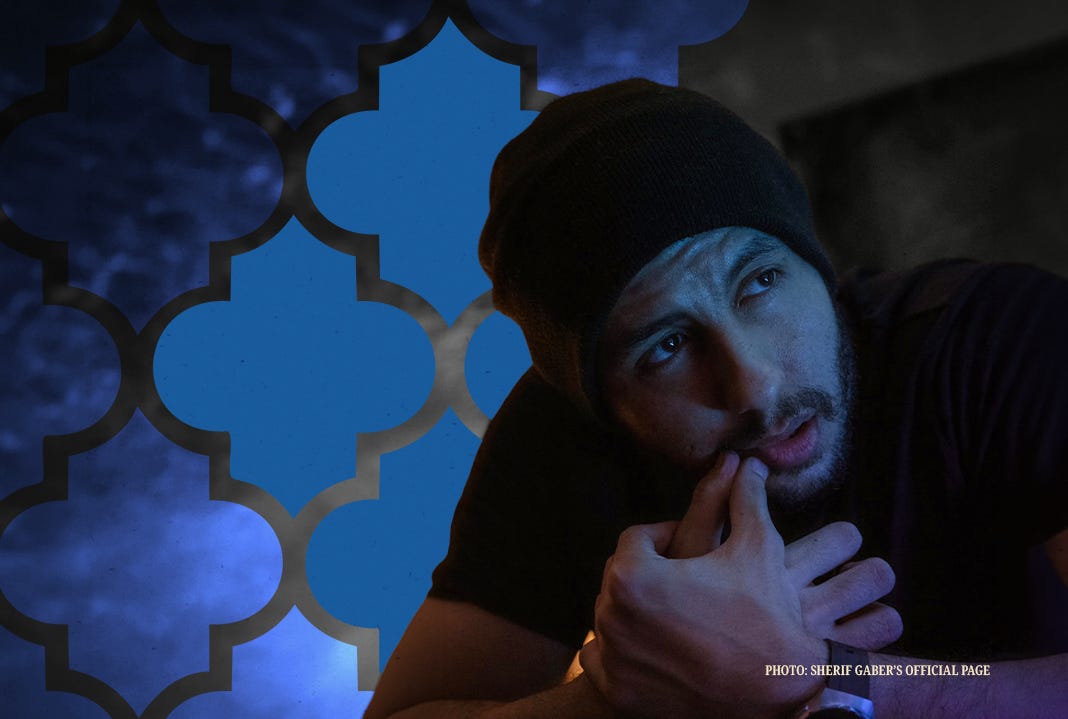
On October 6, 2025, Sherif Gaber, a prominent young Egyptian YouTuber, posted the following plea on X:
“I’m in dire need of a change in atmosphere.. and mindset.. and place.. and memories. I’m in need of recovery. I miss the social interactions and connecting with people. There’s something hurt inside me.. I think.”
This was not an ordinary request for a change of scenery. Gaber, who built a massive following as an atheist content creator in the Arab world, spent years in hiding from Egyptian authorities. He was prosecuted repeatedly over his criticism of religion and convicted of blasphemy in absentia, with sentences totaling nine years in prison.
By the time he posted his plea for help, Gaber was still in hiding and facing the prospect of arrest if authorities found him. It would be his last public communication. Shortly after the post, in November 2025, unconfirmed reports emerged that Egyptian authorities had arrested him as part of a broader crackdown on people accused of violating the country’s blasphemy laws. He has not been heard from publicly since.
Gaber had been jailed before. In 2013, while a college student, he was arrested and detained for allegedly “corrupting public morals,” after challenging his professor’s claim that homosexuality was a mental illness and that it was proper to hang homosexuals in the public square. Gaber objected to his professor’s characterization and confronted him in class. After the encounter, Gaber said, “I was insulted, demeaned, and made to fail after I had been at the top of my class.” The controversy eventually reached the university’s rector, who forwarded it to the local prosecutor, who arrested Gaber for promoting “deviant” behavior.
In one of his videos, Gaber recounts his experience spending a few days in Egypt’s notorious jail system:
“Imagine living in a 9-square-meter room with more than 20 people. Sleeping on your side if you can. Eating only once a day some stale rotten bread and a piece of cheese unfit for human beings, as you keep counting the time minute by minute.” He hints at sexual abuse by guards who “disrespected every part of me,” then pauses to regain his composure.
Far from breaking him, his imprisonment gave him clarity about his lifelong mission:
“Even after everything I’ve endured, I can’t hold a grudge against anyone,” he said in a 2018 reflection video. “It’s unreasonable to expect those raised in a toxic environment with flawed beliefs to recognize those flaws on their own—unless an external influence opens their eyes. They need a spark to help them see what those around them fail to see. Following my imprisonment, I decided to become that spark—someone who says what people are forbidden to hear and teaches what they are forbidden to know.”
In another country, or in another Egypt, Gaber could have found conventional success as an educator or a documentary filmmaker. But those paths were closed to him, so he turned to YouTube and found digital success as both.
Online, he hoped to bypass men like his professor and build a direct relationship with his audience. By late 2025, his channel had more than 520,000 subscribers, making it the largest Arabic-language atheist channel on YouTube, with videos that regularly exceed a million views.
He used his channel to promote gender equality and intellectual freedom, among other things, and to dispel widely held prejudices and superstitions. In one video, he implored Arab women not to accept a subordinate status: “How could you accept living such a life?” In others, he debunked stories of miracles and demonic possessions. He taught his audiences about the theory of evolution, drawing on ancient Greek philosophy and the history of science to show that the Quran’s supposed scientific discoveries are either untrue or borrowed from more knowledgeable sources. He went on an academic deep dive into the history of the hijab to argue that it did not always have the sacrosanct hold it does now, and he introduced viewers to scholarly works arguing that the Quran, far from being handed down directly by God, heavily copied Syriac Christian texts. For many Arabic-speaking young people, his channel was one of the few places they could engage with these questions and the research behind them. Gaber stayed true to his original vision to “teach people what they are forbidden to know.”
He also used humor as a communication tool, acting out skits and tackling questions like the problem of evil. Gaber parodied the keyboard jihadists ever-present on Egyptian social media, and mocked the Islamic fundamentalists living in the West who want to censor and imprison him while they themselves are protected by the West’s secular laws and institutions. The scripts are cleverly written, well produced, and undoubtedly a large part of why his messages traveled so far. At the height of his online fame, both Al Azhar and the Egyptian Coptic Church felt the need to release statements condemning the spread of atheism among the youth.
Gaber’s influence on the Arab youth is hard to measure, but his viewership count speaks for itself. Gaber himself seems to think that the pressure to arrest him is itself a sign of his impact: “This system is so fragile that if it didn’t persecute those who criticize it, then it will fall. The system is not based on science, nor logic, nor conviction, nor even love. The basis that holds this system together today is intimidation and persecution of anyone who criticizes it.”
The hostile videos in response to his work speak to his impact. Each of his uploads drew attention from Egypt’s online inquisitors and heresy hunters, but Gaber took their zeal as yet another indication of weakness: “When your work makes a dominant cultural majority react as though they are an embattled minority, that’s how you know that you’re bringing about real change,” he said in one video.
When one of his critics, convinced that Gaber’s videos were too well-produced to be the work of one man, accused him of being a Freemason puppet, Gaber responded with an extravagant 15-minute skit in which he meets his “handlers” (all played by himself) around a table in a dark, smoky room to debate what to do now that they’ve been “discovered.” “We are here to spread freedom and corrupt the public’s morals,” all the agents around the table say in unison at one point in the video. He invented a screenwriter named Levy, which he also voices, to playfully mock the recurring accusation that he’s secretly working for Israel.
Despite his characteristic sarcasm, there is a remarkable quality of innocence and earnestness in his work: “I won’t force anyone to listen to me, nor threaten them with hellfire if they don’t. I will simply speak. That is all I need to do.” He has the simple and convincing aura of someone who truly believes the values taught in an intro to science class: that a claim survives on its evidence or it doesn’t, and that no title, however sacred, exempts an idea from having to prove itself: “If an idea is true, it needs neither reward nor punishment to be convincing.”
Those platitudes about the marketplace of ideas, so often invoked to defend one’s allies and discarded the moment they might protect someone else, were convictions Gaber actually lived by. He built an entire career around the belief that ideas should survive or fail on their merits, and eventually received a prison sentence for putting that belief into practice.
Gaber never hid his atheism. That transparency made him an easy, and eventually favorite, target for one man in particular: Al-Haytham Hashem Saad, a lawyer affiliated with the Salafist Al-Nour Party, who made arresting and silencing Gaber a personal obsession of his. In 2018, Saad filed a complaint accusing Gaber of “assaulting the Islamic religion” and “mocking the divine self and the Prophet.” Six years later, Saad’s lawsuit produced the sentence that landed him in prison. Saad called the verdict “a vindication of the values of Egyptian society.”
Gaber’s case did not happen in isolation. The Egyptian Initiative for Personal Rights (EIPR) documented that the campaign began in mid-September 2025, with the arrest of another YouTuber known as the “Mufti of Humanity”—Maged Zakaria Abdel Rahman—who was held incommunicado for ten days before his family learned where he was. Security forces then moved outward, arresting people simply for appearing as guests on his channel or posting in a Facebook group called the Arab Atheists Network and Forum. By January 2026, EIPR had documented 26 people charged in that case alone, on charges of “joining a group founded in violation of the constitution and the law” and “publicly assaulting one of the religions whose rites are practiced openly.” One prisoner died in custody; fellow inmates reported it to prosecutors in January 2026. Egyptian authorities have offered no explanation. Only a few weeks after Zakaria’s arrest, Sherif Gaber disappeared, bringing the total number of people EIPR tracked under this single campaign to 52 in just three months.
Egypt’s government has released such prisoners before, but only when there were reputational costs to keeping them detained. It responded when the University of Bologna claimed the Coptic human rights activist Patrick Zaki as its own, and when Vienna’s Central European University did the same for Ahmed Samir Santawy. It responds to diplomatic pressure tied to money it needs, and to the embarrassment of being singled out by Western educational institutions that it desperately wants to be associated with.
But Sherif Gaber has no foreign passport, no foreign enrollment, no government invested in bringing him home. What he can count on instead is the admiration of fans like myself, and the solidarity of the small number of organizations, like the one running this publication, that share his commitment to intellectual freedom without qualification. Scientific and research institutions exist, in principle, to defend exactly this: the right to question, to publish, to follow evidence wherever it leads, regardless of whose doctrine it offends. If that commitment means anything, it should extend to the man now imprisoned for practicing it in public.
In October 2025, Egypt joined Horizon Europe, the European Union’s roughly €95 billion research and innovation funding program, becoming only the second African country admitted, despite concerns over academic freedom. Reporters Without Borders ranks Egypt thirteenth from the bottom worldwide, between Cuba and Afghanistan. Meanwhile, foreign universities are already embedded in Egyptian higher education through private institutions. The German University in Cairo is a private Egyptian university backed academically by German public universities such as Ulm and Stuttgart. The British University in Egypt has its degrees validated by partner UK universities. The American University in Cairo regularly receives U.S. government funding.
Every one of these institutions claims to stand for the values Gaber has risked prison for: free inquiry, the right to question inherited belief, the right to follow an argument wherever it leads. None have condemned his arrest. They should, and they should do so loudly.
Before he disappeared, Gaber mourned his channel’s original aspirations in his last YouTube video:
“I wanted to travel the world with you, to explore it all through my camera, and to show you how beautiful this world really is. I wanted to take you to museums, show you the fossils, and have you all see that there is much to the world that we don’t fully understand.”
Instead of exploring the museums of the world, that young man is likely sleeping tonight in an overcrowded Egyptian prison cell, facing the possibility that the years he hoped to spend discovering the world will instead be spent behind bars.
Middle East Uncovered is powered by Ideas Beyond Borders. The views expressed in Middle East Uncovered are those of the authors and do not necessarily reflect the views of Ideas Beyond Borders.
