


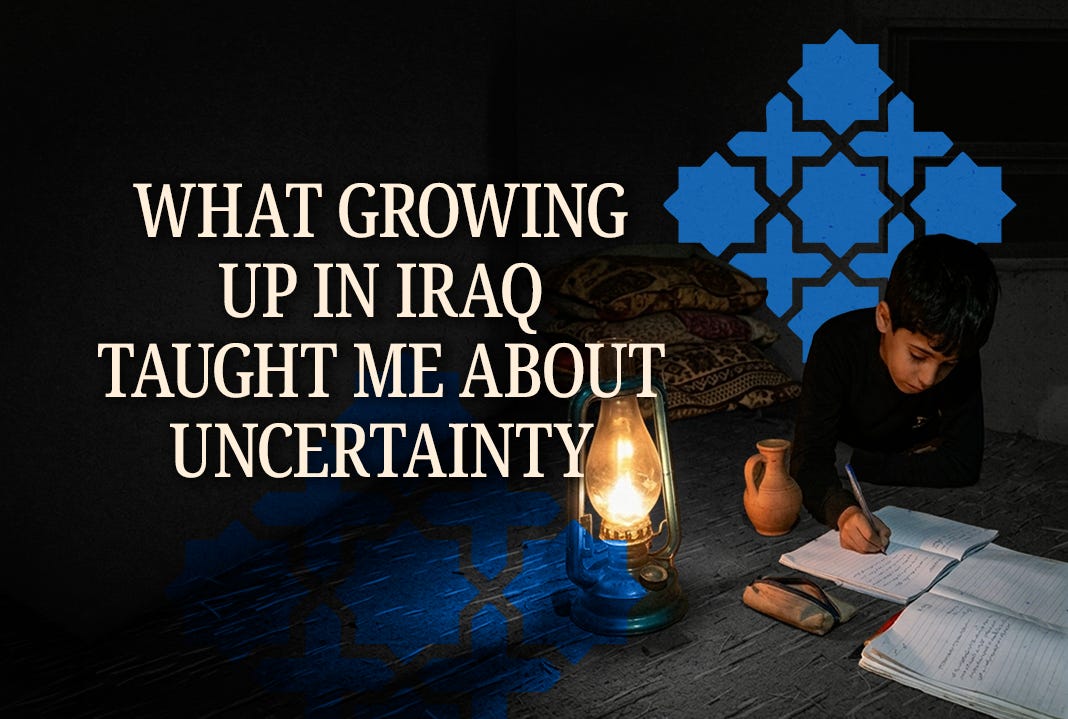
It was March 2012 in Baghdad, Iraq, and I was busy preparing for my final-year baccalaureate exams. Electricity came in predictable halves, twelve hours on, twelve hours off, enough to plan around, enough to study by. I remember opening Facebook and seeing a headline that felt almost unreal: the Ministry of Electricity projected that by 2013, Iraq would not only meet its own electricity needs but export surplus power. I went back to my books with a sense of direction, as if my effort and time were finally aligned.
Fourteen years later, the power still goes out at nine in the evening. Five minutes later, it is back, courtesy of Abu Karrar’s neighborhood generator, and I go back to doom-scrolling and watching mediocre TV with the family. No one is phased by the outages anymore.
Growing up in Iraq teaches you things no classroom ever will. Plan for every scenario. Trust very little. Hope for the best—and inshallah, it will work out. Or at least, will work out enough to get by.
To understand Iraq, you have to look not just at what its people lack, but at what they have built to fill the gaps.
Abu Karrar owns two power generators and is one of the neighborhood’s unofficial bosses. He is quietly resented by everyone, but openly challenged by no one. His electricity subscription runs year-round, costing $30 to $100 per household per month. In winter, when the government grid manages only 18 to 24 hours of supply, paying feels almost wasteful. But summers in Iraq are always right around the corner. When June arrives, and temperatures climb past fifty degrees Celsius, the grid buckles under millions of air conditioners running simultaneously, and supply drops to eight or twelve hours a day. The subscription that felt unnecessary in January becomes a lifeline in July.
This is just one way Iraqis hedge against a system that continues to fall short.
Consider a dull February afternoon. My salary hits the bank account, and I head out to withdraw it. The teller greets me with the expression of someone who’s been personally wronged. I smile anyway. Sometimes the withdrawal goes through after a brief interrogation—questions that have nothing to do with my account, my salary, or any discernible regulation. Other times, I leave empty-handed, told there are “extra fees” to access my own money. Transferring funds abroad—say, to pay a friend back or cover university tuition—is an entirely separate ordeal, best approached with patience, a full afternoon, and low expectations. This isn’t an exceptional experience. It’s a Tuesday.
In November 2024, nearly 90 trillion Iraqi dinars, about $69 billion, representing around 92% of Iraq’s total money supply, remained outside the banking system, according to former Central Bank of Iraq official Mahmoud Dagher. Additional unquantifiable amounts are stored in gold, worn as jewelry, or kept at home. Gold cannot be rendered inaccessible overnight, as many discovered during Lebanon’s 2019 financial crisis, when savings became effectively untouchable. The generation that lived through the UN sanctions of the 1990s, when the Iraqi dinar lost so much value that people weighed their salaries rather than counted them, does not need an economics degree to understand why. As the saying goes in Iraq, “A woman’s jewelry is not an aesthetic choice. It is her portfolio.”
The logic of holding into gold extends beyond the bedroom safe and into marriage contracts themselves. In Iraq, as across much of the Arab world, a marriage proposal traditionally includes a dowry, or muqadam, a sum paid by the groom to the bride, typically in gold. The clichéd explanation is that it honors the bride. The more honest one is that it functions as a financial guarantee in a society where guarantees are scarce.
The muqadam is a down payment against uncertainty: a formal acknowledgment that if the marriage fails, if the groom has a change of heart or walks away, the bride is not left with nothing. It is contingency planning, written into the wedding contract. Today, as gold prices rise sharply, that tradition is becoming a barrier to entry, with fewer couples able to afford to get married.
Young Iraqis who want to marry find the expected dowry amount increasingly out of reach, and engagements are delayed or abandoned. Not for lack of feeling, but for lack of liquidity. The “golden cage,” as Iraqis sometimes call marriage, has never been more expensive to enter, partly because the metal that built it keeps getting more valuable, and nobody wants to be the generation that stops the tradition.
The side hustle completes the picture of a society that operates on contingency plans. Ask a professional in Iraq what they do, and you’ll often get more than one answer: a government engineer who imports spare parts, a schoolteacher who gives private lessons, a doctor who works in a public hospital by day and represents pharmaceutical products on the side, a public official who speaks in careful, conservative terms in formal settings but, in smaller circles, reveals a far more liberal set of views.
Officially, only about 2% of Iraqis hold more than one job, according to the Iraq Labor Force Survey 2021 (ILO), but this reflects only declared, formal employment.
The gap between that figure and what any Iraqi sees every day tells a clearer story: people have quietly built a parallel economy alongside the official one, driven by the simple understanding that a single income—in a country where salaries can freeze and emergencies arrive unannounced—is not enough.
Open the door to the storage room of almost any Iraqi home, and you are likely to find a curated archive of every crisis survived and every emergency anticipated. Large aluminum pots for cooking for forty, in a household of five. Cardboard boxes from appliances purchased 15 years ago. A suitcase inside a suitcase inside another suitcase. An old stereo, cord carefully wrapped. 15 stacked mattresses. Screwdrivers of every size, some rusty. Boxes whose contents no one fully remembers, preserved by the logic that says, “If we kept it this long, there must have been a reason.” Hoarding isn’t an Iraqi phenomenon per se, yet in this context, every object is a hedge against the next disaster.
But the archive is not only made of objects. During the worst years of sectarian violence and suicide bombings, a discreet and largely undocumented practice spread across Iraqi families: sending siblings to different schools. Not for academic reasons, but for the same reason a financial advisor tells you to diversify your assets: if one fails, the other holds. If one school was bombed, the other child would survive. No study has captured this formally, no policy paper has documented it, yet ask around in Baghdad, and all over Iraq, and you will find it in nearly every circle. A cousin, neighbor, or friend whose parents made that calculation without naming it, because naming it would have meant saying out loud what everyone knows but doesn’t want to admit: “Our children are not safe here.”
The same instinct, operating at scale, occasionally backfires. In March 2025, when Iran halted gas exports to Iraq after strikes on its gas fields, Iraqis felt the ripple before the lights had flickered even once. People flooded the markets, not just for food, but also for oil lamps, relics of the 1990s sanctions era that had sat gathering dust for fifteen or twenty years. Within hours, a lamp selling for $1 was selling for $7.50. Less than two days later, Iranian gas exports resumed, the lights stayed on, and the lamps went back into the storage room—joining the forgotten mattresses and screwdrivers to collect dust for another decade. Seven and a half dollars, successfully wasted, and a missed opportunity to tell our children we once worked under lamplight—the same story our parents used whenever we needed motivation, and they needed leverage.
We survived Saddam Hussein, the civil war, and ISIS, but we may not survive our own mothers buying up all the rice, beans, and oil lamps.
The outermost layer of the Iraqi contingency is the exit plan. A growing number of families own property abroad, in Turkey, Jordan, or a flat in a mid-sized European city, not because they plan to leave, but because having it means they could do so in case the worst happens. The numbers reflect this: Iraqis rank fifth among foreign property buyers in Turkey as of November 2025, according to the Turkish Statistical Institute.
Acquiring a second passport is common, and it follows the same logic: acquired through investment or ancestry, held discreetly, renewed faithfully, and valued for what the Iraqi passport simply cannot offer. Iraq’s travel document ranks among the weakest globally, a fact that needs no elaboration for anyone who has stood in a visa queue and watched others walk through doors that remain closed to them.
Since 2005, Iraqi law has permitted dual citizenship, making it legally and practically viable to hold a second passport as a form of mobility and insurance. Since 2017, advisory firms have reported sharp increases in Iraqi applications for citizenship-by-investment programs, with interest rising during periods of instability. For those who can afford it, a second passport is another long-term hedge—a way to secure movement, access opportunities, and keep an exit option open if it’s ever needed.
In Iraq, stability is pieced together from whatever is available: a second income, a quarter kilo of gold, a safe in the closet, a phone call answered on the first ring, an oil lamp kept just in case. It isn’t assumed or inherited.
And in the corner of the storage room, behind the suitcases, there is an A3-sized family portrait from the late 1990s. The photographer instructed everyone to smile, and they did, two, perhaps three generations, lined up together, composed and present, despite everything crumbling around them. Wars, shortages, uncertainty. They lived anyway. They nurtured, planned, and adapted, and somewhere in that photograph is the origin of Iraq’s parallel economy. The need for contingency was not a burden they chose. It was an inheritance they had no choice but to pass on to the next generation.
Right next to it, there is just enough empty space where something used to be. Someone, finally, threw it out. It is a small revolution. It is a start.
Middle East Uncovered is powered by Ideas Beyond Borders. The views expressed in Middle East Uncovered are those of the authors and do not necessarily reflect the views of Ideas Beyond Borders.

Helpful insider look at Iraqi life. I really hope ways can be found to foster the sound economic development the country needs.