


As Iran’s players left the pitch after their World Cup clash with Belgium on Sunday night, the 0-0 draw was being dissected across sports channels, social media and fan forums around the world.
For Rozita (not her real name), sitting in Tehran after months of war, blackouts, and uncertainty, it barely registered. “We really don’t care about them,” she says of Iran’s national team. “Ever since the Mahsa revolution, we don’t care about them because they’re all standing at the side of the regime.”
Rozita and I have been exchanging messages since January, during the wave of protests sparked at the end of December 2025, following the dramatic collapse of Iran’s currency.
The conversation continued through the war, amid sporadic internet connections, air raid warnings, and, more recently, a fragile ceasefire. Even now, with international delegations meeting in Switzerland in an effort to consolidate the truce and prevent a return to conflict, football remains an afterthought.
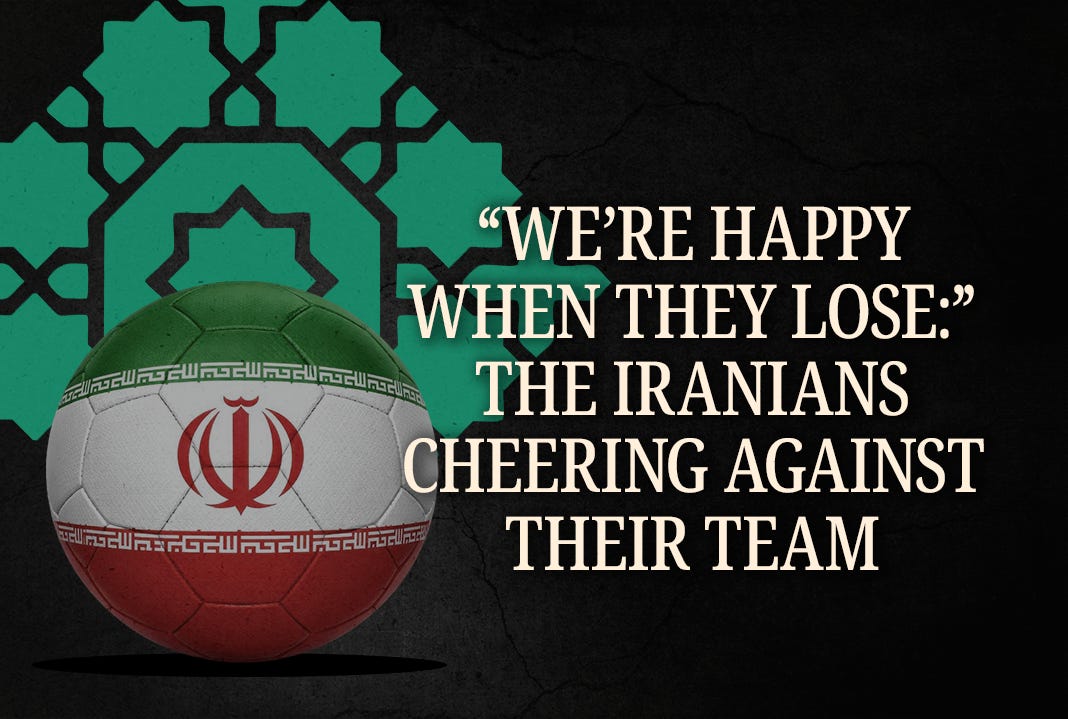
“Most of us didn’t know their names,” she says of the players. “My friends and I, we don’t know when the games will be held. We don’t care. We’re happy when they lose.”
Rozita’s view reflects a fracture that has opened up among Iranians both at home and abroad. Once a rare source of collective pride that transcended politics, Team Melli has become entangled in the bitter arguments surrounding the Islamic Republic, the Women, Life, Freedom (WLF) protests, and the future of the country itself.
That divide was visible before Iran’s opening World Cup match against New Zealand in Los Angeles. Iran’s team arrived in LA on Sunday, June 14 after taking a short flight from their training base in Mexico. At their hotel, they were met by a huge police presence and protesters waving pre-revolution flags.
At a press conference at the LA stadium, Iran’s captain, Mehdi Taremi said this experience was different compared with previous tournaments. “I have felt the tensions as soon as I arrived,” he said. That tension “undermines” the joy usually felt during the tournament and it “undermines the message of FIFA and our people, which is [that] football brings peace”, Taremi added.
The tensions followed the squad throughout their preparations. Iran’s delegation reportedly encountered visa difficulties and travel restrictions, with several members denied entry to the United States. After a 2-2 draw with New Zealand, head coach Amir Ghalenoei described his side as “the most oppressed” team at the tournament.
“He is right. Iranians are playing under draconian conditions,” says historian Dr Arash Azizi, author of What Iranians Want: Women, Life, Freedom. “Even before the tournament began, they were given a hard time and couldn’t train on their desired schedule. Not to mention, like their compatriots in Iran, many players had to live through months of war. Conversely, they’ve been given such a beautiful welcome in Tijuana and I hope it adds to a more lasting Mexican-Iranian friendship.”
The US has now eased restrictions on Iran’s World Cup team, allowing the squad to travel two days before its next match.
Yet while the team complains of political pressures, many of its critics argue that the rupture between Team Melli and sections of the Iranian public began long before the tournament.
The turning point was the death of Mahsa Amini in September 2022. The 22-year-old Kurdish woman died in the custody of Iran’s morality police after being detained for allegedly violating hijab regulations. Her death sparked the largest anti-government protests in Iran for decades.
Initially, members of the national team appeared to stand with the demonstrators. Some players, including striker Sardar Azmoun, publicly criticized the state crackdown. Before Iran’s World Cup match against England in Qatar later that year, the players declined to sing the national anthem, a gesture widely interpreted as solidarity with protesters.
But as the tournament progressed, that support appeared to fade. Whether through personal conviction, political pressure or simple self-preservation, many players adopted a lower profile. For some former supporters, that shift amounted to a betrayal.
Rozita shares with me an Instagram post from a self-described former supporter of Esteghlal, a Tehran-based team. Reflecting on the WLF movement, he writes that he is angry with the club because it had “strayed from the path and customs” associated with Nasser Hejazi, the legendary goalkeeper long admired for his independence and willingness to challenge authority.
Rozita also refers to the national squad as the “mullahs’ football team”, a label that has become increasingly common among some opponents of the regime.
Football remains Iran’s most popular sport and Team Melli continues to command enormous support. Yet for many activists, especially those shaped by the events of 2022, the national team no longer occupies a politically neutral space.
Haleh Blake, co-founder of the activist group United4Mahsa, describes herself as a lifelong football fan. Her mother used to sneak into stadiums dressed as a boy during the years when women were banned from attending matches.
“My husband is into football and we always had parties during the World Cup,” she says. “However, the last tournament was during the Women, Life, Freedom protests, where over 650 people were killed [in November], so I stopped supporting the team.
“The team is used as a political tool—it’s not just a sport.”
She also objects to FIFA’s ban on the pre-revolution flag inside the World Cup venues, adding: “That is our identity for over two thousand years.”
Dr Azizi argues that expecting footballers to become political standard-bearers is unrealistic. “Footballers will always come from a range of opinions,” he says. “It would be bizarre for Americans not to support the US team based on how many Republicans or Democrats there are in it.”
For Azizi, Team Melli remains a national institution rather than a state institution.
“Supporting Team Melli is supporting our boys, members of this nation who are playing for their country on the world stage,” he says. “It is unfortunate that some Iranians don’t support Team Melli and some even actively cheer against it. In my opinion, you should support the national team regardless of their politics.”
Azizi acknowledges that attitudes have changed since the WLF movement, but sees this as part of a broader erosion of faith in national institutions. The split is perhaps most visible within the diaspora, where political disagreements are often expressed more openly than inside Iran itself.
While anti-regime protesters dominated television coverage around the opening match in LA, Azizi notes that many supporters in the stadium also carried the pre-revolution Lion and Sun flag while cheering for the national team. Opposition to the government did not necessarily translate into opposition to the players, he says.
“There were actually very few who chanted against Team Melli,” he says. “It shows you the team is probably much more popular than some would have you believe.”
History offers plenty of precedents, Azizi explains. Exiled communities have frequently struggled with the question of whether national teams represent a people or a government. Syrians were divided over supporting their football team during the recent civil war. Cuban-Americans argued over the Cuban national baseball team when it played in Miami in 2023.
Azizi’s defence of Team Melli is shaped not only by his politics but also by a lifelong connection to Iranian football. In fact, Iran’s current manager was once his coach.
“In my teen years in Iran, I signed up for an Esteghlal football school that was run by Ghalenoei. He personally trained us every day and had a great rapport with us,” he tells me. “He was also well-read and often liked to discuss history and politics and also global football with students who had similar interests such as myself.”
Alas, Azizi seemed more suited to a life off the football pitch. “I remember [Ghalenoei] telling me ‘You should quit football and go do something to do with writing or academia’ which is what I ended up doing with my life!”
That personal connection has not prevented him from criticizing the Islamic Republic. But it does help explain why he rejects the notion that the national team belongs to the regime alone.
Echoing Azizi’s sentiments is Atbin Arian. Though a vocal opponent of the Islamic Republic, he believes fans should stand behind the national team. While he acknowledges supporting Team Melli is “rife with conflict,” he insists that it is possible for Iranians to simultaneously support the team and still be against the Islamic Republic.
He encourages fans to boo the “false” national anthem and bring the pre-revolution flags, instead of booing the players. “We have to separate the players from the regime,” he says on Instagram. “Yes this is a heavily politicized team… but the players are not at fault for the massacre that took place in January.”
Back in Tehran, Rozita’s concerns are more immediate than football. Earlier this year, during one of the most uncertain periods of the conflict, she messaged: “We are scared.”
Like many Iranians, she spends more time thinking about inflation, emigration, and political repression than football results. That reality helps explain why the World Cup carries such different meanings depending on who is watching.
For some, Team Melli remains a symbol of national pride, one of the few institutions capable of uniting Iranians across political divides. For others, the players have become inseparable from a state they believe has betrayed its own people. In this World Cup, Iran’s opponents are not only the teams lined up across the halfway line. The national side is also playing against years of accumulated anger, disappointment, and distrust.
Clearly, football still matters deeply, even when many of the people arguing about it insist that it no longer matters at all.
Middle East Uncovered is powered by Ideas Beyond Borders. The views expressed in Middle East Uncovered are those of the authors and do not necessarily reflect the views of Ideas Beyond Borders.