


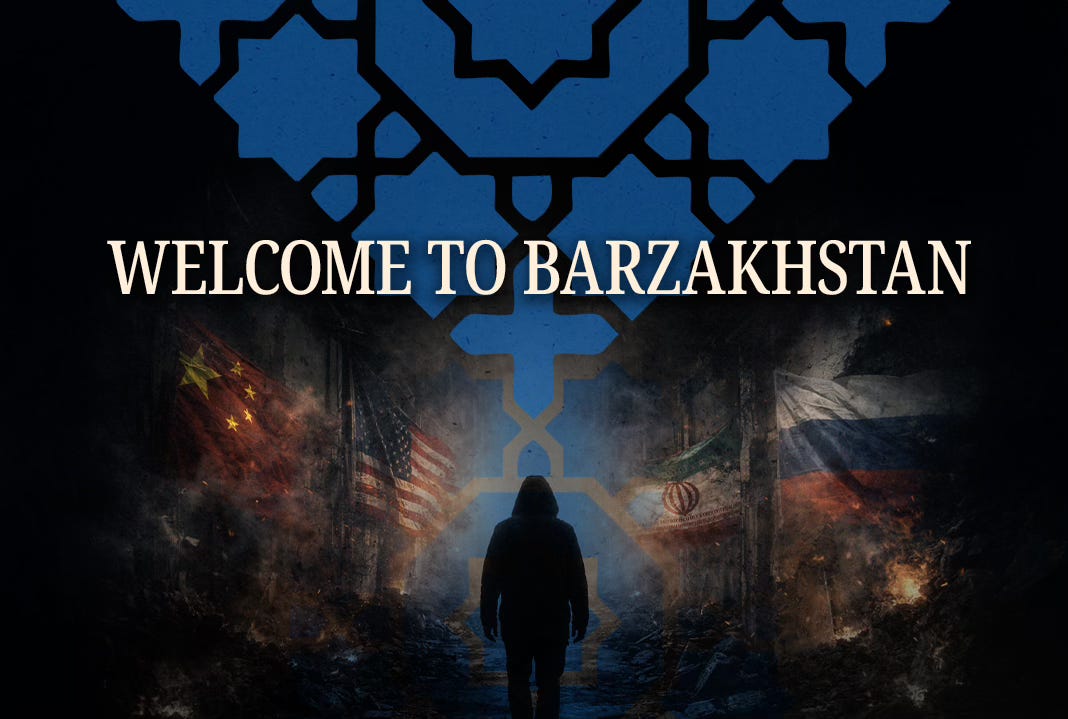
War with Iran. Proxy escalation in the Levant. Great power maneuvering from Moscow to Washington to Paris and Beijing. Sanctions, shadow fleets, drones, assassinations, and covert deals. This is not chaos. This is transition.
We are seeing what a multipolar world looks like where power is no longer in the hands of a single hegemon but distributed among a constellation of actors. This is where the idea stops being a theory and becomes the driving force behind international politics.
Islamic theology presents the idea of barzakh, which refers to a middle realm—the suspended space between death and resurrection. That is where we are today: no longer in the American-led order, not yet in a multipolar one, but caught in an unstable passage between these two states.
Here, power does not disappear. It fragments.
In a multipolar world—rather, in the barzakh leading to it—imperial logic prevails.
Not formal empires with flags and colonies, but spheres of influence, leveraged via energy chokepoints, trade wars, technological advances and geography.
In this dispersed world order, trade is the overriding currency. Security is exchanged for access, oil for weapons, votes for protection, and silence for safety. It is survival of the adaptable, where inflexible, ideologically driven regimes struggle to survive.
To flourish, you must do business. Nowhere is this clearer than in the Levant and Iran, historic gateways at the crossroads of empire. Here, survival has always depended on managing the ambitions of surrounding powers: Rome and Persia. Ottomans and Safavids. Britain and France. The United States and Russia. Now China, Turkey, the United States and the Gulf.
The rule is simple: if you cannot balance competing interests, you become battle terrain.
For all its defiance, this is exactly what the Islamic regime has done to Iran. Through its inflexibility, Iran’s rulers have transformed it from a regional contender into a battlefield, bypassing opportunities to recalibrate and adjust.
For movements built on disruption and resistance, the adjustment is harsher. In a transactional multipolar world order, there are no permanent friends, only temporary patrons. These causes become instruments as militias morph into subcontractors and their ideology becomes branding.
Over time, many such movements mutate. They survive not through popular legitimacy but through underground revenue streams, trading in smuggling, drugs, human trafficking, espionage, and protection rackets. True believers fill the ranks. Crime lords manage the finances. The rhetoric remains revolutionary but the structure resembles organized crime.
In a fragmented world order, multipolarity does not eliminate resistance. It professionalizes, and often corrupts it. So, what of democracy? The institution that has dominated Western politics for decades will come under strain, incapable of absorbing the new imperative for pure transaction.
In places where democracy has strong institutional roots, this will resemble a crisis of confidence. Voters will grow cynical and polarization will intensify as transactional geopolitics tempts leaders to sacrifice principle for advantage. In time, democratic societies will be forced to renew themselves to remain relevant, or relinquish their foothold and hollow out from within.
Where democratic roots are weak, democracy will continue to hover beyond reach. Leaders will invoke sovereignty in the name of stability and citizens will be told to wait for security, growth and order. The waiting can last generations.
The transition to multipolarity is no clean reset. It is not the birth of a just equilibrium among civilizations. It is a renegotiation of power—conducted the way power has always been secured: through war, diplomacy, coercion, cooperation, and competition.
The end result will not be less flawed than the current order. It will simply be flawed differently. Eventually, there will be room to reassert principles and to rebuild norms but that moment will not arrive automatically. It will have to be fought for, intellectually and politically, inside societies as much as between them.
For now, we are in a free-for-all transition. The question is not whether multipolarity is coming. It is whether democracies can survive this transactional age without relinquishing their principles and becoming transactional at the core.
One way this will be tested is through the use of force. During the post-Cold War era, military action was justified through imminent threats—a regime about to attack, a terrorist network preparing a strike, or weapons programs crossing a red line.
In a transitional multipolar environment, the calculus broadens. Military action is not just for immediate danger. It is summoned by long-term positioning: containing an adversary before it consolidates power, securing critical corridors and supply chains, protecting access to energy and strategic minerals, reinforcing alliance systems, or denying rivals a technological or military advantage.
These are not threats that are easily grasped by the public. They unfold slowly, across regions and decades.
The temptation for governments is to argue that strategic action cannot wait for prolonged public debate. We see this playing out in the contest over Taiwan, where supply chains, maritime corridors, semiconductor dominance, and the balance of power across the Pacific are setting the timeline for China’s next move.
And we see it in the United States, where democracy appears to have been supplanted by strategic imperatives. The current war with Iran, initiated without explicit congressional authorization, has triggered a heated debate over executive war powers and constitutional limits.
For supporters, the strategic rationale is clear: preventing Iran from reaching a tipping point in missile and nuclear capabilities and reshaping the regional balance of power justifies the actions taken. Critics respond that no imminent threat was demonstrated and reiterate the constitutional requirement for Congress to authorize war.
Both arguments reveal a deeper tension.
Democratic systems were designed for an era in which war was exceptional and clearly defined. Multipolar transitions are messier. They generate gray zones where strategic calculations collide with democratic procedures.
At the same time, the United States is entering this transition under conditions of intense polarization. Republicans and Democrats now interpret foreign policy primarily through the lens of domestic political competition. As each side mobilizes its base, narratives harden and nuance disappears. Facts are selectively deployed and strategic debate collapses into partisan signaling.
When that happens, democratic norms begin to erode—not because democracy has failed, but because it is struggling to operate under conditions it was never designed to withstand.
Yet this conversation cannot be avoided indefinitely. At some point, American political leadership will need to re-establish a minimal strategic consensus—a recognition that certain principles and procedures must remain intact even as the geopolitical environment becomes more volatile.
Without such a framework, the transition to multipolarity will not only reshape global power. It will destabilize the democratic systems meant to manage it. And so we return to the condition of barzakh, an in-between world where the old system has lost authority but the new one is not yet legitimate. The question is whether we can cross over without losing the principles that made the previous order worth defending in the first place. Because if we cannot, the world that emerges on the other side will not merely redistribute power. It will redefine our concept of legitimacy entirely.
Middle East Uncovered is powered by Ideas Beyond Borders. The views expressed in Middle East Uncovered are those of the authors and do not necessarily reflect the views of Ideas Beyond Borders.
Very powerful essay - it should be read widely by politicians across the globe.