


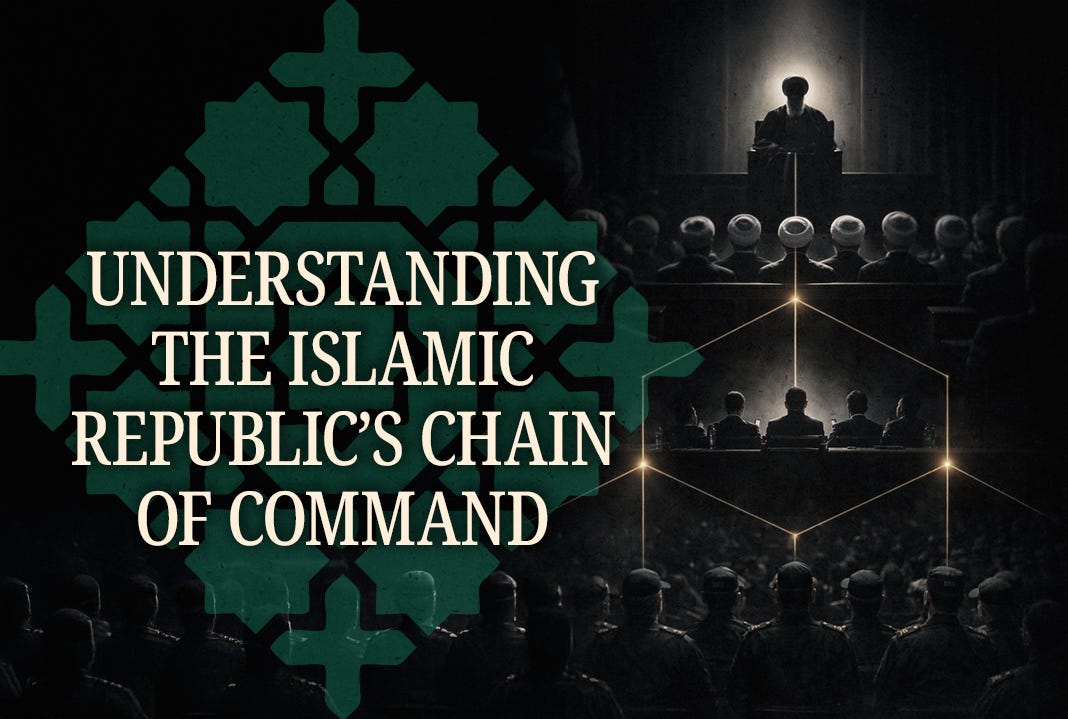
Iran’s political system is often described as complex and opaque, but beneath that complexity lies a deliberate architecture. The Islamic Republic is neither a conventional dictatorship nor a normal republic. It is a hybrid order that combines elections with clerical guardianship, public participation with strict ideological supervision. To understand how Iran functions, it is not enough to track who wins elections. The decisive question is where ultimate authority resides and how directives move through the chain of command.
At the center of this order stands the Supreme Leader, known in Persian as Rahbar or more formally Rahbar-e Moʿazzam. The position was created after the 1979 revolution under the doctrine of Velayat-e Faqih, or the Guardianship of the Islamic Jurist. This doctrine holds that in the absence of the Hidden Imam, a senior cleric must assume final responsibility over the state. The Hidden Imam, or Muhammad al-Mahdi, is the 12th and final Imam in Twelver Shia Islam, believed to be a messianic figure who went into divine hiding (occultation) in 874 A.D. to escape persecution. To believers, he is expected to return at the end of time to restore justice and peace and defeat evil, acting as humanity's ultimate guide. The concept holds strong political relevance, particularly in Iran, where it has inspired revolutionary thought and is central to the country's religious identity.
In practice, the Supreme Leader appoints the head of the judiciary, the commanders of the armed forces, the intelligence leadership, and the heads of major state media institutions. He defines the broad direction of domestic and foreign policy and serves as commander in chief. Iran has a president and a parliament, but both operate within parameters set at the apex of the system.
The relevance of that structure has become especially visible in the last twenty-four hours. Following coordinated U.S. and Israeli strikes on Iranian military and strategic sites, including facilities tied to the country’s security establishment, Iran’s response is not stemming from parliamentary debate or presidential initiative. Retaliatory missile and drone launches against U.S. positions and allied targets across the Gulf were directed through the Supreme National Security Council and executed by the Islamic Revolutionary Guard Corps (IRGC). Public statements from Tehran reflected a unified line. In moments of acute external threat, the architecture of command goes like this: the presidency manages messaging and diplomacy, but strategic military decisions originate higher up and flow downward through clerical and security channels.
Iran’s elected institutions do matter, but they are not sovereign. The president, or the Rais-e Jomhur, is chosen by popular vote and runs the executive branch, oversees the budget, appoints ministers, and represents Iran abroad. Yet on core issues such as war, peace, nuclear policy, and the structure of the armed forces, his role is circumscribed. Parliament, the Majles-e Shoraye Eslami, debates and passes laws, but legislation must pass through unelected oversight bodies before taking effect. The Assembly of Experts, a clerical body elected by the public and formally tasked with supervising the Supreme Leader, operates discreetly and has historically affirmed the existing order rather than moderating it.
The most consequential filter on political life operates before ballots are cast. All candidates for major elected offices must be approved by the Guardian Council, the Shoraye Negahban. This unelected body reviews parliamentary legislation and can reject laws it considers incompatible with Islamic law or the constitution. More significantly, it vets candidates for the presidency, the parliament, and the Assembly of Experts. Those judged insufficiently aligned with the system’s ideological foundations are disqualified. Elections, therefore, unfold within a bounded spectrum. Citizens choose from options that have already been screened for reliability.
The judiciary, or Ghove-ye Ghazaiyeh, reinforces these boundaries. Its leadership is appointed by the Supreme Leader, and it functions as both a legal and ideological institution. Special courts handle political cases and clerical matters, including the Special Clerical Court, Dadgah-e Vizheh-ye Ruhaniyat, which operates outside the standard judicial framework. Through prosecutions, disqualifications, and selective enforcement, the judiciary maintains discipline among elites and deters overt dissent.
Alongside these clerical and legal institutions stands the Islamic Revolutionary Guard Corps, the Sepah-e Pasdaran-e Enghelab-e Eslami. Originally formed to defend the revolution, it has evolved into a central pillar of the state. It commands ground, naval, and aerospace forces, oversees internal security through the Basij militia, and maintains extensive economic interests. The Guard answers directly to the Supreme Leader rather than to the elected government. In the present confrontation, it is the Guard’s aerospace and missile units that have carried out retaliatory strikes, and it is the Guard’s commanders who define the military posture. The regular army exists, but the strategic levers are concentrated within the IRGC’s hierarchy.
Much of Iran’s governance also runs through councils that sit above or beside formal institutions. The Expediency Discernment Council mediates disputes between parliament and the Guardian Council and advises the Supreme Leader. The Supreme National Security Council formulates key security and foreign policy decisions; its resolutions become binding once approved by the Supreme Leader. During the current crisis, emergency meetings of this council have served as the formal mechanism for authorizing responses to foreign attacks. The structure allows rapid coordination among clerical authorities, military commanders, and senior officials without relying on open legislative processes.
Elections serve a specific purpose within this design. They provide a channel for public participation, allow competition among approved factions, and offer the state a measure of popular legitimacy. Voter turnout can be high, and debates among insiders can be genuine. Yet elections do not determine the country's strategic direction. Decisions about war, deterrence, and nuclear policy remain insulated from electoral volatility.
This produces an order governed by an interlocking network of institutions and elites rather than by a single ruler acting alone. Authority flows through clerical doctrine, security organizations, and supervisory councils, reinforcing one another. The Supreme Leader occupies the apex, but the system's durability rests on the alignment between senior clerics and the commanders of the coercive apparatus. This alignment explains how Iran absorbs protests, manages succession, and responds to external shocks without immediate structural upheaval.
Understanding this chain of command is essential in moments like the present one. When foreign aircraft strike Iranian territory and missiles are launched in reply, the sequence of decisions follows a predictable path: strategic guidance from the Supreme Leader, coordination through the Supreme National Security Council, operational execution by the Revolutionary Guard, and public positioning by the president and foreign ministry. The visible drama of explosions and headlines sits atop a deeply institutionalized command structure.
Now, however, rumors are circulating that the Supreme Leader himself may have been killed. If that were true, the system would enter its most consequential test since 1989, when Ayatollah Khomeini died, and the Assembly of Experts moved quickly to appoint his successor. The constitution provides a procedure: the Assembly of Experts is responsible for selecting a new Supreme Leader, and in the interim, a temporary leadership council—composed of the president, the head of the judiciary, and a senior cleric from the Guardian Council—can assume certain duties. Yet the formal mechanism tells only part of the story. The decisive question would be whether the Revolutionary Guard and the senior clerical establishment remain aligned during the transition.
In the immediate term, the security apparatus would likely tighten control, restrict information, and project a sense of continuity to prevent panic. The Supreme National Security Council would continue to function, and military operations would proceed under existing chains of command. But succession in wartime carries risks. Rival clerical factions could press competing visions for the future leadership. Senior Guard commanders, whose institutional interests are deeply tied to the current order, would play a central role in shaping the outcome, whether by backing a consensus candidate or by exerting pressure behind the scenes.
If alignment at the top holds, the transition could be managed quickly and with minimal public disruption. If it does not, uncertainty within the senior clerical and security ranks would slow decision-making at a moment when the regime’s survival depends on it. In a system that binds religious authority to the command of armed force, the death of the Supreme Leader would not automatically dismantle the state, but it would test the arrangements that keep its institutions moving in concert.
If the system falters, the initial strain would most likely appear at the summit. The doctrine of Velayat-e Faqih depends on cohesive clerical authority and, crucially, on the loyalty of the security establishment to that authority. Should consensus at the top erode—particularly within the senior ranks of the IRGC—the vertical chain linking religious legitimacy to armed force would weaken. Oversight bodies such as the Guardian Council and the Assembly of Experts derive their influence from that same chain. The technocratic bureaucracy and local security networks might continue to function for a time, but without unified direction from above, coherence would fade. The decisive variable in Iran’s stability, therefore, lies less in street unrest than in the continued alignment between the Supreme Leader and the institutions that carry out his commands.
In wartime, chains of command are tested in real time. Iran’s is now under its most decisive test in a generation.
Middle East Uncovered is powered by Ideas Beyond Borders. The views expressed in Middle East Uncovered are those of the authors and do not necessarily reflect the views of Ideas Beyond Borders.
So grateful for this incisive summary, which refrains from speculation but sets out the internal elements and dynamics so clearly.
thank you so much for the grounded, measured, real-time (but not rushed) analysis. and for always featuring human rights leaders on the ground who we can follow during these times to get more nuanced analysis than what any single platform i've found provides.