


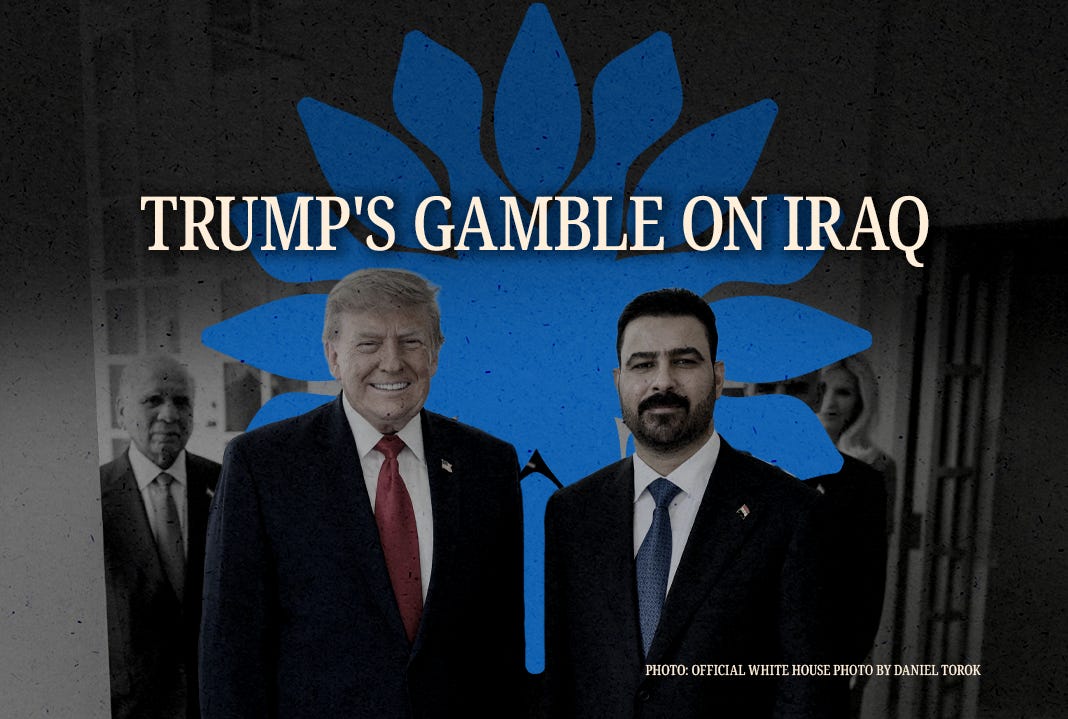
President Donald Trump’s meeting with Iraqi Prime Minister Ali al-Zaidi puzzled many observers of Iraq. On its face, the meeting appeared contradictory. Zaidi rose to power from the Coordination Framework, the coalition of predominantly Shiite political parties that has served as the principal political vehicle for Iranian influence in post-2003 Iraq. Before becoming prime minister, he was also publicly associated with allegations involving financial networks that U.S. authorities said were facilitating sanctions evasion benefiting Iran’s infamous Islamic Revolutionary Guard Corps (IRGC).
Yet there he was, warmly welcomed at the White House, praised by President Trump, and presented as a potential partner in leading Iraq into a new chapter.
Many analysts have treated this as evidence that Washington has either abandoned its previous concerns about Iranian influence in Iraq or become willing to overlook them for the sake of short-term stability. I believe there is a third, more likely explanation. The Trump administration is betting that Iraq’s political elite are less ideological revolutionaries than political mercenaries, willing to shift their loyalties when their interests stand to benefit from it.
Iran’s influence in Iraq rests on two mutually reinforcing pillars. The first is political and ideological. Through parties, militias, religious networks, and patronage, Tehran has spent more than two decades embedding itself within Iraq’s governing institutions. The second is economic. Iraq became Iran’s financial and commercial lifeline, particularly after the expansion of international sanctions. Access to Iraqi banks, exchange houses, border crossings, oil and gas deals, and commercial networks enabled Tehran to soften the blow of economic isolation.
Iraq’s integration into the global economy was an asset to Iran. It needed Iraq to remain sufficiently connected to international and regional markets because that connectivity created opportunities for sanctions evasion, financial transfers, and commercial activity that would have been impossible inside Iran itself.
This dual structure exposes an apparent contradiction in Iranian strategy. While Tehran invested heavily in maintaining armed groups and ideological influence, it also had every incentive to preserve an internationally recognized, economically integrated, and Western-financially integrated Iraqi state. Iraq functioned as a bridge between Iran and the global economy. The revolutionary project depended, to some extent, on the very international system it publicly rejected.
Washington, rather than attempting to dismantle Iraq’s political order or engineer another ambitious nation-building project, seems to be taking a risky gamble, asking, “What happens when the interests of Iraq’s political class begin to diverge from those of Tehran?”
This question deserves more attention than it has received. Many Iraqi politicians who built their careers in the post-2003 political system are not only ideological revolutionaries, as some claim. They are political entrepreneurs. Their primary objectives have often been longevity, influence, access to state resources, and personal enrichment rather than advancing an Iranian revolutionary project.
Iraqi leaders often develop interests that differ from those of the coalitions that elevated them. Every prime minister inherits responsibility for governing an increasingly complex country whose economic future depends on international investment, financial stability, and functioning relations with both regional and global powers. Once in office, Iraqi leaders often find that governing the country conflicts with the narrower interests of the political factions that helped bring them to power.
This pattern has appeared repeatedly since 2003. Successive Iraqi prime ministers, despite entering office with varying degrees of support from Iran-aligned political forces, have sought to consolidate their own authority once in government. Some attempted to strengthen relations with Arab neighbors. Others pursued closer cooperation with Washington. Still others tried to distance Iraqi state institutions from militia influence without directly confronting Tehran. Their success was mixed, but shows that political elevation in Baghdad often requires catering to personal political and financial interests rather than remaining indefinitely loyal to the coalitions that brought them to power.
Trump’s strategy suggests he understands this dynamic. Rather than assuming that every politician associated with the Coordination Framework is permanently subordinate to Tehran, the administration appears willing to test whether self-interest can become a more powerful force than ideological loyalty. The implicit offer is straightforward. Iraq’s political leadership can retain access to international capital, American investment, energy partnerships, and broader integration into global markets, provided it demonstrates a willingness to strengthen state institutions, combat corruption, and gradually reduce the autonomy of armed groups operating outside the state’s control.
Whether the strategy succeeds will depend on whether Iraq’s political elite are ultimately driven by ideological loyalty or political and economic self-interest.
The debate unfolding across Iraqi and Arab media reflects precisely this uncertainty. Some commentators argue that Zaidi represents the first serious opportunity in years to restore Iraqi sovereignty by centralizing control over weapons, pursuing anti-corruption efforts, and reducing the influence of armed factions operating beyond the state’s authority. Others are deeply skeptical, noting that he is still a product of the same political ecosystem that enabled Iran’s influence in the first place and questioning whether any leader selected through the Coordination Framework can genuinely dismantle the networks that produced him. Still others argue that Zaidi’s real objective is neither alignment with Washington nor with Tehran, but the preservation of a delicate equilibrium between the two powers while maximizing Iraq’s room to maneuver.
As it currently stands, there are a lot of unanswered questions.
Will the Iraqi government move beyond arrests of lower-level officials and begin confronting politically protected corruption networks? Will financial channels that have enabled sanctions evasion be dismantled? Will the government establish a genuine monopoly over the use of force, or will armed organizations continue to operate as parallel security institutions? Will Iraq deepen its economic integration with Gulf states and Western investors while simultaneously attempting to preserve privileged economic ties with Iran?
The answers to these questions will determine whether Trump’s wager succeeds.
The administration is not attempting to transform Iraq into a liberal democracy. Nor does it appear to believe that Iraq’s political class will suddenly embrace the US-led world order.
Instead, it assumes that once presented with a clear choice between participation in the global economy and continued dependence on an increasingly constrained Iranian regional network, at least some of Iraq’s governing elite will choose the former.
This is not an explicitly transactional strategy. It rests on a reading of Iraq’s political economy’s evolution over the past two decades.
Iran retains enormous leverage through political allies, economic networks, and armed groups that continue to shape Iraq’s internal balance of power. Yet if Washington has correctly assessed that the defining characteristic of Iraq’s political elite is not ideological commitment but political and economic self-preservation, then Trump’s approach may prove more realistic than many of his predecessors’ attempts to reshape Iraq through military or institutional engineering.
The success or failure of this strategy will be measured by whether Iraq’s ruling class ultimately proves more committed to preserving its access to global markets than preserving the Islamic Republic’s regional project. If Trump’s calculations are correct, the forces that gradually loosen Tehran's grip on Iraq may be the very political incentives that once helped entrench it.
Middle East Uncovered is powered by Ideas Beyond Borders. The views expressed in Middle East Uncovered are those of the authors and do not necessarily reflect the views of Ideas Beyond Borders.