


The Persian Gulf is on fire. Iranian missile strikes, naval standoffs, and oil tankers burning in waters that supply a third of the world’s energy have consumed every headline, every breaking news alert, and every geopolitical conversation for weeks. It is the kind of crisis that swallows everything around it, including questions that were, not long ago, impossible to ignore.
Gaza has nearly vanished from the news cycle. The Strip, which dominated global discourse for more than two years, drove millions into the streets from London to Washington, and sat high on the agendas of Western governments, has now largely disappeared from public discussion—even as the rubble and the people living in it have not gone anywhere.
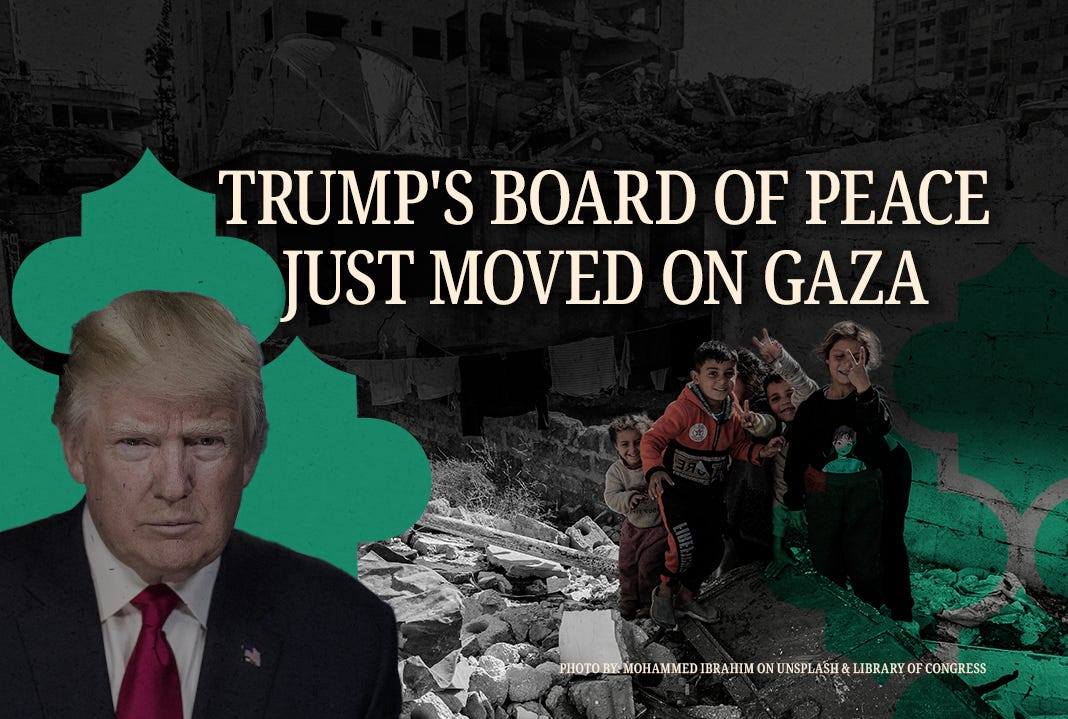
And yet, amidst all this chaos, something has been prepared by the Trump administration in the past few weeks. Nicolay Mladenov, director general of Trump’s Board of Peace, announced that a new framework has been agreed upon by all mediators to the Gaza war. The framework is simple: full disarmament of Hamas and all armed groups in the Gaza Strip—including anti-Hamas militias that have recently emerged and taken control of parts of it—“all militias with no exception,” in Mladenov’s words, as a precondition for unlocking reconstruction, advancing Palestinian unity, and taking a first serious step toward resolving the Palestinian question in its entirety.
Hamas and Palestinian Islamic Jihad (PIJ) answered—though not in words—the following day. Checkpoints, police cars, and conspicuous displays of force were visible throughout the Gaza Strip.
Fighters from PIJ’s armed wing, Saraya al-Quds, and Hamas’s al-Qassam Brigades appeared in multiple locations, distributing sweets to mark the first day of Eid al-Fitr, donning military uniforms typically reserved for ceasefires.
The message was legible without anyone needing to say it out loud: we are still here, we are still armed, and we are the day after.
But how much of an arsenal are these militias actually defending?
According to the Israeli Institute for National Security Studies, Hamas now holds roughly ten percent of its prewar rocket arsenal, and its estimated 17,000 fighters, most of them new, young, and inexperienced, have approximately 10,000 rifles.
The organization that launched the October 7 attacks through coordinated land, sea, and air operations no longer exists in its former form. Its commanders have been killed, its battalions dismantled, and its weapons-production infrastructure largely destroyed.
The Hamas that appeared on Gaza’s streets distributing Eid sweets is a shadow military force operating from a position of institutional catastrophe. It is a movement increasingly anxious about its own irrelevance.
Hamas’s political leadership knows this to be true. On November 5, speaking to Al-Jazeera, senior Hamas political bureau member Mousa Abu Marzouq offered what passed, in Hamas’s language, for a concession: weapons with ranges beyond the buffer zone, he said, were “reasonable to discuss,” because they could pose a direct threat to the other side. For an organization that has historically treated any discussion of disarmament as an immovable red line, acknowledging that some weapons are reasonable to discuss is a messaging shift, however tactical and self-serving.
What remains in Hamas’s hands are modest weapons: Kalashnikovs, pistols, and improvised arms assembled from unexploded Israeli ordnance scattered across the Strip after two years of bombardment. These are crude devices built from the debris of the very war being waged against them.
Other pro-Hamas militias, particularly the PIJ, are in no better condition than Hamas. Hamas has, however, been more successful in developing backup institutions and succession mechanisms, replacing each military leader almost immediately after being killed.
In the case of the PIJ, that infrastructure does not exist. What remains is a small number of militants attempting to stand alongside Hamas during public displays in uniform, in the hope that financial support from Tehran continues.
The supply lines that once fed a more serious arsenal have been strangled. Hezbollah, historically a crucial conduit for Iranian weapons reaching Gaza, has been effectively neutralized following Israel’s campaign in Lebanon. The Iranian regime itself, battered by successive strikes on its military and nuclear infrastructure, is in no position to run the kind of smuggling operation it once did through the Axis of Resistance. The tunnels into Sinai are under unprecedented pressure from Egyptian security cooperation. Hamas is limited to what it can manufacture locally and scavenge from battlefield debris.
And yet these light weapons are not nothing. They are the one thing Hamas cannot afford to give up, because they are the mechanism through which it controls the Gaza Strip. Not the tunnels, not the rockets, not any capacity to threaten Israel—those are gone or severely diminished. What they have retained is the ability to impose order, or disorder, on a civilian population of two million people who have every reason to resent it. This is why Hamas’s political bureau frames disarmament as an existential question. Surrendering the guns is not the loss of any meaningful strategic military capability. It is the surrender of the power to govern through intimidation, and that is the only card Hamas has left to play.
Gaza’s people deserve the chance to build something new—not under the control of armed factions, the authority of militias that have replaced them in parts of the Strip, nor under the permanent shadow of a war that serves every corrupt actor except the civilians trapped between them.
Hamas and the PIJ are unlikely to agree to this voluntarily. That has been tested repeatedly over the past two years, and their position has been consistent. Pressure, therefore, becomes unavoidable. One track is already underway: targeting the networks that sustain them, including their sponsors in Tehran.
The second must come from those who claim to stand for Gaza’s future. The pro-Palestine movement has done significant work in pushing to end the war and expand humanitarian aid. But if that effort stops short of confronting the forces obstructing Gaza’s recovery, then it is reasonable to question what its vision ultimately entails. Calling for a Gaza free from siege, but not free from armed authoritarian rule, leaves the central issue unresolved.
Gaza’s people have been anguished, exhausted, and stripped of nearly everything. After all of that, the least that can be offered is a credible path forward—one that cannot exist under the rule of militias, whether Hamas or those that oppose it.
What is at stake is the possibility of ordinary life: cities governed by institutions, laws that protect their citizens, and rights that apply equally to all. That is not an unreasonable demand. It is the baseline that Gaza has been denied for far too long.
Middle East Uncovered is powered by Ideas Beyond Borders. The views expressed in Middle East Uncovered are those of the authors and do not necessarily reflect the views of Ideas Beyond Borders.
As I said in this piece, Hamas will oppose any plan that makes them irrelevant, even if that means not rebuilding Gaza and even if it means not solving the Palestinian question; this is how Hamas thrives through chaos and destruction, they literally invest in it.
This is helpful information. Thanks for this contribution.