


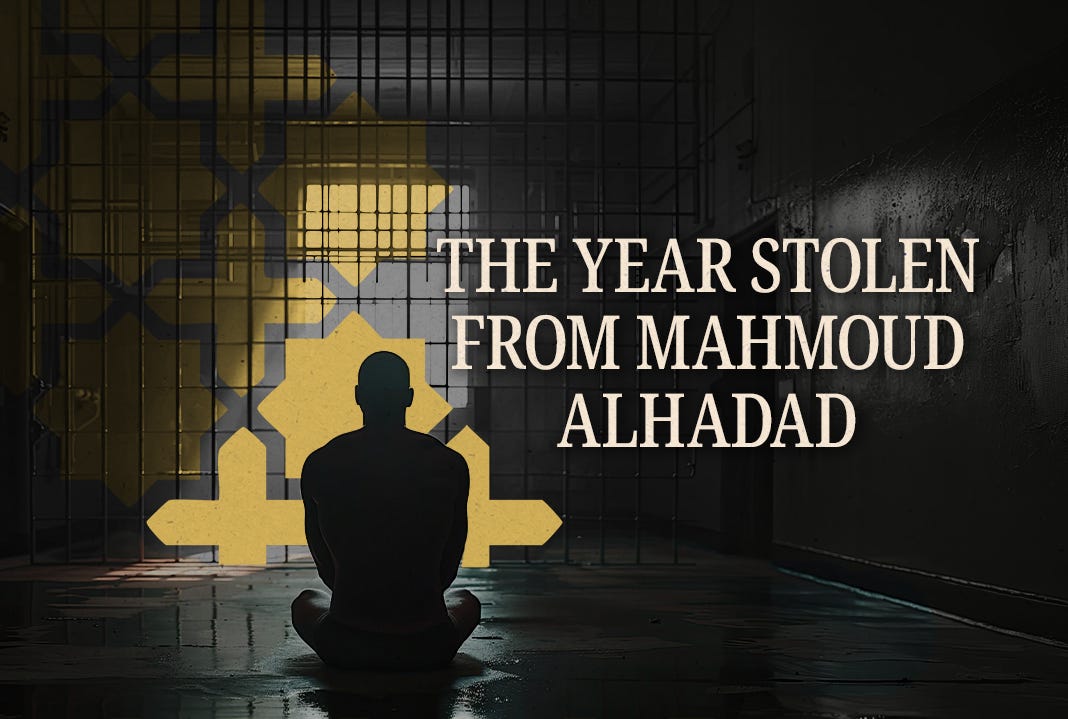
While scrolling through social media during the war in Gaza, I came across a post saying that a friend of mine had been detained by the Israeli army while sheltering in Khan Younis. No one knew where he had been taken, and I did not know whether I would ever see or speak to him again. Months later, when a post from him appeared on Facebook, I rushed to message him. After hearing what he had endured, I promised him I would help make his story heard.
Mahmoud Alhadad was detained at Nasser Hospital in Khan Younis on February 14, 2024, while sheltering at one of the last functioning hospitals in Gaza after much of the enclave’s healthcare system had been devastated by the war. Blindfolded and handcuffed, he was taken by Israeli soldiers to Israel, where he spent a year in detention without ever being charged with a crime.
Alhadad is not the only Gazan who was detained during the war without being charged with a crime. Like hundreds of Gaza’s residents, he was held under Israel’s Incarceration of Unlawful Combatants Law. Following the Hamas attacks on October 7, 2023, Israel massively expanded its use to detain Palestinians from Gaza en masse without charge or trial. The law allows the Israeli military to imprison people the army considers affiliated with groups engaged in hostilities against Israel.
Asking him to describe the first moments of his detention, he said: “They gathered all of us in a crowded room, then a truck came to take us all together,” he recounted. During his initial interrogation near the Gaza border, Alhadad said he was beaten and threatened by the Israeli soldiers. “They asked me where the hostages are? Where does Hamas store guns? The interrogator told me either you answer me, or you are going to die at my hands.”
Mahmoud thought his answers would save him, but they did not. He told interrogators he had no information about hostages or weapons, explaining he was a civilian seeking medical care at the facility. Despite this, he was transferred into Israel’s prison system.
His first stop was the notorious Sde Teiman detention center in Israel’s Negev desert. The facility drew international attention after a leaked video showed five Israeli reservists beating and sexually abusing a Palestinian detainee, who survived with a ruptured bowel, severe internal rectal injuries, broken ribs, and punctured lungs.
“It’s like a storage facility,” Alhadad said. “We will be on our knees, handcuffed. We were something like 100 prisoners, with our hands to the back, from 6 am to 11 pm.”
He described being forced to kneel for up to 17 hours a day, where even the slightest movement was met with beatings. “You cannot stand or change your position to lean, look at others, or sleep; if you try, you will be beaten,” he said. Even basic needs were restricted. “When I want to go to the toilet, I go handcuffed, and my eyes are closed. Even when we want to sleep, we sleep handcuffed, and our eyes are closed.”
Alhadad said guards used dogs to intimidate prisoners. “They used to freak us out with dogs; sometimes they unleashed them on us. People peed on themselves from fear.”
Alhadad’s account confirms details from other reports by human rights organizations who demanded the closure of this facility, including Amnesty International and B’Tselem (The Israeli Information Center for Human Rights), which described the facility as “only the tip of the iceberg” of a broader, institutionalized network that has effectively been converted into de facto torture camps.
Three weeks after he arrived, Alhadad was transferred to another detention facility, known as the
“Al-Moskobiya” detention center in Jerusalem, where he remained for 33 days. He was then moved to Ofer Prison for 120 days, followed by a stint at Negev Prison, where he stayed from July 2024 until his release in February 2025.
Alhadad said the conditions in the Negev prison were no better. He described severe overcrowding, with 30 to 40 prisoners housed in tents with only 14 beds. “The winter was extremely cold, and the summer was extremely hot,” he stated. “I wept due to the cold weather; we lacked warm clothing.” Each morning, guards would confiscate blankets and mattresses, only to return them at night. “Rather than cleaning them, they are causing us to endure additional hardship,” he told me.
On top of the psychological and physical torture, there was a widespread outbreak of skin diseases, especially scabies and boils amongst the prisoners, due to lack of hygiene.
Alhadad’s ordeal extended beyond his own treatment. Cut off from his family in the Gaza Strip and denied any phone contact, he had no way of knowing whether or not they were alive. During interrogations, he says he was threatened with their murder if he did not provide information about Hamas and the hostages—a tactic he says was also used against many other Palestinian prisoners and detainees.
The abuse of Palestinian prisoners in Israel is an open secret in Gaza. I remember hearing stories from the older generation in the Strip about numerous Palestinians who were arrested and tortured in the aftermath of the first Intifada, and the pattern is continuing now. Beating, threatening, humiliating, and recently sexually abusing Palestinian prisoners. Suspicion of affiliation is enough to justify it—absent any concrete proof.
When I asked about the food, hoping to steer the conversation toward something less painful, his answer did little to lighten the mood.
“We eventually recover from scabies after we’re released,” he said. “But no one gets enough food. I lost 30 kilograms during my detention.”
He added that everyone was held under the same legal framework, regardless of who they were: “People who had lost a leg, the elderly, young people, women, doctors, and criminals.”
When I asked whether he had access to a lawyer, Alhadad said legal representation was largely symbolic.
“Lawyers visited only a limited number of prisoners, and no prisoner was allowed more than one visit,” he said. “The lawyer only asked about prison conditions. He had no authority to defend you or look into your case. Basically, his job was just to see that you were alive.”
Alhadad was released a year later as part of the February 2025 hostage-prisoner exchange. Today, he lives in a makeshift tent in Gaza.
Torture is a war crime. When committed systematically and on a large scale, it constitutes a crime against humanity. Multiple human rights organizations argue that this standard applies to the treatment of Palestinian detainees in Israeli custody.
At least 98 Palestinians have died in Israeli detention facilities since October 2023, according to Palestinian authorities and human rights organizations, citing violence, starvation, inadequate medical care, and other inhumane conditions.
Mahmoud Alhadad survived. He left detention thirty kilograms lighter after a year without charge or trial. He contracted scabies, was forced to kneel for up to 17 hours a day, threatened with the murder of his family, and released without ever being told why he had been imprisoned.
I recounted my own experience of torture and imprisonment at the hands of Hamas in my recently published book, Seashells at the Shores of Gaza: Testimonies and Memories from a Shattered Land.
As my friend spoke, I recognized much of what he was describing. Our captors were different—his were Israeli prison guards, mine were Hamas—but torture has a way of stripping away those distinctions. You are thrown into a place where your body and mind are systematically broken. Even after you leave, part of you never does.
The Israeli detention centers where Alhadad says he was abused are still open, and the legal framework that enabled his imprisonment without charge remains largely intact. Many of those implicated in allegations of abuse continue to serve, while new reports of mistreatment continue to emerge.
(Just yesterday, 60 prisoners were released from Israeli custody and transferred to Nasser Medical Complex in Khan Younis. Many arrived in wheelchairs, appearing visibly malnourished and exhausted.)
As we spoke, it became clear that Alhadad was not seeking revenge. Like so many survivors of torture, he simply wants acknowledgment, accountability, and the assurance that no one else would endure what he did. Hamas has never claimed to be bound by the rule of law. Israel does. That is precisely why it has a duty to investigate these allegations, hold those responsible to account, and ensure its detention system reflects the standards it expects others to uphold.
Middle East Uncovered is powered by Ideas Beyond Borders. The views expressed in Middle East Uncovered are those of the authors and do not necessarily reflect the views of Ideas Beyond Borders.
Good to know, to share, but the ai voice sucks. Let me read it.