

The Worst of Both Worlds for the Middle East
Wars may produce winners and losers on paper. Markets are less forgiving. Across much of the region, countries are absorbing the costs of conflict without securing the benefits of peace.

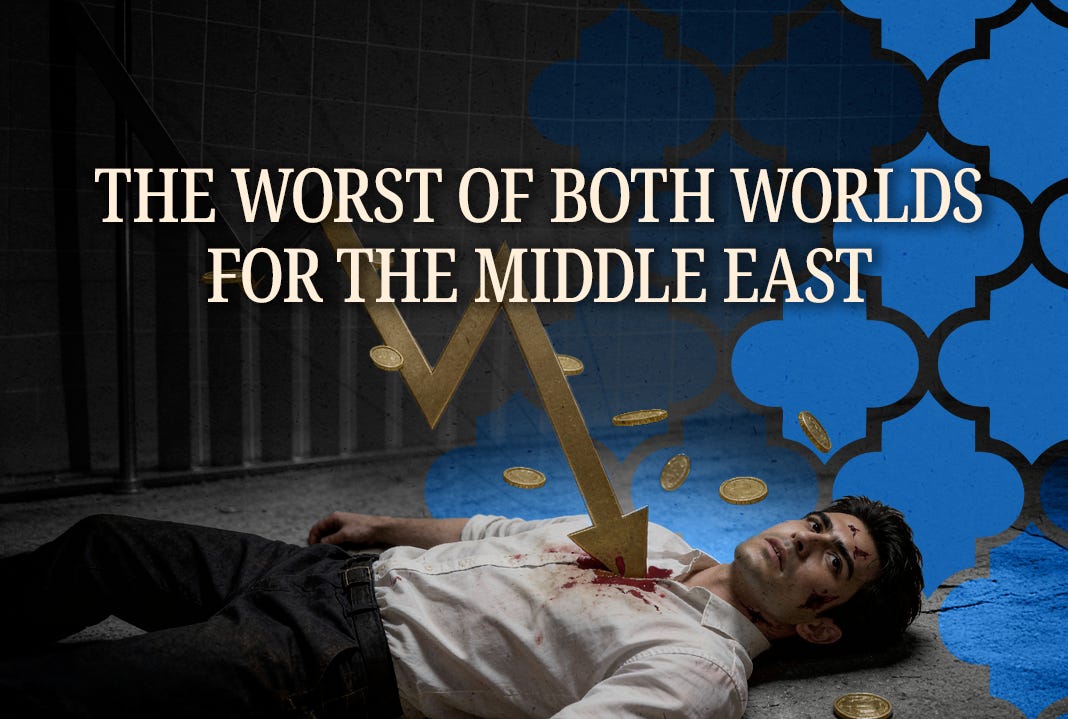
Every time war erupts in the Middle East, the same debate follows. Who won? Who lost? Which side gained leverage, preserved deterrence, improved its negotiating position? Analysts map missile exchanges and flight patterns, politicians declare victory, and commentators rush to sort the players into winners and losers.
I think we are asking the wrong questions.
The one that matters is simpler: Would you invest your money in the Middle East today?
Not if you are a sanctioned oligarch hiding assets, or a connected businessman chasing government contracts, or a state moving capital for strategic reasons. I mean an ordinary investor or entrepreneur, someone who earned their money and wants to put it somewhere productive. Would they build a factory here, start a company, hire workers, or bet their future on the region?
The answer tells us more about the state of the Middle East than any war outcome. And the uncomfortable reality is that much of the region is getting the worst of both worlds, bearing the economic costs of war without the dividends of peace.
The numbers are starting to confirm it. The International Monetary Fund’s most recent outlook cut its expected growth for the Middle East and North Africa in 2026 to roughly 1 percent, down sharply from forecasts near 4 percent, with Iran and Iraq among the economies expected to bear the brunt. The World Bank has issued parallel warnings that conflict and geopolitical instability are eroding investment confidence and dragging down growth across the region.
What does this mean for the people living in the region? Lower growth means fewer jobs. Fewer jobs mean delayed marriages, delayed homes, and delayed independence. More graduates will compete for fewer job openings and more talented people will conclude that their future must lie elsewhere.
The real economic cost of instability is not the damage it causes today but the uncertainty it creates about tomorrow. Investors do not simply calculate returns, but also predictability. A manufacturer wants to know the supply chain will function next year. A tourism operator wants to know whether flights will continue to run. A founder wants to know whether skilled workers will still be in the country 18 months from now.
Conflict destroys that confidence, and the damage radiates outward. When airlines suspend routes, airports lose business. When shipping lanes get riskier, insurance premiums climb. When uncertainty rises, investors postpone, and postponed investment means fewer jobs created. The recent fighting disrupted energy production, trade, and air traffic across the Gulf, and that disruption reached far beyond the countries actually exchanging fire.
The reported U.S.–Iran framework deal captures the problem perfectly. If it holds, the reopening of the Strait of Hormuz will offer real relief to energy markets, shippers, insurers, and governments desperate for a break. But this does little to restore confidence or ensure predictability. The hardest questions—Iran’s nuclear program, sanctions relief, enforcement, and regional escalation—are being pushed into another round of talks. It may be a step forward, but for investors it is still uncertainty with a calendar attached.
Here the simple story breaks down, and it is worth being honest about why.
The region is not uniformly repelling capital. It is bifurcating. While the conflict zone hemorrhages confidence, the Gulf monarchies are doing the opposite. The UAE, Saudi Arabia, and Qatar market themselves as the stable harbor precisely because the neighborhood is turbulent. Dubai absorbs the capital, talent, and company headquarters fleeing less predictable markets. Riyadh courts the foreign investment that Tehran and Baghdad cannot. For these states, regional instability is a competitive advantage they are actively selling.
The places that can least afford to lose their best people and their investable capital are the ones losing them, and much of what they lose flows straight to their wealthier, calmer neighbors.
This is also why Iran deserves its own line of analysis rather than being folded into a regional average.
Unlike the hollowed-out states that buckled under external pressure, the Islamic Republic defines its mere survival as victory; it can absorb economic punishment that would topple a more conventional government and call the endurance a win.
But survival does not automatically beget prosperity. A regime can outlast sanctions and war and still preside over an economy that no rational person would build a future in, and that gap between political durability and economic hopelessness is exactly where a generation gets lost.
That younger generations bear the deepest cost. Across the region, millions of educated, ambitious, globally connected young people enter the workforce every year. Ask many of them what their long-term goal is, and the answer is no longer to start a company, build a product, or buy a home. It is to leave.
And Western nations are not exactly chomping at the bit to accept more migrants or refugees.
Strategic victories mean little if a country’s most talented citizens conclude that their future lies elsewhere. Nations grow when people invest, build, and stay—not when capital and talent are searching for a way out.
So, before we debate who won the latest round of fighting or celebrate the next diplomatic breakthrough, we should ask a different question. Five years from now, will more people be building their future in the Middle East, or planning their exit from it?
That is the scoreboard that matters.
Governments can survive wars, regimes can survive sanctions, and militaries can preserve deterrence. None of those achievements guarantee that a young engineer will start a company, that an investor will build a factory, or that a talented graduate will decide to stay.
For too long, the region has measured success by what it has managed to endure rather than what it plans to build.
The real contest in the Middle East is not between rival states, armed groups, or competing alliances, but between countries that can convince people to invest their lives there and countries that cannot. The winners will not necessarily be those with the strongest militaries or the most durable regimes. They will be the ones that become places where people can confidently imagine a future for themselves and their families.
The future belongs to the places people choose to stay.
Middle East Uncovered is powered by Ideas Beyond Borders. The views expressed in Middle East Uncovered are those of the authors and do not necessarily reflect the views of Ideas Beyond Borders.
Well stated.