


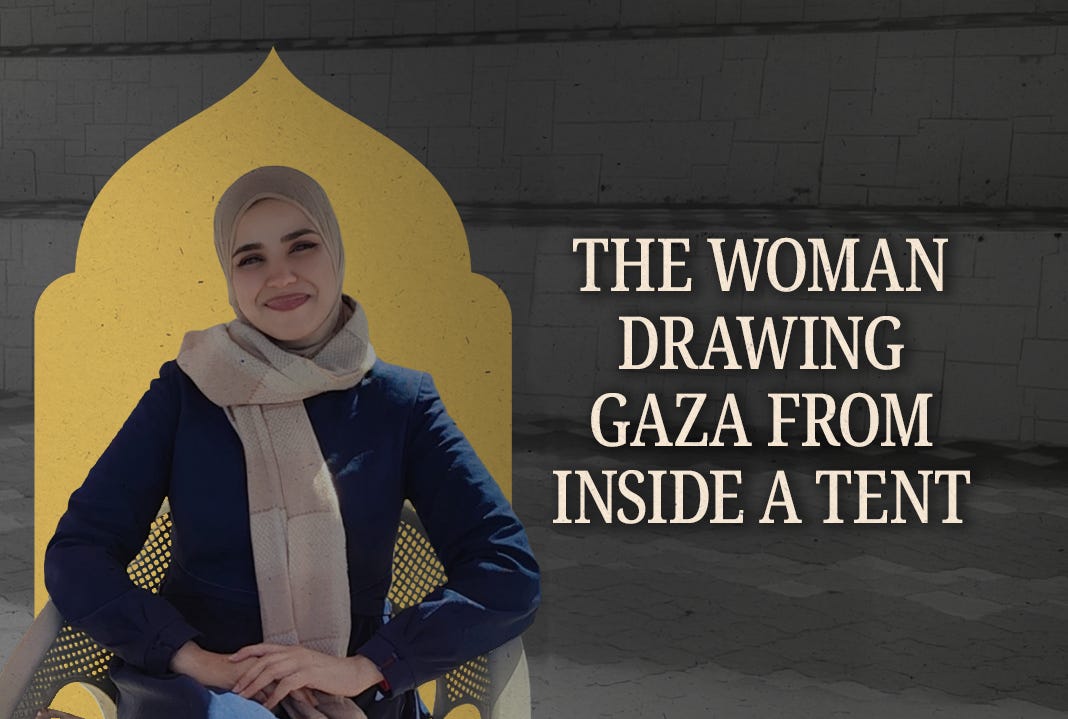
One year after our last interview, Safaa Odah still lives in a tent in Al-Mawasi, the Khan Younis area of southern Gaza. It is from here that the Palestinian cartoonist continues to draw. Despite the ceasefire and hope that the end is near, she often hears gunfire, with military operations encroaching closer and closer to her makeshift home.
“Summer has made life even more difficult,” Safaa tells Middle East Uncovered, “tents are not designed to protect people from extreme heat, so even the simplest daily activities have become exhausting. Military operations have moved closer to us, and now we hear gunfire much more often. We live with constant anxiety, never knowing what might happen from one moment to the next.”
Odah, born in Rafah in 1984, is a cartoonist and animation artist with a master’s degree in psychology. Before the war, her work consisted of drawings and animated images that explored the relationship between art, society, and mental health. But since October 7, 2023, her life changed dramatically. Like hundreds of thousands of Palestinians in the Strip, she was forced to leave her home and move several times, searching for safety.
Her house in Rafah, now largely depopulated, was destroyed. “A home is not simply a place to live,” she explained. “It is our homeland, our parents’ sacrifice, our memories.” After multiple displacements, the tent in Al-Mawasi is now her new home. But it has also became her art studio. For a while, Odah drew on the sides of her tent because paper was impossible to come by.
Odah’s story has attracted international attention. “At the beginning of the war, when I ran out of paper, I drew on the sides of the tent because they were the only surface available to me,” she said, “later, I returned to drawing with pen on paper. For now, I am temporarily working on a computer, waiting until I can have a dedicated drawing device that will allow me to work more effectively and return to my usual artistic process.”
She turned the tent into a canvas, drawing the war as she experienced it. While much of her work depicts destruction, hunger, and displacement, it’s important to her to also showcase the ordinary acts of care and routine that continue around her.
Through Instagram, where she has nearly 45,000 followers, Odah publishes her cartoons in real time, using the social network as a visual diary of sorts. Her style is immediately recognizable by the essential lines, black-and-white drawings with blue shading, and simple images that convey complex emotions.
The collection “Safaa and the Tent,” published in English and later released in Italy under the title “Safaa e la Tenda” by Fandango Libri, brings together all of her drawings from 2023 to 2025. It has since become one of the most significant artistic testimonies of the war.
In 2025, Odah received the Special Award from the Lakes International Comic Art Festival. Her work has been praised by Joe Sacco, a cartoonist, journalist, and author of Palestine, who described her images as among the most powerful works to come out of Gaza during this period.
Her pieces have made their way to Italy thanks to the exhibition “Al di là del mare. Palestina Italia” (Beyond the Sea. Palestine Italy), born of the artistic dialogue between Odah and the Italian cartoonist Pat Carra. The exhibition, dedicated to the relationship between two united by their shared language of comics and ability to portray the present, is currently on display in Lecce and Rome as part of the Bande de Femmes festival and will continue in Modena in September.
For Odah, who cannot leave Gaza, seeing her drawings exhibited so far from the Strip allows her to travel, in a way. “It means a great deal to me because, although I am still in Gaza, my drawings have managed to travel where I cannot,” she says, “through these exhibitions, I feel that my voice and the stories of the people here are reaching a very distant audience.”
Her hope is that the public will not stop at images of war alone. “I hope visitors will see more than images of the conflict. I would like them to understand the humanity behind every drawing: the dreams, the fears, the resilience, and the daily lives of ordinary people. If someone understands that the people of Gaza are not just numbers in the news, but human beings with hopes and stories, then my work has achieved its purpose.”
For Odah, comics do more than tell stories. They document history as it unfolds, capturing the human element other forms of media cannot. “A news report tells you what happened, but a drawing can show you how it felt,” she says. “I do not draw to replace journalism, but to add the human dimension that is sometimes missing from the news.”
Each of her cartoons is a reflection of something she has experienced directly. “I am not drawing as an outside observer. I am part of the story myself. Sometimes it is painful to transform these experiences into art, but I feel responsible for continuing.”
The lack of materials, limited electricity, the summer heat inside the tent, and the sound of gunfire make even the creative process tough. “The challenges I face are both practical and emotional. Finding drawing materials is still difficult, and there is no proper place to work. At the same time, the uncertainty of every day makes it hard to concentrate.” There are efforts underway to help her leave Gaza, but the process is slow and uncertain.
When the war ends, Odah dreams of returning to more ambitious projects. “I would like to create a graphic novel. I also dream of making an animated film. There are many stories waiting to be told.”
Outside her tent, the gunfire is still too close. Inside, Safaa Odah keeps drawing, documenting a place, a people, and a life that war has already changed beyond recognition.
Middle East Uncovered is powered by Ideas Beyond Borders. The views expressed in Middle East Uncovered are those of the authors and do not necessarily reflect the views of Ideas Beyond Borders.

Though Sacco actively downplays Hamas and claims that they're not “murderous as Israel”. 🤬