


Earlier this month, at a parliamentary briefing in London on the future of Syria, there was a mixture of anger and bewilderment from the Kurdish representatives that has become painfully familiar.
“Why does the world hate the Kurds so much?” One exasperated delegate asked the room.
The sentiment, shared by many, was prompted by recent events that unfolded in northeast Syria this month. They were the logical outcome of a choice made far from the Euphrates, following Western powers abandoning their Kurdish allies after getting what they needed from them.
What followed was inevitable.
On January 8th, the Syrian army asked civilians within the Kurdish-controlled Aleppo neighborhood of Sheikh Maqsoud, Ashrafieh, and Bani Zeid to leave as their fighting with the Kurdish-led, US-supported Syrian Democratic Forces (SDF) resumed for its third day. After giving an early-afternoon deadline, the army started shelling, with the SDF opening fire in response. This fighting was the most severe since Bashar al-Assad was ousted from power in December 2024.
Roughly 140,000 civilians were displaced, and eight civilians were killed in the Kurdish-majority neighborhoods.
The clashes then led to a security vacuum across territory where thousands of ISIS fighters and their families had been held since the caliphate’s collapse in 2019. Under mounting pressure and with external support thinning, the SDF abandoned key detention sites. The result was chaos.
About 120 ISIS inmates escaped from al-Shaddadi prison, which was previously controlled by the SDF, on January 19th, according to Syria’s interior ministry. Around 81 of the ISIS inmates had already been recaptured by the following day, while 40 remained at large. Kurdish officials, however, insist the number is higher.
Meanwhile, as Syrian forces advanced in the area, the massive al-Hol camp in al-Hasakah Province was briefly deserted. The camp is home to 30,000 people and is considered one of the most unstable environments in the region because most of its inhabitants are wives and children of ISIS operatives. The al-Roj camp is a smaller facility that confines 2,500 people, mostly foreign nationals awaiting deportation. This list includes Shamima Begum, who left her home in East London to join ISIS when she was 15.
For years, the SDF has overseen what amounts to the largest and most perilous detention system. It was never intended to last forever, but rather on the unspoken understanding that the Kurds would contain the problem, and the West would provide the requisite defense guarantees, funds, and political solutions in due course.
It was a huge burden, manageable only with continued Western backing, particularly from the US.
Then Washington dialed back its commitment to the SDF while signaling a new readiness to talk with the Islamist-led government in Damascus.
Now, with a truce in place between the central government and SDF, efforts are being made to integrate the Kurds into the Syrian state. The SDF has agreed, but it’s less a sign of strength than of how boxed-in the Kurdish leadership has become—squeezed by the regime, threatened by Turkey, and quietly deprioritized by the very power that had once described them as indispensable partners.
Then there’s Turkey, which many observers have portrayed as the winner of the Syrian civil war. Turkey has always considered the SDF an affiliate of the outlawed PKK (Kurdistan Workers’ Party) and has targeted the Kurds since 2016. Ankara does not want an autonomous Kurdish region on its borders, so when American backing for the SDF declined, it saw an opportunity in backing the Syrian National Army and the forced dissolution of Kurdish autonomy. The West, in its choice between a NATO ally and a stateless friend, opted to remain silent.
Under these converging pressures, the SDF was left managing an impossible task. A non-state force governing contested territory, it was suddenly expected to hold together detention centers housing some of the world’s most dangerous terrorists, without the political cover, military backing, or resources that had made that task viable in the first place.
“What the coalition forces and American officials are doing is not acceptable,” said Hediya Youssef, a Syrian-Kurdish political official. “Are you truly lacking in principles? Are you so willing to betray your allies?”
The jihadi camps are, as one counterterrorism analyst put it to me, breeding sites of extremism. Inside al-Hol, ISIS loyalists established alternative legal courts, educational institutions, as well as carrying out executions. Cases were documented of the ongoing slavery of Yazidi children seized in 2014, who were registered under false identities to avoid discovery.
The consequences will not remain confined to northeast Syria. Fighters and ideologues who escape custody will seek to regroup and re-embed themselves in vulnerable communities. The West, having insisted for years that ISIS detainees remain in Kurdish hands, now faces the blowback of withdrawing the means to keep them there.
ISIS remains a threat in the region and has carried out high-profile atrocities, such as December’s Bondi Beach attack in Australia.
That is partly why the Kurds, along with other minorities in Syria, argue that it is naïve for the Trump administration to believe that al-Sharaa, a former jihadi who once had a $10 million bounty on his head, can be trusted to keep terrorists locked up, given the limited ideological difference between his Sunni Islamist party, Hayat Tahrir al-Sham, and ISIS.
Instead, the US has abandoned its Kurdish allies—who were battling enemies that no other nation wanted to face—because the old rules-based international order is over.
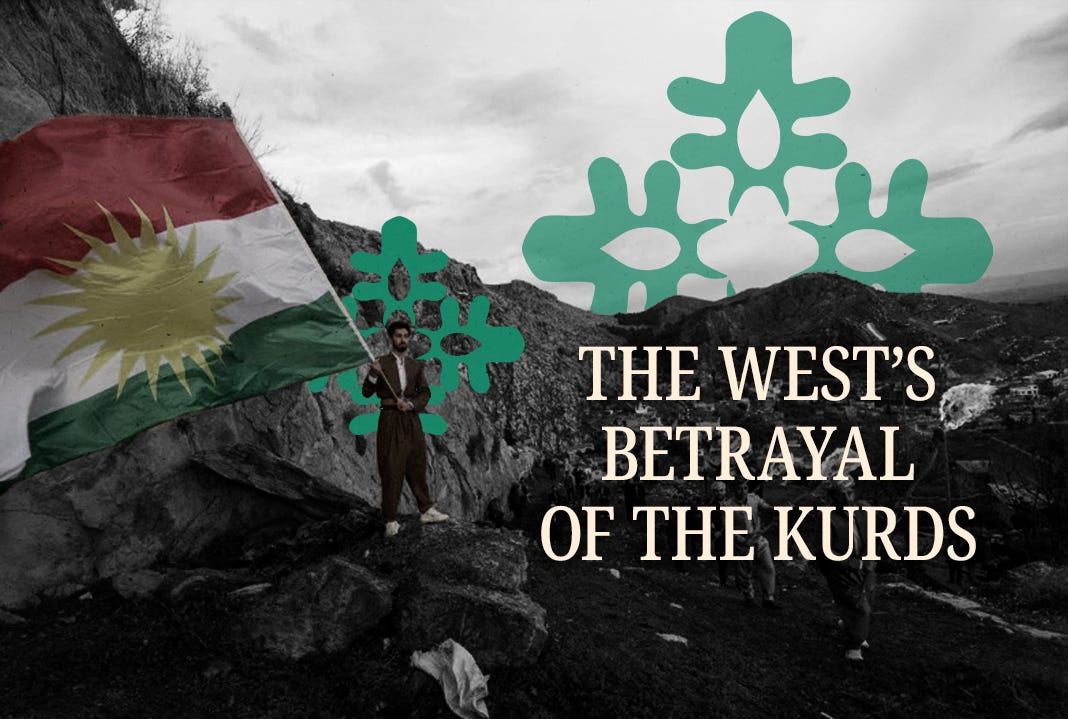
The Kurdish proverb “we have no friends but the mountains” encapsulates the plight of its people. Once again, with the dust settling in Syria, this is yet another example of how the West has betrayed the Kurds.
Middle East Uncovered is powered by Ideas Beyond Borders. The views expressed in Middle East Uncovered are those of the authors and do not necessarily reflect the views of Ideas Beyond Borders.

Iram, thank-you for this. On Guerre and Shalom substack, I have published an urgent appeal on this matter: https://danielclarkeserret.substack.com/p/halt-the-genocide-of-the-kurds-in?r=2bk821
The Kurds weren’t betrayed.
They were decommissioned.
They functioned as a containment interface holding territory, prisoners, and moral risk that Western states didn’t want to internalize.
Once that interface stopped fitting the new strategic map, it was removed.
What followed wasn’t a policy failure. It was an unassigned function: detention, control, and legitimacy with no owner.
That vacuum is what ISIS exploits every time.