


Today, Middle East Uncovered will publish two pieces examining the growing media and political controversy surrounding testimonies of sexual violence connected to October 7 and the war that followed. These accounts are graphic, painful, and difficult to engage with honestly.
We are publishing them because we believe difficult testimonies should not disappear beneath ideological battles. Too often, public discourse has centered more on defending narratives than confronting what victims describe. Our goal is not to litigate suffering selectively or protect one political camp from scrutiny, but to examine how these testimonies are being received, contested, weaponized, and, in many cases, buried beneath the broader war over narratives.
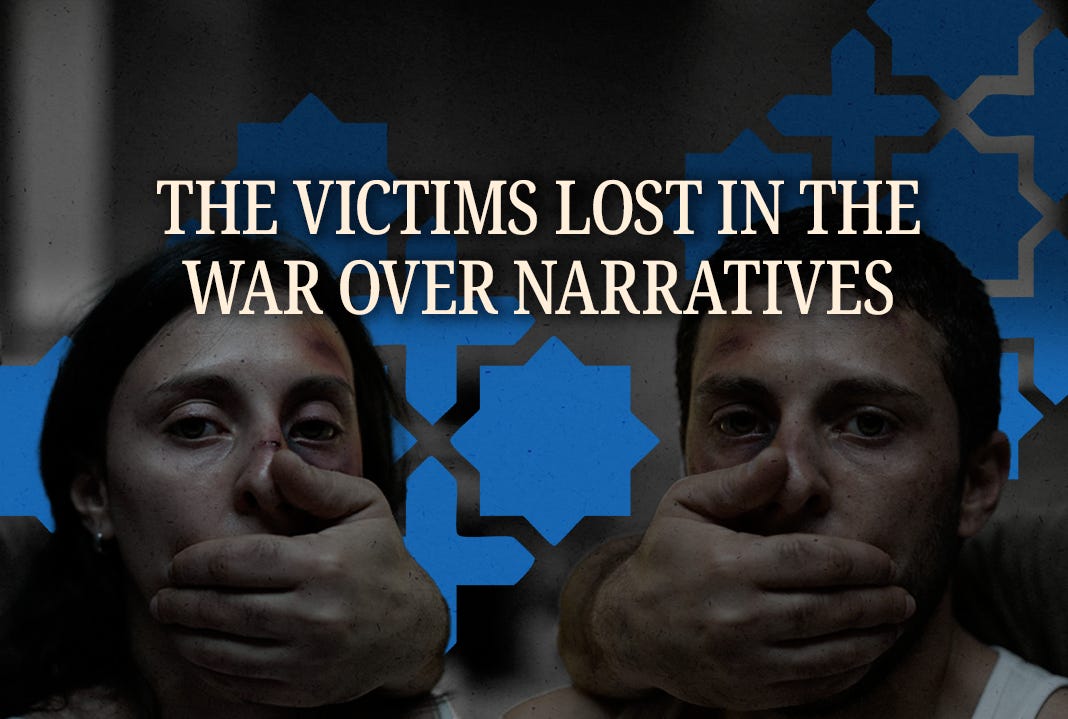
Since October 7 and the war in Gaza that followed, much of the public discourse surrounding the conflict has turned into a battle over competing narratives. More recently, the pro-Palestine and pro-Israel camps have clashed over two separate reports involving sexual violence. The New York Times (NYT) published testimony from Palestinian prisoners describing sexual abuse in Israeli jails, while The Daily Wire covered a report by The Civil Commission on October 7th Crimes by Hamas Against Women, Children and Families documenting Hamas’s sexual violence against victims of October 7.
The timing intensified the dispute: The New York Times’ piece appeared less than 24 hours before the Civil Commission released its findings.
Those who viewed the NYT report as less credible, or rejected it entirely, focused heavily on its sources. One was the Geneva-based Euro-Med Human Rights Monitor, founded and chaired by Ramy Abdu, a Palestinian figure widely perceived by the pro-Israel camp as being close to Hamas circles—a connection used to cast doubt on testimonies collected through his organization. Another was Shaiel Ben-Ephraim, an Israeli activist who shifted from outspoken pro-Israel advocacy to strongly anti-Zionist positions during the course of the war. Ben-Ephraim also amplified a claim circulated by Euro-Med Monitor alleging that Israeli forces used dogs trained to sexually assault Palestinian detainees, a claim many in the pro-Israel camp dismissed as antisemitic blood libel.
On the other side, many in the pro-Palestine camp dismissed the Civil Commission’s report outright because it came from an Israeli NGO focused specifically on documenting Hamas’s sexual crimes against victims of October 7. Others continued to deny the evidence surrounding Hamas’s sexual violence altogether, insisting that there is still not enough proof to conclude that such crimes took place.
The two reports include horrific, stomach-turning testimonies. Palestinian detainees described being sexually abused with objects such as metal batons and carrots by Israeli prison guards, while others recounted settlers in the West Bank zip-tying and violently pulling their genitals.
The Civil Commission’s report on October 7 documented multiple accounts of sexual violence committed by Hamas fighters during the attacks, including testimonies describing gang rape, mutilation, and the targeting of victims before and after death at sites such as the Nova music festival, where more than 370 people were killed. One survivor quoted in the report said he had been treated “like a sex doll” by his attackers.
Both camps have invested more time and energy in discrediting the messengers on the opposing side than in listening to the testimonies themselves.
Once that happens, the victims themselves disappear beneath the argument. This is despite the substantial evidence that Hamas used sexual violence against victims of October 7 and against hostages held in Gaza—evidence that exists regardless of which outlet covered it or who amplified it politically. The Civil Commission’s report, compiled over two and a half years from more than 10,000 photographs and videos and over 430 interviews, is not made less credible because The Daily Wire chose to report on it. A separate United Nations report likewise found “reasonable grounds” to believe that Palestinian militias committed sexual violence during the October 7 attacks.
The abuse of Palestinian prisoners is equally confirmed by a record of testimony that predates the most recent war. A leaked video from the Sde Teiman detention facility showed Israeli soldiers sexually abusing a Palestinian detainee. Five soldiers were arrested; the charges were later dropped. A survey published last year by Save the Children found that more than half of Palestinian children between the ages of 12 and 17 had witnessed or experienced sexual violence in Israeli jails.
It is, of course, reasonable to scrutinize the organizations and individuals collecting evidence. But what matters more is listening carefully to the testimonies themselves and examining whether the accounts are credible and consistent. A victim’s nationality should matter far less than the violence they endured. Suffering is not determined by ethnicity or political affiliation, yet both sets of victims are increasingly being turned into instruments in a broader political struggle by camps more invested in defending a cause than confronting the human reality of what these people experienced.
Listening to their testimonies should not be limited to publishing them in an opinion piece or an independent NGO report, though both matter. It must be followed by programs that help those victims recover from what they have been through, and hold the perpetrators accountable. The conditions of Palestinian prisoners inside Israel require a serious, independent investigation. Since Ben Gvir became Israel’s national security minister, and more so after October 7, he has openly boasted of his goal to worsen conditions for prisoners, writing on X in 2024 that it was one of the highest goals he had set for himself in office.
There are no winners in the battle for narratives. Each side will continue defending its own version of events for years to come. But every hour spent arguing over the credibility of a journalist or the politics of an NGO is an hour not spent listening to survivors describe what was done to them.
The testimonies discussed here—those of Palestinian prisoners and those of October 7 survivors and hostages—are not competing claims that cancel one another out. They are separate accounts of violence committed against human beings by specific perpetrators, and they demand serious investigation, accountability, and long-term support for those who survived them. The political camps that have turned these testimonies into ammunition would do far more for the people they claim to defend if they focused on that instead.
Middle East Uncovered is powered by Ideas Beyond Borders. The views expressed in Middle East Uncovered are those of the authors and do not necessarily reflect the views of Ideas Beyond Borders.
Look I get your overall point of centering victims, but our main issue with the Kristof NYT piece is not that it just uses horrible sourcing and thus we don’t believe them, it’s the physical impossibility of training dogs to rape people that is the most salacious part of his article. Kristof could have reported on the actual documented increase in abuse in Israeli prisons under Ben-Gvir, especially without saying “it’s what Hamas did on Oct 7 but everyday!” but he didn’t.
As far as the Oct 7 rapes, you don’t even need to believe the Israeli report. Simply look at Hamas’s own pictures of Naama Levy’s injuries once she was taken to Gaza and you can see sexual violence with your own eyes. The evidence chains at this point are not at all comparable. When there is corroboration of the Palestinian narrative, many Israelis and many Anerican Jews will indeed believe the victims as they did with the Sde Taiman abuses, but journalism requires at least some due diligence rather than just saying “both sides bad” or “some people claimed”.
Get actual neutral organizations to report on the actual abuses in Israel to help us make Ben-Gvir go away and reform the system and actually help people who are victims, especially with Israeli elections coming up where something might actually change