

The Unfinished Legacy of the Nakba
Seventy-eight years later, Palestinians continue to mourn the events of 1948. Constantin Zurayq framed it as a call for self-examination, modern state-building, and a break from political illusions.

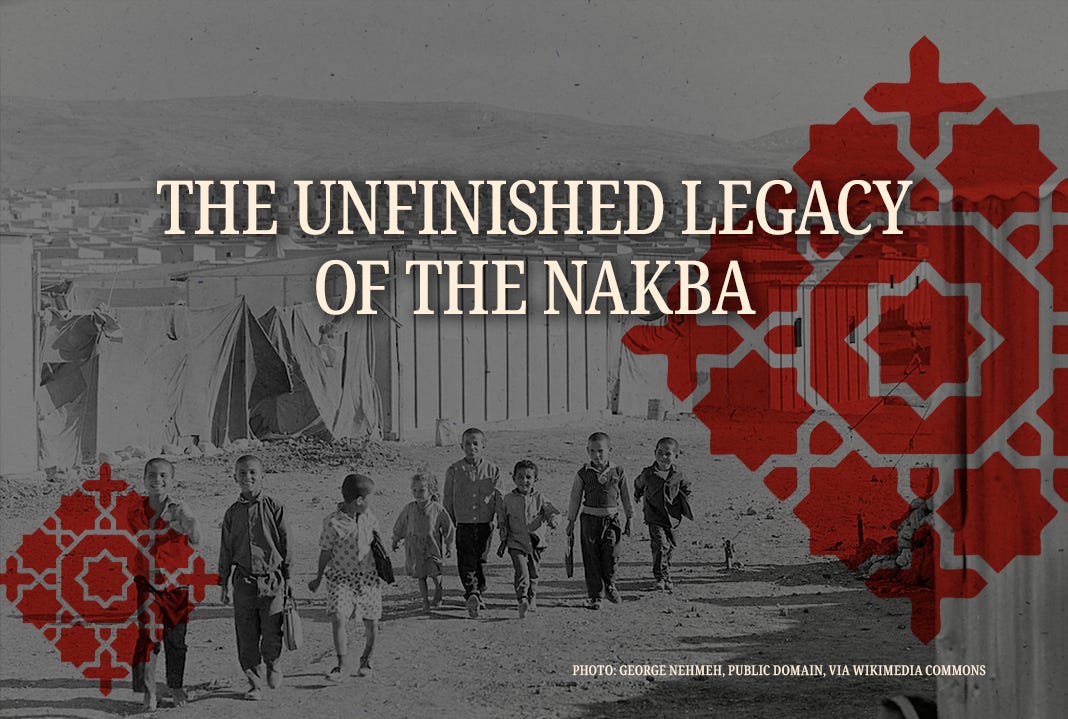
Every May 15th, Palestinians commemorate Nakba Day—or the “catastrophe” marking the 1948 displacement of more than 750,000 Palestinians from their homes and villages by Zionist militias during the war surrounding the creation of the state of Israel. For Israelis, the same events are remembered as the War of Independence, fought after several Arab armies rejected the UN partition plan and invaded the newly declared state.
Across Palestine, the day begins with school and university strikes, posters covering walls and shopfronts, and radio broadcasts recounting stories of displacement alongside calls for marches and protests. Yet beneath the rituals of commemoration lies a single question shared by Palestinians in Gaza, the West Bank, inside Israel, in the refugee camps of Lebanon and Syria, and across the diaspora: When are we going back?
In Gaza, nearly 70 percent of the population is classified as refugees under UN standards. In Lebanon and Syria, hundreds of thousands of Palestinians remain trapped in legal and political limbo, unable to return to the places their families left in 1948, yet unable to build stable futures where they are.
Two years after the events of 1948, the United Nations established a temporary body under Resolution 302 (IV) to address the humanitarian crisis following the Arab-Israeli War. The body was called the United Nations Relief and Works Agency for Palestine Refugees, or UNRWA. The stalemate in the Palestinian-Israeli question, now nearly 78 years old, turned what was supposed to be a temporary measure into a permanent one, step by step.
What began as a refugee population of fewer than one million steadily expanded as UNRWA extended refugee status to the children and grandchildren of those displaced in 1948. According to the agency’s 2026 figures, the number of registered Palestinian refugees now stands at nearly 5.9 million, with almost half holding Jordanian citizenship.
To understand how the word “Nakba” entered the global political vocabulary, it is worth returning to its older Arabic meaning. Long before 1948, Arabs used the word to describe catastrophe, calamity, or profound loss. In 1267, the Andalusian poet Abu al-Baqaa al-Rundi wrote Ratha’ al-Andalus (“Lament for al-Andalus”), mourning the fall of Cordoba, Seville, and Valencia to Christian kingdoms during the Reconquista. Palestinians later used the term to describe the 1936–1939 Arab revolt. But until 1948, “Nakba” remained a general expression for collective loss rather than a fixed political term.
The word acquired its fixed political meaning after the Syrian historian Constantin Zurayq published the first edition of his book, Ma’na al-Nakba (The Meaning of the Disaster). In his 95-page book, the word “refugees” was not used to describe the displaced Arabs, as it was published three months before the UN began applying that term to them. In only one instance did Zurayq use the Arabic word “Musharadeen”— the homeless—to refer to them.
For Zurayq, the Nakba was not only the displacement of Palestinians. It was also the defeat of five Arab armies and local militias by a modern political movement—Zionism—organized around discipline, institutions, and long-term strategy. To him, that defeat exposed the deeper political and cultural failures of Arab societies.
Zurayq identified many causes behind this defeat, some amounting to self-criticism, others pointing to Western imperialism. What stood out most among them was the scientific and rational failure of Arab countries and their inability to enter the modern age. Another cause was the gap between rhetoric and reality, and the failure to build strong, productive alliances. Arabs, according to Zurayq, excelled at passionate discourse but fell short when it came to organized, meaningful action. Instead, they sought emotional solidarity—something valuable in its own right, but incapable of solving problems on the ground.
To address this, Zurayq outlined both short and long-term goals. Nearly 80 years on, the short-term ones have long since passed. In the long term, Zurayq believed that nothing would change without a scientific and educational renaissance—societies that produce knowledge rather than merely consume it. He called for the building of modern states with effective institutions, the rule of law, and rational administration, as well as genuine economic and political integration capable of transforming the Arab world into a cohesive force. Above all, he demanded freedom from intellectual inertia: a move away from emotional and rhetorical thinking toward a critical rationality capable of planning and honest self-evaluation.
The word has shifted significantly from what it was meant to be to how it is used today. Nothing can erase what the Arabs of Palestine endured in the events surrounding the creation of the state of Israel. Some Israeli historians, like Benny Morris, have acknowledged this, though reluctantly. Nor can anything strip Palestinians of their fundamental rights, including the right to self-determination.
At the same time, nothing can help us as Palestinians if we continue to perceive our history in a way that teaches us little and insists that the only path forward is to reverse the events of the past. History cannot be undone, and across the many negotiation attempts toward a resolution of the Palestinian-Israeli question, the insistence on returning the descendants of the 1948 refugees to what is now the state of Israel has consistently been an obstacle—contributing to the failure of those negotiations and, at other times, undermining Palestinians’ credibility in their commitment to a two-state solution.
That said, reconsidering our history and what we draw from it is not a call to erase it. What we should demand is official acknowledgment from the state of Israel itself—as a political and legal entity—that the displacement of 1948 was a crime committed against a people who had every right to remain on their land. Beyond that, the descendants of those displaced are owed financial compensation for what was taken from them, and a genuine home in a sovereign Palestinian state.
Zurayq wrote in 1948 that Arabs were good at passionate discourse but poor at organized action. Seventy-eight years later, transforming the memory of the Nakba into concrete, achievable demands—acknowledgment, compensation, statehood free from occupation—may be the most faithful way we have left to prove him wrong.
Middle East Uncovered is powered by Ideas Beyond Borders. The views expressed in Middle East Uncovered are those of the authors and do not necessarily reflect the views of Ideas Beyond Borders.