


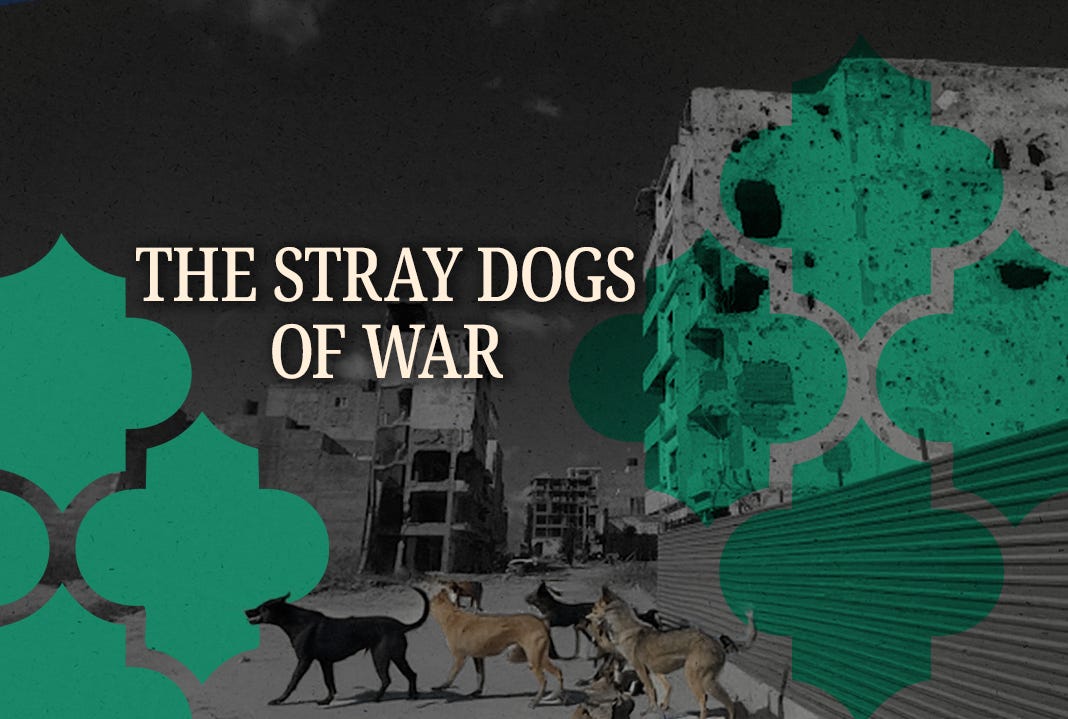
When I visited Benghazi last November, a coffee shop perched above the Mediterranean had become one of the main attractions along the city's newly renovated corniche. Yet beyond its mesmerizing view, the war's wreckage still spanned the city. Streets that were once teeming with life had fallen eerily quiet. Buildings that once stood tall were damaged or destroyed. As residents fled, stray dogs gradually took their place. The ruins became their home, and the bodies of fallen fighters their means of sustenance.
To understand how Benghazi reached this point, you have to go back more than a decade. After Gaddafi’s downfall in 2011, Libya descended into conflict. Benghazi became one of its fiercest battlegrounds as Islamist armed groups, including Ansar al-Sharia and later ISIS, established a presence in the city. In 2014, Khalifa Haftar launched a military campaign dubbed “Operation Dignity” to drive them out. In a span of three years, Haftar succeeded in his mission, but the war’s toll on Benghazi’s infrastructure was severe. Despite the reconstruction projects, remnants of the war, whether damaged buildings or stray dogs, continue to haunt the city.
Benghazi is not alone. Across the Middle East, wars have produced growing populations of stray dogs. During the war in Gaza, efforts to identify bodies of certain Palestinians were difficult, given that some of them were scavenged by dogs. Graves in Rafah, the southernmost part of Gaza, were also pillaged by the same animals. Even Palestinian children were not spared the sight of dead bodies being torn apart by stray dogs.
Similar incidents were witnessed by American soldiers during the war in Iraq. One serviceman was traumatized after seeing dogs feeding off bodies in mass graves. Another retired serviceman, Cody Alford, described a similar experience in an interview about his time in Fallujah.
Today, stray dogs have become a grave concern for Benghazi’s residents. On multiple occasions, children have been either wounded or killed.
Mecca Al Magribi, a 3-year-old girl who regularly played with the neighbors’ kids, disappeared on the morning of January 3rd. She went out to play but never returned home. Her family was concerned and publicized her disappearance on social media. Eventually, she was found after being mauled by a pack of stray dogs. She later died from her injuries.
The incident involving Al Magribi triggered a massive outcry. The government was criticized for failing to regulate or curb the spread of the dogs, and many residents called for a solution, citing the devastation they were causing.
In response, internal security forces launched a campaign to cleanse the city by exterminating them. The campaign was not well received by segments of the population, who believed there were better alternatives.
To date, there is no concrete data on the number of stray dogs roaming the streets of Benghazi or how many have been eliminated. However, in 2020, a similar campaign was launched by the same unit of Benghazi’s internal security forces. It was in response to another incident when a child was attacked, barely surviving after being severely wounded. The campaign reportedly eliminated 2 percent of the entire population.
Even though another campaign was launched in 2022, stray dogs continue to encroach on Benghazi’s neighborhoods.
Hind Salameh* is a Benghazi resident who spoke to Middle East Uncovered about the impact of stray dogs on her daily activities. Salameh lives in Al Keesh, an old neighborhood affected by the proliferation of the dogs. Both Salameh and her mother were bothered by the increasing number of these animals, blaming the municipality for failing to implement containment programs.
“I often joined my mother during her walk around the neighborhood,” said Salameh. “However, we tended to carry sticks or a brick to fend off the dogs in case they attacked us. When we heard the tragic story [of Mecca Al Maghbribi], we gave up on walking. After a full day of work, you need a bit of fresh air. However, killing the dogs is not the best way to tackle this issue.”
The head of the stray dog unit, Deputy Officer Abdul Rabah Al-Faydi, said the extermination campaigns are necessary to protect residents from attacks and reduce the risk of disease. It was the same method adopted by the municipality in Baghdad, which eliminated more than 19,000 dogs in 2025.
Without a sustainable government program, the stray dogs of Benghazi will likely encroach even deeper into different neighborhoods. From Benghazi to Baghdad, advocates have argued that shelters and humane population control offer a more sustainable solution than mass extermination. Advocates point to neighboring Erbil as evidence that another approach is possible. There, authorities say a three-year program of collecting, sheltering, and sterilizing stray dogs has brought attacks in the city center under control.
Along the corniche, Benghazi’s cafés are busy again, and the city is slowly rebuilding. But a few streets over, residents still carry sticks and bricks when they leave home. As the city recovers, the challenge is not just repairing what the war destroyed, but confronting four-legged scavengers it left behind. How the city chooses to respond will shape the future of both the stray dogs and the residents who are forced to share the city with them.
*Hind Salameh is a pseudonym, as she spoke to Middle East Uncovered on the condition of anonymity.
Middle East Uncovered is powered by Ideas Beyond Borders. The views expressed in Middle East Uncovered are those of the authors and do not necessarily reflect the views of Ideas Beyond Borders.
