


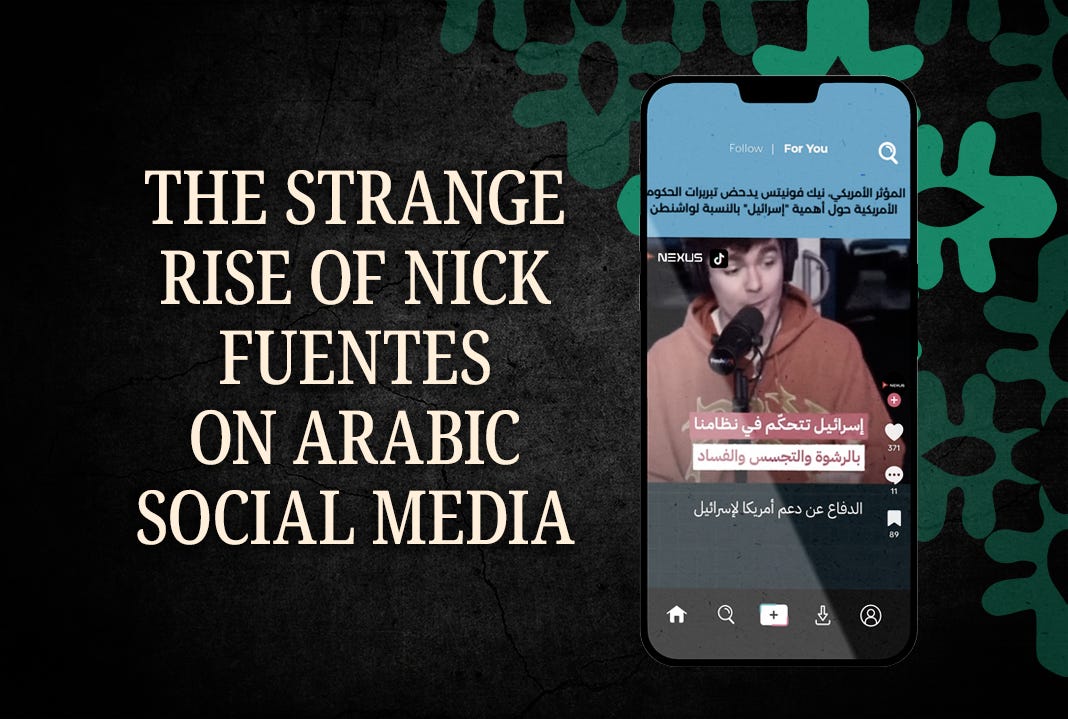
Scroll through Arabic TikTok, YouTube Shorts, or Facebook Reels, and you’ll notice a strange and troubling pattern. Short clips circulate of an “American journalist” or an “American YouTuber” speaking bluntly about Israel, Jews, or U.S. foreign policy. The videos are dubbed or subtitled in Arabic. The tone is triumphant, and the comment sections are overflowing with praise.
What is almost always missing is a name.
In many cases, the speaker is Nick Fuentes or Tucker Carlson. But naming them clearly would complicate the narrative, so the algorithm—and the people feeding it—often choose ambiguity instead. The result is a curated illusion: a fearless Western insider “telling the truth” that American media supposedly suppresses.
Their sudden popularity across parts of the Arab internet is neither accidental nor random. It points to something deeper and more unsettling: a growing overlap between elements of the American far right and segments of the Middle East’s media ecosystem, bound together less by shared values than by a shared fixation.
Nick Fuentes is neither a mainstream American conservative nor a dissident journalist. He is a far-right activist and internet personality who founded a contemporary “America First” movement distinct from the broader, historically rooted America First tradition in U.S. politics. Fuentes’ version uses the language of nationalism to promote a white nationalist and antisemitic ideology that rejects liberal democracy, pluralism, and the postwar political order. He has repeatedly advanced conspiracy theories about Jewish control of media, finance, and U.S. foreign policy, praised authoritarian governance, argued against women’s political participation, and framed liberal values as signs of civilizational decay.
In the United States, he is banned from major platforms, disavowed by mainstream conservatives, and widely recognized as an extremist. In parts of the Arab digital sphere, however, he has been quietly rebranded as a brave American voice “exposing Israel” or “speaking honestly about the Jews.”
Tucker Carlson occupies a different category. For years, he was the most influential cable news host in the United States. Since leaving Fox News, he has reinvented himself as an independent media figure skeptical of U.S. foreign interventions, hostile to political elites, and increasingly contemptuous of the American establishment. Carlson is not Fuentes, and he does not openly endorse antisemitic ideology. But his commentary has, over time, blurred the line between criticism of Israeli government policy and narratives that echo older conspiratorial claims about Jewish influence in Washington. More importantly, his framing of power, empire, and hypocrisy aligns closely with the editorial instincts of outlets such as Al Jazeera.
Search Arabic TikTok for phrases such as “American journalist exposes Israel,” “American YouTuber talks about the Jews,” or “Western voice against Zionism,” and the pattern becomes unmistakable. Dozens, sometimes hundreds, of short clips appear. Many are pulled directly from Fuentes’ livestreams or Carlson’s interviews. They are tightly edited, stripped of context, and often presented without attribution.
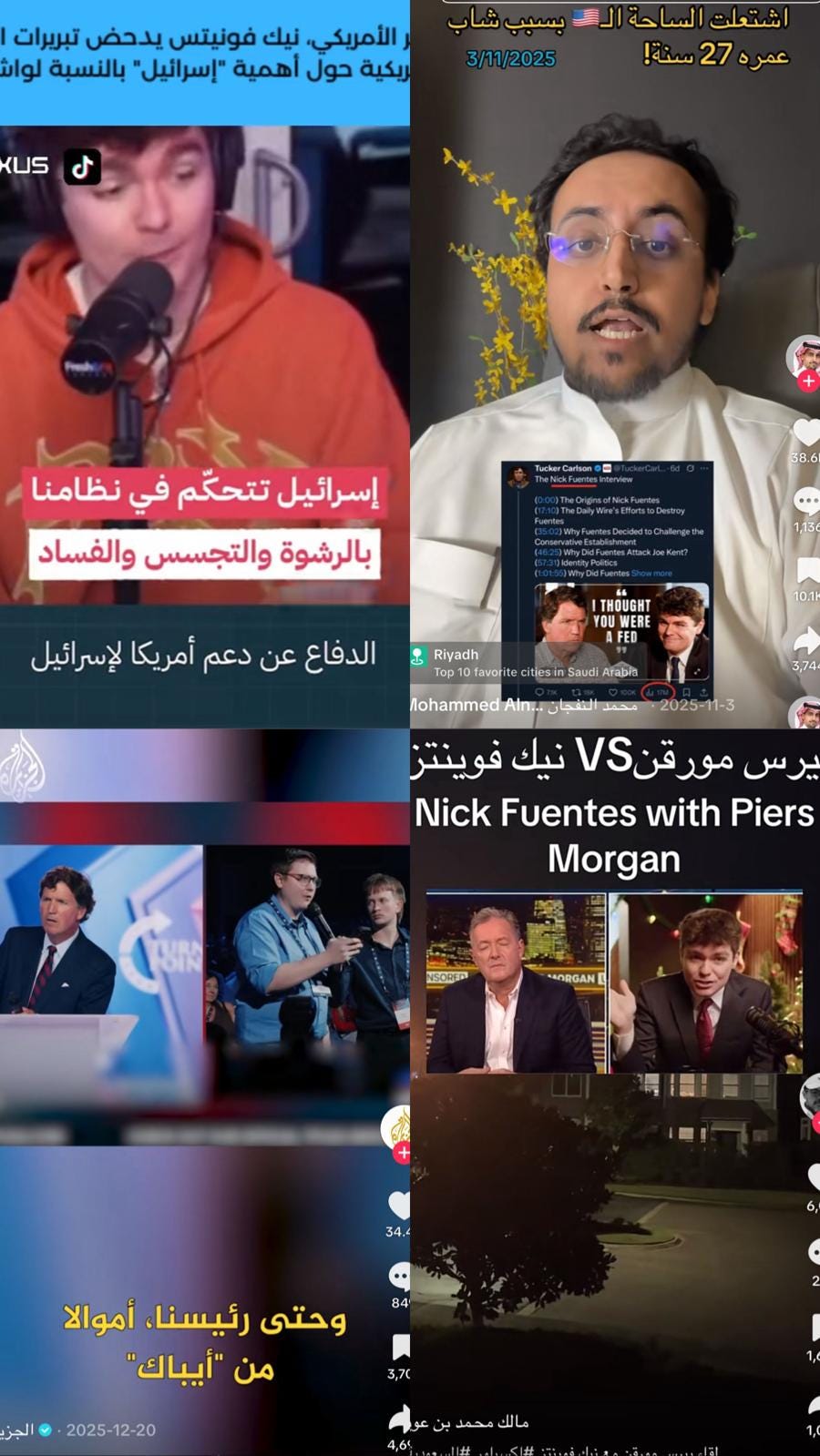
The anonymity is purposeful. If Nick Fuentes were introduced honestly—alongside his views on race, women, democracy, and authoritarian rule—his appeal would diminish instantly. His broader ideology is incompatible with the values of most Arab audiences sharing these clips. The omission enables the content to travel.
Al Jazeera does not need to endorse Fuentes to benefit him. What matters is selective amplification. Segments of Carlson’s content that align with Al Jazeera’s framing of Israel and American power are clipped, translated, and pumped into the Arabic media bloodstream. From there, they are picked up by influencers, meme pages, and political accounts that thrive on outrage and affirmation. The unspoken message is that if even prominent Americans are saying this, it must be true.
The effect is a feedback loop. Western extremist rhetoric is laundered through Arab media circulation and re-emerges as valid opinion.
None of this is an argument against criticizing Israeli government policy or U.S. foreign policy. Those critiques are legitimate. Defending Palestinian rights is legitimate. But none of that requires antisemitism. Opposition to occupation or military policy is not the same as collective blame, racialized narratives, or recycled myths about hidden Jewish power. When those lines are crossed, political critique turns into something else—and credibility is lost in the process.
What is unfolding online is troubling. A segment of the American far right and parts of the Middle East’s ideological media space are finding common ground in hostility toward Jews, even if they arrive there through different histories and vocabularies. In the U.S. far right, antisemitism is framed as resistance to “globalism” and liberal elites. In much of the Middle East, it is framed as anti-imperialism or “resistance.” Different language, same target.
That is why figures like Fuentes can be celebrated in spaces that would otherwise reject everything he stands for.
Fuentes and Carlson clips rack up millions of views on TikTok. Arabic captions praise their “courage” and “honesty.” Comment sections are filled with applause rather than scrutiny. This is how extremism spreads now—not through manifestos or lectures, but through emotionally charged clips severed from context and responsibility.
This trend does not meaningfully advance Palestinian liberation, challenge Western hypocrisy, or weaken Israeli power. What it does is import Western extremist ideologies into Arab discourse and bind legitimate grievances to figures who openly reject pluralism, equality, and democratic values.
Celebrating figures like Fuentes does not empower the Arab world. It diminishes it. In the name of opposing injustice, parts of the Arab media ecosystem are amplifying voices that would gladly see the region marginalized, ruled by authoritarian ethno-nationalism, or written off entirely—while maligning Jews in the process.
Middle East Uncovered is powered by Ideas Beyond Borders. The views expressed in Middle East Uncovered are those of the authors and do not necessarily reflect the views of Ideas Beyond Borders.
