


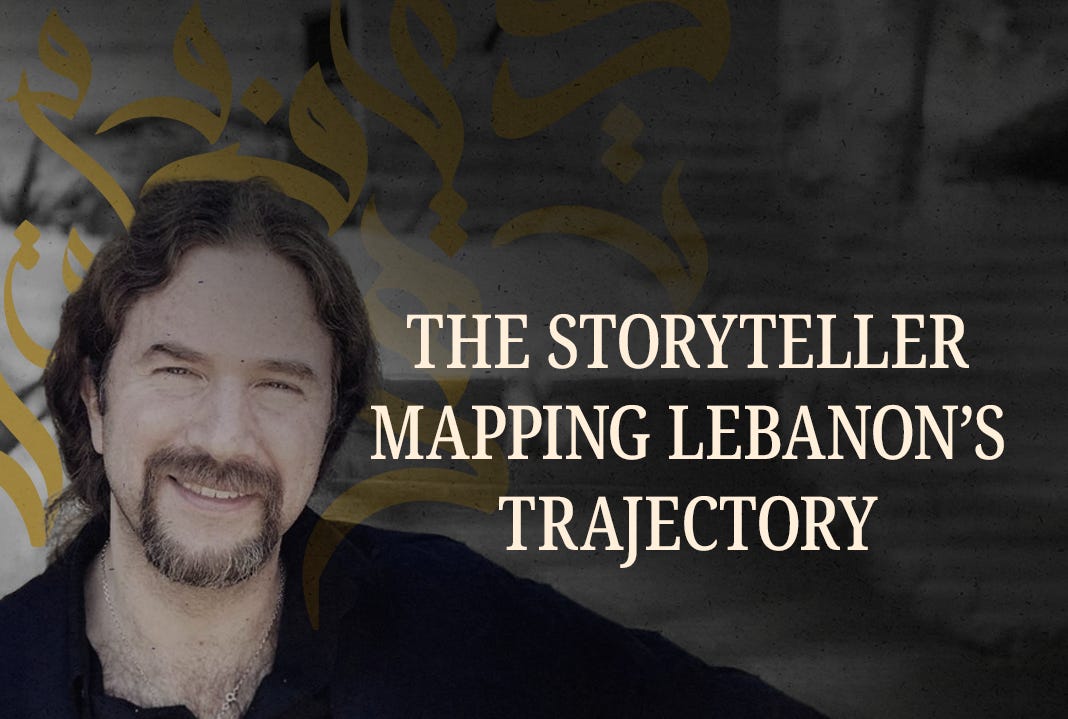
Ronnie Chatah greets me over Zoom with the calm assurance of someone who has spent years explaining Lebanon to audiences who only think they understand it. He speaks with precision and warmth, with a voice that makes complex ideas feel legible without flattening them.
From the first moments of our conversation, it’s clear that he sees Lebanon as a complicated but beautiful country shaped by trauma, a people unwilling to cede their dogged sense of hope, and a history that never quite stays confined to the past.
Chatah is 44, and, by his own count, has seen “one too many wars” in Lebanon. Growing up, conflict arrived in cycles: chaos followed by a stretch of “relative calm,” a little growth, and then regression again.
How he sees Lebanon now is filtered through those cyclical repetitions. When I ask whether the latest shifts—a new president, another ceasefire with Israel, and foreign envoys shuttling through Beirut—have changed anything, he doesn’t hesitate.
“I’m not a big fan of putting too much expectation on moments of what looks like maybe perceived hope,” he tells me. He has seen this movie before: international enthusiasm, big speeches, headlines about turning points—and then the slow slide back into stagnation.
Since early 2025, Lebanon has had a new president: Joseph Khalil Aoun, a former army commander, who was elected after more than two years of political deadlock. His rise was hailed in some corners as a sign that Iran’s influence might be waning and that the Lebanese state could finally reclaim some authority.
Inside Lebanon, the reality has been more complicated. Aoun has pushed to revive the 1949 armistice agreement with Israel and expand indirect talks over the border, arguing that this is the only way to stop Israeli airstrikes and secure the release of Lebanese captives.
Hezbollah condemned the move as a “blunder,” warning that the state would be making concessions without getting anything real in return.
Chatah isn’t shocked by this kind of standoff. For him, it’s not a story of heroes and villains, but of expectations colliding with structures that haven’t changed.
“The president spoke a language of concern,” he says. “He sounded proactive on neutralizing Lebanon. People heard that and thought, ‘Maybe this time.’ But he’s still a consensus president. Without Hezbollah’s blessing, he wouldn’t have become president. So how far can that go?”
He pauses.
“I think people had higher expectations than they should have.”
Chatah spends much of his professional life talking about the consequences of political violence and armed sub-state groups like Hezbollah—often, as he puts it, to make sure the group doesn’t win a false narrative it has attempted to construct of pro-Palestine and anti-Israel resistance.
As Iran confronts renewed internal unrest driven by economic collapse, public dissatisfaction, and mounting pressure on the regime, the question of how that instability reverberates across the region has become unavoidable. For Lebanon, the stakes are especially high. Iran’s relationship with Hezbollah has long been framed as a question of bandwidth: does Tehran, when under stress at home, pull back from Lebanon, or lean on it more aggressively?
Chatah rejects the premise. In his view, Iran’s regional posture is inseparable from regime survival itself. If the regime were ever to face an existential threat, he argues, restraint would not be the likely outcome. “If the regime is really at risk of falling,” he says, stressing that there is “no indication as of yet that that is what’s happening,” his assumption is that Tehran would “activate their proxies as a last means of survival.” In that scenario, Lebanon would not become quieter. It would likely become “far more volatile before the end of the regime there in Tehran.”
Chatah also cautions against assuming that domestic instability reduces Iran’s capacity or willingness to project power through Hezbollah. He describes the relationship not as a discretionary investment but as “an organic, very, very critical relationship” tied to Iran’s survivability “both at home and abroad.” Even after Hezbollah suffered heavy losses in the most recent war with Israel, and even amid growing pressure for disarmament, “Iran still funds this militia as it exists.” For Chatah, Lebanon remains a frontline because Tehran has structured its regional strategy around militias beyond its borders.
What has changed, he argues, is Hezbollah’s autonomy. As Israel has hit the group aggressively, “Iran is in more control of Hezbollah than it would like to be,” he says. “The autonomy of the group has been sacrificed entirely.” That tighter command-and-control relationship, he adds, is not a sign of Iranian confidence but of overreach—an uncomfortable arrangement born of losses rather than strength. Whether Iran’s internal turmoil deepens or stabilizes, Chatah’s assessment is that Hezbollah remains central to Tehran’s calculations, and Lebanon remains exposed to the consequences.
“The Hezbollah of pre-October 8, 2023, will never reemerge,” he says. In his telling, the militia-party that spent four decades perfecting its role as Iran’s most successful proxy—subduing the Lebanese state, shaping its security, steering its foreign policy—was broken by last year’s war. Not by Lebanese politics, and not by some sudden flash of accountability, but by the sheer cost of the confrontation itself.
“They lost their entire command structure and their secretary general, who at some point was more prophet-like than a militia leader,” Chatah says. “That Hezbollah is over.”
What exists now, in his view, is something more naked: a group less autonomous, more directly an “organic reflection of the Iranian regime in Lebanon.” A Hezbollah that may never again be able to wage a full-scale war with Israel, not because it doesn’t want to, but because the price it paid was too high.
Meanwhile, the war itself never fully ends.
A ceasefire separates Israel and Hezbollah on paper, but drones overhead, artillery exchanges on the border, and periodic airstrikes put Beirut back into the headlines. Israel has hit Hezbollah targets in the southern suburbs multiple times (as recently as this week) since the truce, including strikes on underground infrastructure and operations that killed senior commanders. Israel claims the country has not upheld its end of the ceasefire agreement, which included a Lebanese pledge to disarm militant groups.
For most Beirutis, the pattern is familiar. Explosions a couple of kilometers away, the eerie hum of drones, and the quiet everyday calculation of how close is too close.
“In times of war,” Chatah says, “there’s a serious risk simply being in Beirut. But I don’t think the Israelis are interested in disarming Hezbollah. They’re interested in preventing future war with Hezbollah. That’s their concern.”
He says it with the resigned clarity of someone who has learned to live inside that gap between what’s morally necessary and what’s politically likely.
If you only followed Lebanon through breaking-news alerts, you would think the country oscillates between violence and ceremony—airstrikes in the southern suburbs, diplomatic visits and symbolic prayers—rarely pausing long enough to show how people actually live in between.
Late last year, Pope Leo finished his first foreign trip with a waterfront Mass in Beirut, praying for peace and visiting the ruins of the 2020 port explosion—a blast that killed more than 200 people and has become a symbol of Lebanon’s broken justice system.
He stood at the blast site alongside officials accused of obstructing the investigation, calling for accountability while victims’ families listened. Later, he joined Christian and Muslim leaders in Martyrs’ Square to praise Lebanon’s tradition of coexistence—a reminder that this tiny, exhausted country is still home to the largest Christian population in the Middle East, and to a constitutional system that insists, at least on paper, that power be shared.
Chatah watched it all with a sense of déjà vu.
“John Paul II came to Lebanon in 1997,” he says. “It’s almost repetition—the same messages, the same expectations, the same pain. Thirty years later, we’re still here, still not going the way we should.”
He is not a religious man. “I have no relationship to God,” he tells me, but he went out to see the pope anyway. He is drawn to moments that reveal Lebanon’s contradictions: a Christian president welcoming a pope in a country where many Christians have emigrated; Hezbollah supporters waving Vatican flags while their movement’s leaders reject disarmament; a multi-faith crowd cheering a man in white robes against the backdrop of drones and debt.
“The country is broken,” he says, “but it’s also genuinely tolerant in ways you don’t find in many places. That’s something I cherish. Beirut is still a cosmopolitan city that pulls in the region’s best—or used to, at least.”
People keep asking Chatah what he is. Analyst? Historian? Activist? Advocate? He’s given so many talks, panels, podcasts, and TV hits that the question feels inevitable.
“That’s the only question I struggle with answering,” he admits. “I don’t know the answer.”
What he does know is that his work revolves around storytelling, around taking things back in time, but not so far back that they harden into museum pieces. He is allergic to both exoticized portrayals of Lebanon and the romanticization of “resistance.” He doesn’t want former Hezbollah leader Hassan Nasrallah to be revered by anti-colonial and anti-imperialist advocates, but he also doesn’t want criticism of Hezbollah to slide into sectarian hatred or simplistic geopolitical binaries.
“I live in that space,” he says—the uncomfortable middle, where extremism from any direction looks more similar than different once it reaches its edge.
He has spent years walking people—literally—through Beirut’s living memory with his WalkBeirut tour (currently on hold due to the ongoing crisis), stopping at intersections where Ottoman villas lean into French-era facades and glass towers, and explaining how a broken political system rose from the rubble. He later built The Beirut Banyan podcast as a kind of audio extension of those walks, a place where conversations about politics, history, and grief can breathe.
He knows what political violence feels like up close. In 2013, his father, the economist, former finance minister, senior foreign affairs advisor, and Ambassador to the US Mohamad Chatah, was assassinated in a car-bomb attack downtown attributed to Hezbollah.
Chatah has said he no longer expects Lebanon’s political system to produce a serious investigation or meaningful accountability, whether in his father’s case or in other political assassinations. But he insists he is not a cynic.
“Not cynical,” he insists. “Cynicism is an ugly trait. I don’t like cynicism. But yes, I am pragmatic.”
The distinction matters to him. Cynicism suggests giving up on meaning; Chatah is still betting on it.
On paper, Chatah’s “community” is made up of diplomats, analysts, ministers, and—increasingly—influencers. He’s on calls with cabinet officials one moment and going back and forth with anonymous TikTok geopolitics “experts” the next.
But he doesn’t mistake any of that for friendship.
“None of that is pleasure,” he says. “Real pleasure and real friendship have nothing to do with this stuff.”
His favorite nights are spent in the mountains, looking at the sky with people who want to talk about anything but Lebanon’s latest crisis. He gets visibly uncomfortable at the idea of an ideological friend group.
“I get turned off when it’s an echo chamber,” he says. He wants disagreement at the dinner table, not just on cable news.
And despite job offers abroad, he hasn’t left Lebanon in six years. “I do what I can to make opportunities remote,” he says, half-joking. “Everyone says, ‘You have to leave, you have to work in the office.’ I prefer not to.”
He has lived in Texas, Virginia, the Czech Republic, and the UK. When I ask him about his favorite place outside Lebanon, he surprises me by naming Washington, DC.
“Maybe it’s the right size,” he muses. “And there’s a real reflection of the world in that city, too. Beirut has a version of that.”
What keeps him tethered isn’t faith or blind optimism. It’s a stubborn insistence that Lebanon’s pluralism, its strange experiment in power-sharing among minorities, its free-speech culture and instinctive tolerance, is still worth fighting for.
When I finally ask him what hope looks like, he laughs softly, like he’s been bracing for the question.
“Hope for Lebanon,” he says, “is having this inefficient, outdated, maybe even retrograde experiment—this sectarian system, this weird way of power sharing among minorities—begin to function again in a way that’s meaningful and not compromised by war.”
For Chatah, tangible progress won’t arrive as another brief tourism boom or a couple of good summers. Lebanon’s flourishing requires sovereign resolution, an end to being used as a launchpad for other countries’ wars, and a foreign regime that no longer shapes the country’s security and foreign policy through local militias.
He doesn’t need to see the happily-ever-after himself to wish for it.
“I’d like to see the page turn,” he says. “Maybe a chapter closing by the end of my life. I don’t need to see how it works long term. I don’t have that much time. But I’d like to see it at least flicker again and begin to work.”
Outside, the drones keep circling over Beirut. Down on the waterfront, memories of the pope’s Mass and the port blast sit uneasily together. In Baabda, the president is busy reassuring foreign envoys that Lebanon wants peace while arguing with a militia that refuses to disarm.
In the meantime, Chatah keeps doing what he does best: telling the story honestly, so that when Lebanon finally turns the page, someone will remember how we got here.
Ronnie Chatah is the host of The Beirut Banyan podcast (@thebeirutbanyan), founder of the WalkBeirut tour, and opinion columnist for a variety of outlets on Lebanese affairs. You can find him on Instagram, Facebook & Twitter @thebeirutbanyan
Middle East Uncovered is powered by Ideas Beyond Borders. The views expressed in Middle East Uncovered are those of the authors and do not necessarily reflect the views of Ideas Beyond Borders.