


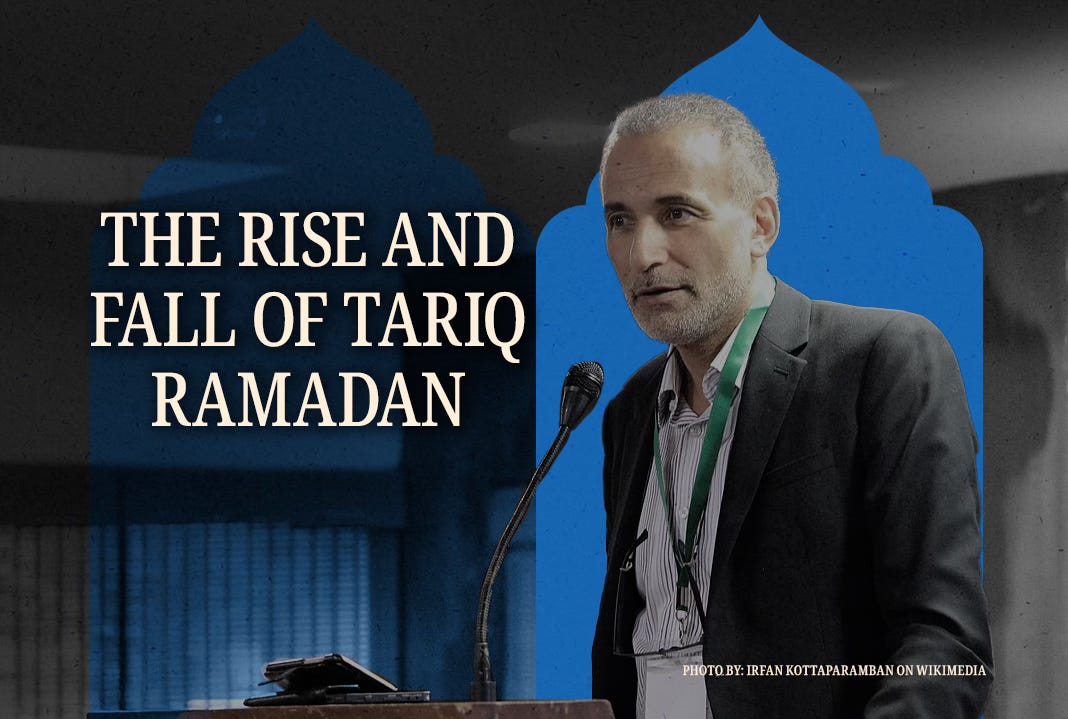
In a 2009 interview on a Canadian-Islamic channel, Tariq Ramadan discussed his views on women’s rights in Islam. “I don’t think Islam has a problem with women—Muslims have,” he said.
Ramadan, then a professor at Oxford University, argued that Muslim societies are mostly concerned about the roles and functions of women, when “the starting point should be your relationship with God.” Muslims must “speak about women as beings,” he said, and the hijab must not be enforced. “It’s against Islam to impose on a woman to wear the headscarf, and it’s against women’s rights to impose on her to take it off,” Ramadan continued.
This was during the peak of his career. At the time, Ramadan was a star in the Muslim world, his charisma and progressive views on Islam drawing concert-sized audiences. Many women saw him as a defender of their rights, and Time magazine named him among the 100 most influential people in the world in 2004.
That all changed in 2017, when Ramadan was accused of sexual assault. Last month, a Paris court sentenced Ramadan—in absentia—to 18 years in jail for raping three women.
He had already been convicted in Switzerland in 2024 for a separate rape case.
Ramadan’s lawyers said the 63-year-old was being treated in Geneva for multiple sclerosis and condemned the trial as a farce. To this day, he continues to claim the charges are politically motivated, citing Islamophobia.
Though a warrant has been issued for Ramadan’s arrest, Switzerland does not have an extradition treaty with its neighbor. Ramadan also faces a permanent ban from French territory.
The long-awaited conviction marks the latest fall from grace of a man who posed as a leading “moderate” figure, despite his family background. Ramadan’s maternal grandfather was Hassan al-Banna, who founded the Muslim Brotherhood in Egypt in 1928, and his father, Said Ramadan, was one of the organization’s leading figures.
The making of his public persona can be traced to the 1990s, when, during his burgeoning interest in Islam, he undertook intensive religious studies in Egypt before returning to Switzerland. In his 2009 book, What I Believe, Ramadan describes his spiritual awakening as a desire to “build bridges” between the Western and Islamic worlds. He said that he favored an interpretive rather than a literal reading of the Qur’an.
Western liberals embraced Ramadan as a bridge between cultures. Born in Switzerland, fluent in French and English, he cut a suave, liberal figure for a Western audience while retaining a certain authority in the Muslim world.
Although he insisted that he disavowed the views of his fundamentalist grandfather, some observers noted that his dissertation on Hassan al-Banna’s work appeared sympathetic. Charles Genequand, his principal supervisor in the 1990s, said Ramadan’s thesis was “trying to place Hassan al-Banna within a reformist movement of Islam that existed in the 19th century, while camouflaging his very conservative vision.”
The Muslim Brotherhood, whose slogan is “Islam is the solution,” is designated as a terrorist group and banned in Egypt, Saudi Arabia, and the United Arab Emirates. The US government has taken steps to label specific foreign branches of the Muslim Brotherhood as terrorist organizations.
Ramadan’s association with Yusuf al-Qaradawi, a prominent Muslim Brotherhood cleric based in Qatar, also raised some eyebrows. Egyptian-born al-Qaradawi had previously defended suicide bombings and claimed the Holocaust was a “punishment” for Jews.
Ramadan’s ambiguity was further exposed during a televised debate on secularism and Islam. Nicolas Sarkozy, then interior minister, tried to get the scholar to condemn the Islamic punishment of stoning for adultery. Instead, Ramadan said there ought to be a “moratorium” on such practices.
It’s no wonder the French writer Caroline Fourest argued that Ramadan presented a moderate face to Western audiences while conveying different messages to the Muslim world.
Despite these emerging contradictions, Ramadan’s rise continued. In 2005, he was awarded a fellowship at St Antony’s College, Oxford, and in 2009, he was appointed to the University of Oxford chair in Contemporary Islamic Studies funded by Qatar. Ramadan seemed untouchable. Ultimately, it was sexual misconduct that would undo him, as it has so many other powerful men.
In 2017, the #MeToo movement came for him with multiple allegations of sexual assault in France and Switzerland. One of the victims was Henda Ayari, a former Salafi Muslim. She said she approached Ramadan at a time in her life when she felt “lost and weak”. Ayari was separated from her husband and had been told to remove her Islamic veil to find work.
After contacting Ramadan online for advice, the mother of three agreed to meet him in his Paris hotel room in 2012. He “kissed” her, “choked me so hard I thought I would die,” “slapped” her, cursed at her, and “humiliated” her before raping her. “He pounced on me like a wild animal,” Ayari said.
She blamed herself for meeting him alone and remained silent for many years, claiming he’d threatened her children.
Another woman—a disabled Muslim convert known as “Christelle”—alleged that she was raped and beaten by Ramadan in a hotel in Lyon in 2009. She provided investigators with messages and identified an intimate scar on Ramadan’s body.
Then others began coming forward. Several women claimed Ramadan had conducted sexual relationships with them when they were underage students in Geneva. One girl who rejected his advances was 14.
Initially, Ramadan denied having sexual relations with the woman. But following his 2018 arrest in France, an investigation revealed text messages exchanged between him and Christelle that appeared to corroborate her version of events.
“I sensed your discomfort … sorry for my ‘violence’. I liked it … Do you want more? Not disappointed?” he wrote to her the following day. A few hours later, he wrote: “You didn’t like it … I’m sorry [Christelle]. Sorry.”
Ramadan was forced to admit he’d had affairs with at least five women, but insisted they were consensual. No wonder the married father of four wanted a “moratorium” on corporal punishment—under Islamic law, the punishment for adultery is stoning to death.
As legal pressure mounted, Ramadan was in and out of the hospital with multiple sclerosis. His lawyer argued that his condition was “incompatible with detention”, and he was released on bail after 10 months.
Throughout it all, the academic has framed the charges as being politically motivated, claiming most of it was down to Islamophobia. In his 2019 book Devoir de Vérité (Duty of Truth), he compared his legal troubles to the 19th-century Dreyfus Affair, claiming he was the victim of a political witch-hunt. Just as French captain Alfred Dreyfus was wrongfully convicted of treason on account of his Jewish heritage, Ramadan was, he said, being framed in an “anti-Muslim” plot.
In some of the media coverage, Ramadan was able to claim, largely unchallenged, that he was the target of a “witch hunt” and that his enemies “worked together with the Zionists” on his downfall.
His accusers also feared they would suffer if court proceedings were open to the public. One woman alleged she was spat upon, slapped, insulted, and followed by his supporters.
Moreover, the response from institutions was far from immediate. Oxford University allowed Ramadan to continue teaching for three weeks before granting him a leave of absence. Eugene Rogan, the director of Oxford’s Middle East Center, argued that some students felt it was “another way for Europeans to gang up against a prominent Muslim intellectual.
“We must protect Muslim students who believe and trust in him, and protect that trust,” Rogan said.
This prompted concerns that Ramadan was being held to different standards on account of his religion. Then, in September 2024, a Swiss appeals court in Geneva convicted the scholar of rape and sexual coercion, overturning a previous acquittal from 2023. He was sentenced to three years in prison, with one year to be served, following an attack on a woman in a Geneva hotel in 2008. Two years on, a Paris court has found him guilty of raping three women.
As Ramadan was hospitalized in Switzerland, he was tried in absentia. Switzerland does not generally extradite its citizens, making it unlikely that he’ll actually serve his sentence. Ramadan has also announced that he will appeal.
For many years, Tariq Ramadan’s contradictions and doublespeak were glossed over by a Western audience that desperately wanted to believe in an Islam that could be compatible with European societies. Unfortunately, it came at the expense of women’s dignity—something, ironically, that this venerated Islamic scholar had been claiming to defend.
Middle East Uncovered is powered by Ideas Beyond Borders. The views expressed in Middle East Uncovered are those of the authors and do not necessarily reflect the views of Ideas Beyond Borders.
The strength of Tariq's ideas are not affected by the legal campaign against him. The modernization of Islam and specifically the criticism and reform of Fiqh are trends globally in many countries, they will continue as 2B persons and their neighbors engage human journey, discover new knowledge and adapt to new society and choices. Fiqh and the scholarly systems are powerful tools that are employed to different ends. As ethic systems that help form country cultures and bolster the procreative capacity of families and in turn the learning and adaptability of children to modern labor. And in the political realm as tools for political trends, ranging from supremacist-nihilist jihadi revolt in west Asia and the Sahel, to the industrializing state of Iran that has shouldered the burden of self determination for west Asia and is today weakening the regressive western hegemony and control over the Gulf.
Islam is much more important to the building of Europe than a 'bridge', it is a major demographic in a few countries that has been paternalized under the western liberal eurotard wing that is dragging down the continent with wars on energy, productivity, responsibility and Russia. Fiqh includes culture of responsibility. A political realignment that ranges together the trends that stand for responsibility and the ethics of human journey (including Christians, nativists and materialists), against the liberal neutrality toward ethics which is a soft nihilism, can accelerate European rebuilding.
A prescient position of Tariq in 2009 was calling to establish ethic councils composed of religious and non religious domain experts to monitor and recommend controls on emerging technology. The continued advance of intelligent software and newest inventions of compute and AI has revealed new novel hazards amidst fantastic productivity potential. Assisted teen suicides by ChatGPT are an extreme example of liberal neutrality toward ethics in practice. Some American firms are learning a specific neutral i.e. nihilist ideology 'Effective Altruism' into LLMs.
Automation will drive higher conceptual and autonomous ethical capacity of practitioners and it is unlikely that the latest turn of liberalism to neutrality toward ethics can support the cultivation of modern labor which relies on families and schools raising children toward challenge and hence stable emotions and psychic structure that can focus and learn. The well of senior ethic systems - Islam, Christianity, Indian (Vedic, Jain, Buddhist), materialism and ancestor veneration - needs to be elevated for automation, to create a generation of workers that can automate society.
The metoo mudslinging is as old as the state. The capacity to generate conspiracy theories reached a new scale with the epstein nonsense. Ideas need to be judged on their own merit, and recourse to conspiracy theories or smaller scandals indicates inability to digest the ideas themselves. As technology advances the ability of larger masses to engage and decide about broader and more complex ideas and institutions becomes critical to avoiding or reducing hazards and violence, and continuing the human journey longer and farther by more persons.