The “Pro-Palestine” Movement is Hijacking the Palestinian Cause
As extremists and activists alike project their fantasies onto Palestine, Palestinians themselves are sidelined—spoken for, misunderstood, and forced to answer for violence they did not choose.
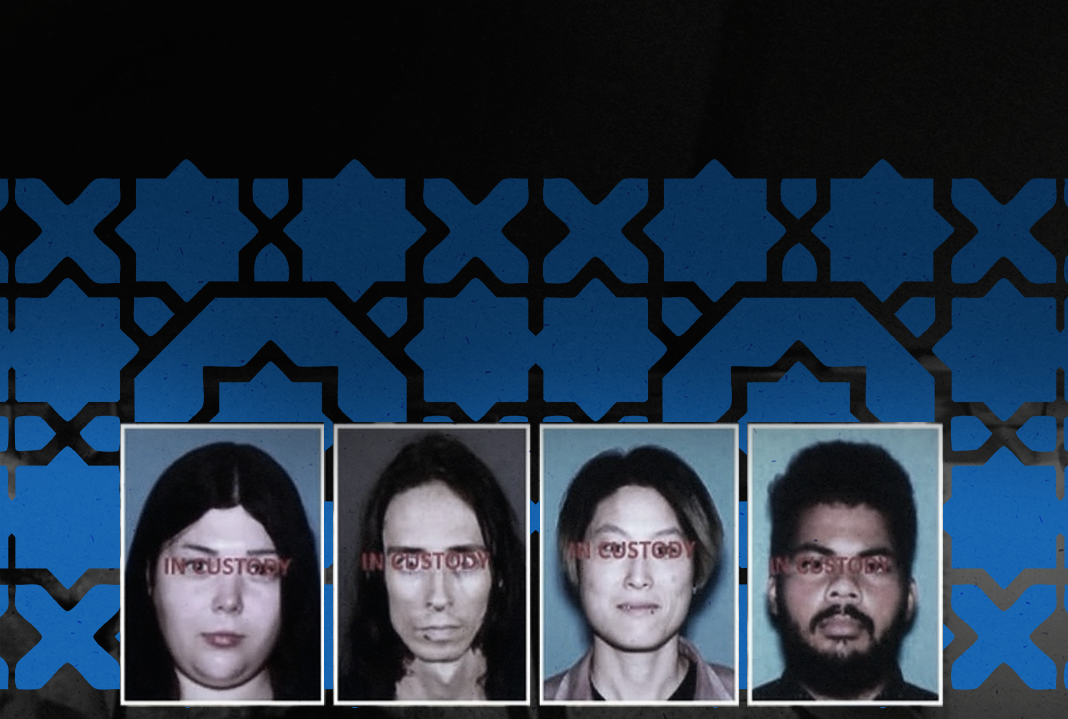
It was an event that passed with relatively little public notice: last Friday, four members of an extremist group called the Turtle Island Liberation Front (TILF) were arrested in Lucerne Valley, accused of plotting a large-scale bombing for New Year’s Eve in Southern California. The group is said to embrace an anti-Western, pro-Palestinian ideology.
Fortunately, the attack was thwarted before anyone was harmed. But the episode points to a broader and deeply consequential pattern.
None of the four defendants had lived in the Palestinian territories—neither the West Bank, East Jerusalem, nor Gaza. They had not experienced occupation, siege, or war; most Palestinians have likely never heard of them. Yet they allegedly planned an attack on U.S. soil in Palestine’s name. And, as so often happens, Palestinians will likely bear the political and social consequences. Public discourse rarely distinguishes between those who act “for Palestine” and Palestinians themselves. Every act of violence committed in Palestine’s name becomes another burden ordinary Palestinians must disavow, explain, or apologize for—often while having no authority over the narrative invoked on their behalf. Such acts compound suspicion, fuel delegitimization, and place Palestinians under a kind of permanent moral probation. Their political claims are reframed as inherently dangerous, while those who embrace militant rhetoric from afar return to their lives largely insulated from the fallout.
This incident reflects a dynamic long visible in segments of the Western pro-Palestine movement, particularly within far-left activist circles. Much of their engagement emerges through the lens of postcolonial theory and radical revolutionary thought—a simplified moral binary of oppressed Palestinians versus oppressive Israel. Influenced by writers like Frantz Fanon, who argued that the colonized possess the moral right to resist “by any means necessary,” some activists police ideological boundaries, treating dissenting Palestinian perspectives as insufficiently authentic. The Palestinian voices most affected by occupation or blockade often find themselves granted only conditional platforms. Calls for “armed resistance,” “freedom fighters,” or “any means necessary” are welcomed; critiques of such rhetoric are dismissed as betrayal.
In practice, this excludes a wide spectrum of Palestinian views. Palestinians who stress civilian protection, governance failures, or nonviolent strategies are often sidelined. As one Western observer noted, protest slogans and solidarity movements frequently drown out Palestinian voices that do not conform to a singular vision of militant resistance—voices focused on ordinary life, coexistence, or criticism of armed groups. Manar Al-Sharif, a Syrian-Palestinian who joined Gaza’s 2019 “We Want to Live” protests and advocates nonviolent resistance, put it bluntly: “Those people are not willing to listen to the people who lived these realities. It is really ridiculous.”
The result is paradoxical. Western activists, distant from the conflict and insulated from its risks, increasingly define what it means to be Palestinian. By valorizing militant frameworks and marginalizing dissent, they inadvertently encourage individuals—like the members of the Turtle Island Liberation Front—to act in the name of a struggle they barely understand. Palestinians, meanwhile, must disavow violence they did not condone and navigate narratives shaped far from Gaza, the West Bank, or East Jerusalem. Solidarity becomes a form of narrative control, in which Palestinian voices are simultaneously claimed, managed, and spoken over.
The picture is no less complicated in Arab and Muslim countries. Historically, Palestine was a galvanizing cause, invoked as a pan-Arab or pan-Islamic struggle. Demonstrations surged during the Second Intifada and during past wars in Gaza. This time, however, the Arab world saw far fewer protests than the West. With the exception of large demonstrations in Morocco and several thousand protesters in Amman, mobilization across the region was limited.
The reasons are largely structural. Since the crackdowns following the 2011 Arab Spring, mass protests, regardless of their cause, have been viewed as direct threats to state stability. Egypt’s Tahrir Square, which once held millions, is now effectively closed to public gatherings. Gulf monarchies have tightened restrictions on assembly. Jordan, where more than half the population is of Palestinian origin, allows only tightly managed demonstrations, wary that broader mobilization could destabilize the monarchy. Elsewhere, such as Sudan, domestic conflict has absorbed public attention and constrained political expression. Ironically, the populations closest to Palestine, geographically and culturally, are often the least able to show solidarity in visible ways.
Caught between Western ideological projections and regional authoritarian constraints, Palestinians find themselves spoken for by almost everyone yet heard by practically no one. Western activists claim to represent Palestinian aspirations while overshadowing Palestinians who challenge militant orthodoxy. Arab publics, though sympathetic, are stifled by states that suppress dissent or calculate the political risks of public mobilization. Palestinians are left to shoulder the consequences of violence committed in their name by distant actors and to watch as their cause becomes a vessel for others’ ideological ambitions rather than a genuine pursuit of self-determination.
The arrests in the United States have further exposed the dangers of acting in the name of Palestine without understanding Palestinian realities. True solidarity requires listening—amplifying the diversity of Palestinian perspectives, valuing nonviolent strategies, and resisting the temptation to impose distant ideological frameworks. Until that happens, activism risks becoming not a form of support, but another mechanism through which Palestinian stories and futures are warped without their consent.
Middle East Uncovered is powered by Ideas Beyond Borders. The views expressed in Middle East Uncovered are those of the authors and do not necessarily reflect the views of Ideas Beyond Borders.


But have they? The first massacre of Jews by Palestinians in the Mandatory British Palestine era was in 1920, then followed like clockwork in 1921, 1929, 1936-1939, 1946-1948, long before the state of Israel. Later we saw the cross border attacks by Fedayeen 1948-1967, the 137 suicide bombings of the second intifada 2000-2005, and the October 7 2023 massacre. In between all of those, a constant hum of terrorism - lynchings, shootings, bombings, knife attacks, car ramming. What we see is that no matter how many times the Palestinians were offered an independent state, they kept rejecting it. They are stuck in a sunk cost fallacy, that surely the next massacre will send The Yahud running (to where? Dunno) and all that wasted time, blood and stolen economic development opportunity will have been worth it. The Free Palestine cult largely aligns with a large portion (if not majority) of the Palestinians on a goal of achieving a genocide and ethnic cleansing fod 7.7 million Israeli Jews.
I appreciate your activism, I agree that two independent states are the only practical solution, and that it’s pointless to expect either side to evaporate. I agree that the Free Palestine cult is excited to fight Israel to the last Palestinian. I agree they don’t care at all about the Palestinians, but rather use them like Arab autocrats as a distraction and excuse to massacre Jews. But I disagree that they aren’t aligned with many (maybe most) Palestinians.