


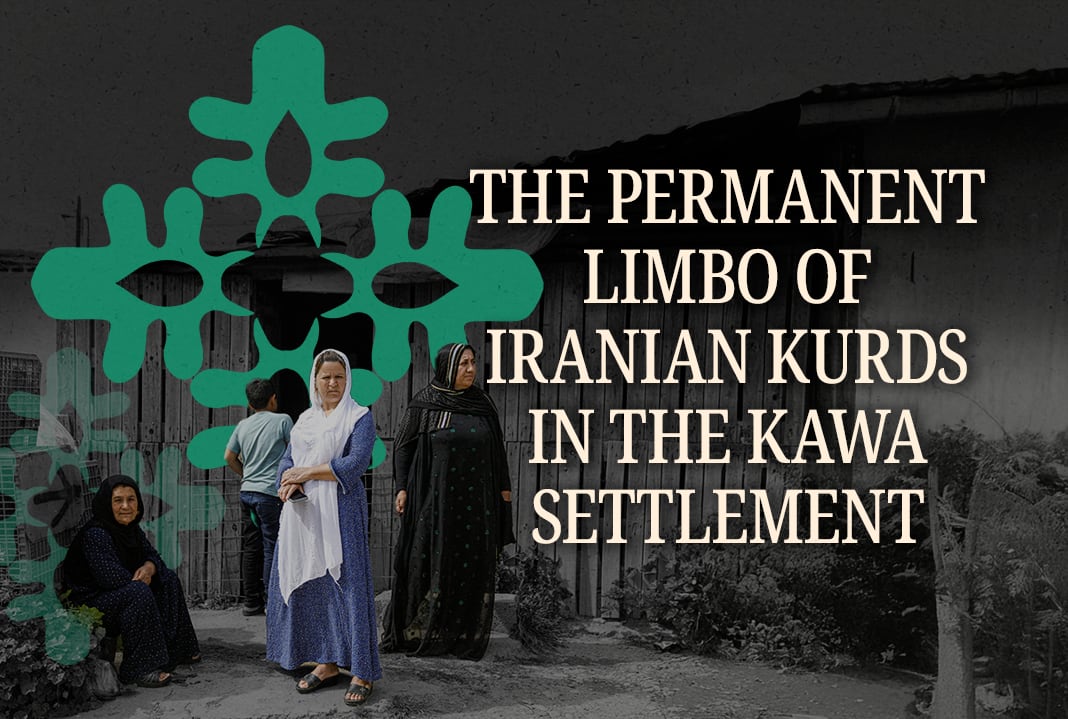
Rows of low concrete houses emerge through the haze of spring heat at the end of a dusty road, some 30 kilometers south of Erbil, in the Kurdistan Region of Iraq (KRI). A line of workshops and shops sits almost empty; their owners stand at the doorway waiting for customers who rarely come.
This is Kawa, an informal settlement of poorly managed roads and small concrete units—the epicenter of a suspended existence. Home to hundreds of Iranian Kurdish families, here it feels like time has stalled.
Raheem
In the shade of a storefront, a woman sits watching the street. Behind her, inside a small workshop, Raheem Abdulmuhamad Mahmoud is at work.
Now in his fifties, Raheem arrived here in 2005 from Anbar, in southern Iraq. Like thousands of others, he left Iran as a child following the 1979 Revolution. “I was about six years old when we got here from Iran, during the Iraq-Iran war,” he recalls.
Raheem’s journey mirrors that of the thousands of Iranian Kurds who fled persecution under Ayatollah Khomeini. Most were settled at the Al Tash camp near Ramadi, which hosted over 12,000 people across two decades. Built in the mid-1980s by the Iraqi government, the camp became home for families later recognized as refugees by the United Nations High Commissioner for Refugees (UNHCR).
For many, the journey was a long arc toward Kawa. Following the 2003 fall of Saddam’s regime, the lack of safety in central Iraq—exacerbated by Al Qaeda and intense fighting—pushed them to flee once again.
As Al Tash became hostile ground due to constant attacks and deteriorating services, residents sought shelter elsewhere.
By 2005, the UN refugee agency and the Kurdistan Regional Government (KRG) agreed to create the Kawa settlement. Tents sprang up 30 km south of Erbil with support from a local NGO; what began as a temporary refuge quickly became a permanent home.
Yet, decades later, the legal status of these families remains frozen. According to UNHCR data from March 2026, there are approximately 8,953 Iranian refugees and asylum seekers in Iraq today.
Survival in Kawa is a permanent struggle for daily wages. Raheem cleans chickens for his neighbors, a job demanding on his health. “I don’t even sell chickens; I just clean them for 1,000 IQD ($0.65),” he explains.
After nine years, the toll is evident. “I got an allergy from the feathers, and I’m not supposed to be doing this job anymore, but I’m forced to, because there are no other options for me here.”
After decades of being displaced, Raheem faces the harsh reality of statelessness. His only official document is his Iqama—the residency card issued by the Kurdistan Region of Iraq (KRI) to foreigners. While it grants a legal presence, the lack of full citizenship limits employment opportunities, leaving essential healthcare financially out of reach.
“We have no citizenship, no rights,” Raheem says. “I need an eye surgery very urgently, and I cannot afford it; I am just waiting, and no one has helped me.” He blames the UN for treating his community as a closed case. “The UN has mistreated us.”
Hiwa
Born into displacement, Hiwa—whose name has been changed for security reasons—runs a small butcher shop. In his early thirties, he is part of a generation that has never known Iran, a place his family left behind long before he was born. Born in Iraq, he arrived at Kawa as a teenager around 2007, spending seven years in a tent before moving into a concrete unit. Today, he bears the scars of a life belonging nowhere.
“My parents are both Iranian, but I am stateless,” he says, his voice carrying a long-held frustration. “What is the sense in me being stateless? I haven’t made any mistakes.”
Because his family lacks Iranian documentation, they cannot return, even to visit. “We only have the Iqama,” he says, his reality stark: ‘We are stuck here because Iran doesn’t want us and Iraq doesn’t take us; we feel stuck in the middle.”
Maintaining an Iqama is a hurdle, requiring a local sponsor and a yearly fee. While it grants rights to housing and private-sector employment, it forbids movement into Federal Iraq. For those without it, the only link to the system is a UNHCR certificate—a document required for legal residence—yet many here dismiss it as “useless”.
Like his neighbors, Hiwa has a young family and struggles to make ends meet. He opened his shop at 5:00 am, but by midday, he had barely any customers.
“People are living completely hopeless,” he says. “If there were a chance, they would go to Europe walking.” He describes a neighborhood where men work in construction, street cleaning, or painting, earning a meager 300,000 IQD ($228) per month. But even this small income is precarious. “Some days they don’t make any money because it all goes to transportation,” Hiwa explains. “If we were not hard workers, we would have died starving.”
Saeed and His Wife
Inside a spacious living room, a woman reflects on a life spent in suspension while her husband is busy with the midday prayers.“We are burned with displacement,” she says.
The couple, parents to six children, crossed into Iraq in 1980. They describe the ensuing forty years as a single, decades-long struggle. “We have had no future at all,” she explains. “Our children cannot get jobs, and we cannot obtain any official documents, so we don’t have any rights to work. We just manage with day-to-day labor.”
Originally from the Kurdish province of Kermanshah, their lives were upended by the outbreak of the Iran-Iraq war. Veterans of Al Tash, they found themselves starting over again in 2006 upon reaching Kawa.
The reality of their status soon set in: without recognized documentation, their children—now aged 13 to 22—are ghosts in the system. Their educational certificates are not recognized, and they cannot pass any checkpoints outside the Kurdistan Region. “We have nothing here,” Saeed Ahmad says bluntly. “My kids have a UN paper to go to school. But our future is lost.”
Their reliance on casual labor brings in less than 10,000 IQD ($8) per day, leaving them in debt and falling behind on electricity bills.
Saeed blames the UN for their “permanent limbo”, recalling the 2005 move as a betrayal rather than a rescue. Here, the feeling among many is one of abandonment. “The UN threw us here, left us alone, and they didn’t care,” his voice sharpens. “It’s been seven or eight years; they haven’t even visited us.” He notes that the Kurdish government warned the UN at the outset that they could only provide land and school enrollment, not ongoing aid.
Today, the couple renews their UN documents every two years but has lost all faith in the paperwork. “We cannot even go through a checkpoint with it. We cannot get jobs, education. It’s useless—just a piece of paper.”
Saeed’s frustration is palpable. “It’s not logical that we have been here for 47 years and don’t have any rights,” he says. “We want Iraq either to give us citizenship or throw us back to Iran.”
While Iraqi law theoretically offers a path to citizenship after 10 years’ stay or marriage, administrative hurdles make it impossible for Iranian Kurdish refugees.
When asked about returning home, the couple is hesitant regarding political shifts in Iran; what they need are practical reassurances of safety. “We don’t care if the regime falls or not,” Saeed says. “But if they compensate us, take us back legally, and pass an amnesty law, it would be better than living here.”
Ultimately, Saeed and his wife only wish to exist within the law, whether here in Iraq or back in Iran.
Hussein
The reality of a double displacement is the story of a people who, after fleeing Iran, found themselves packing again when life became dangerous even in Iraq. Hussein Gholam Ali, an elderly man, experienced the loss of security a second time in Iraq firsthand. While the Iranian Kurds in Ramadi had been provided three-month food parcels by the government, that support ended abruptly in the summer of 2003.
For Hussein, now living in a house built by an NGO, survival is a matter of collective charity. He points at his belongings, noting that almost everything was donated. “Some people bring us money and donations every month,” he says; it is the only way his family carries on.
Sitting on a rug, he shows his bruised legs. “I have many diseases—heart surgery, blood pressure issues,” he says. His condition prevents him from working, leaving his son as the sole breadwinner for a family with no safety net.
Hussein has no intention of returning to Iran. With family connections long since severed and the ongoing tensions, a future in Iran is impossible to imagine. ”They are being bombed, everything is way too expensive,” he notes. “And we have been here very long.”
For now, Hussein’s life depends on the kindness of strangers. While he holds an Iqama, his lack of stable income means he cannot afford the medications he desperately needs. He expresses deep gratitude toward a doctor who provides his medicine for free—a small mercy in a life defined by instability.
In Kawa, reality is a fragile existence where survival depends on the solidarity of individuals, rather than in local institutions or a UN system that has failed people. Residents continue to lean on one another, waiting for a rights-based future that remains out of reach.
Stella Martany contributed translation and local research for this report.


Middle East Uncovered is powered by Ideas Beyond Borders. The views expressed in Middle East Uncovered are those of the authors and do not necessarily reflect the views of Ideas Beyond Borders.
