


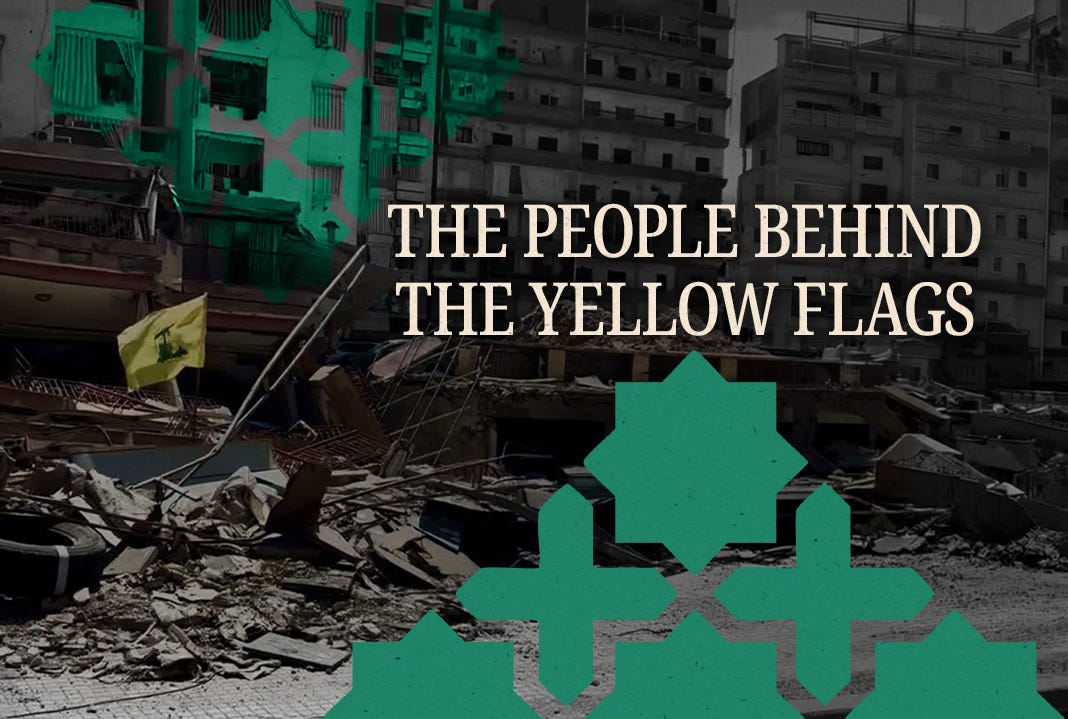
The high-pitched whine of a low-flying drone hangs over Beirut’s southern suburbs. Below it, excavators chew through mountains of concrete. Between the shattered bricks lie fragments of ordinary lives. A child’s toy, family photographs, a soot-blackened sofa, a single Christmas stocking. On top of one pile of rubble, a fresh yellow flag flutters in the summer wind.
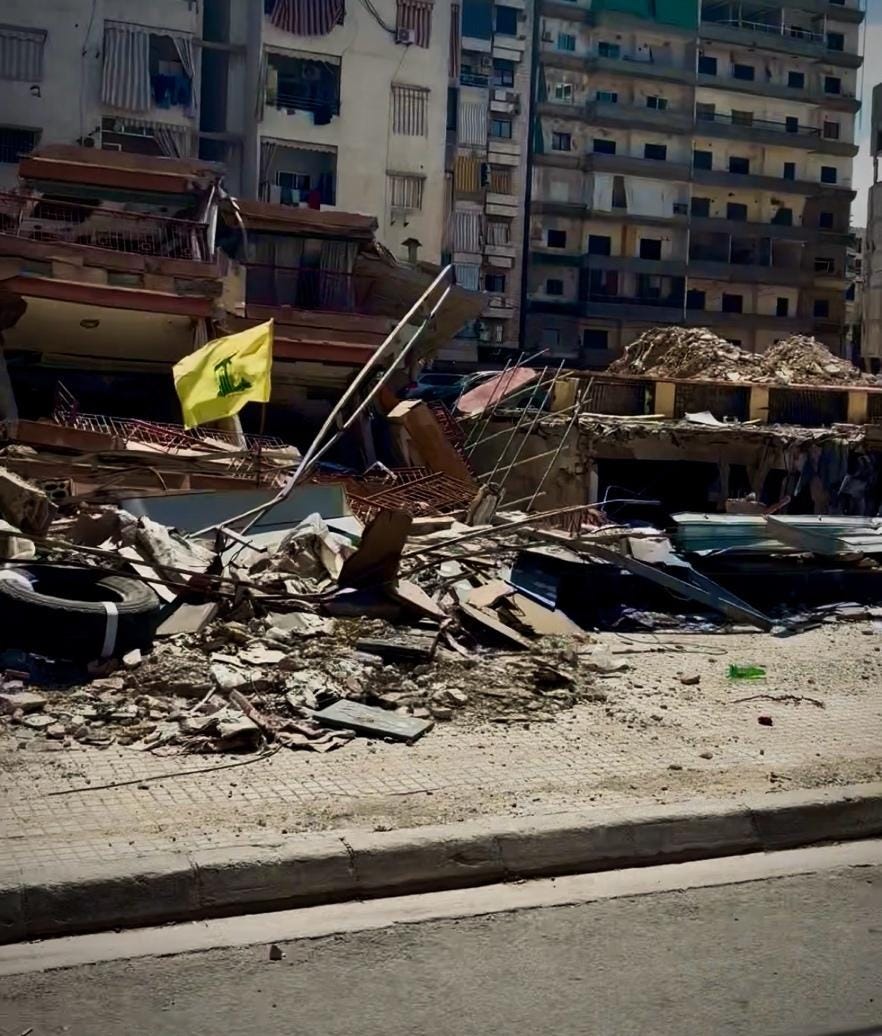
As Dahiyeh slowly begins to rebuild, the symbols of Hezbollah remain just as visible as the destruction.
To many outsiders, the flag is a symbol of what is often called a “Hezbollah stronghold.” To the people who live here, it tells only a fraction of the story.
The citrusy, earthy aroma of za’atar and the fatty, nutty smell of melted cheese drifts into the street from a small bakery where Ali Jaber is tossing one piece of dough after another into the blazing oven. As he replaces the baked manakish (or manouche, a popular Lebanese flatbread akin to pizza) with raw ones, customers wander in and out.
During the war, the oven stayed lit.
“We kept making manouche,” he says. “It’s our land. If we didn’t stay, who would?”
Some days the strikes hit the buildings right outside the bakery. Other days they just made the shelves next to Ali Jaber shake.
“We don’t know the word fear. We have been through so much.”
On the wall behind him hangs a portrait of Hassan Nasrallah, the deceased secretary-general of Hezbollah.
Ali Jaber notices me looking at it.
“In the West, you see Hezbollah as terrorists,” he says.
“But that’s not the only truth. We are people. We are families. It’s my mother, my father, my sister, my brother and the child in my wife’s stomach. We were born and raised here. We are people of this land. You are the ones who don’t understand us. So how will we ever get our point across to the world?”
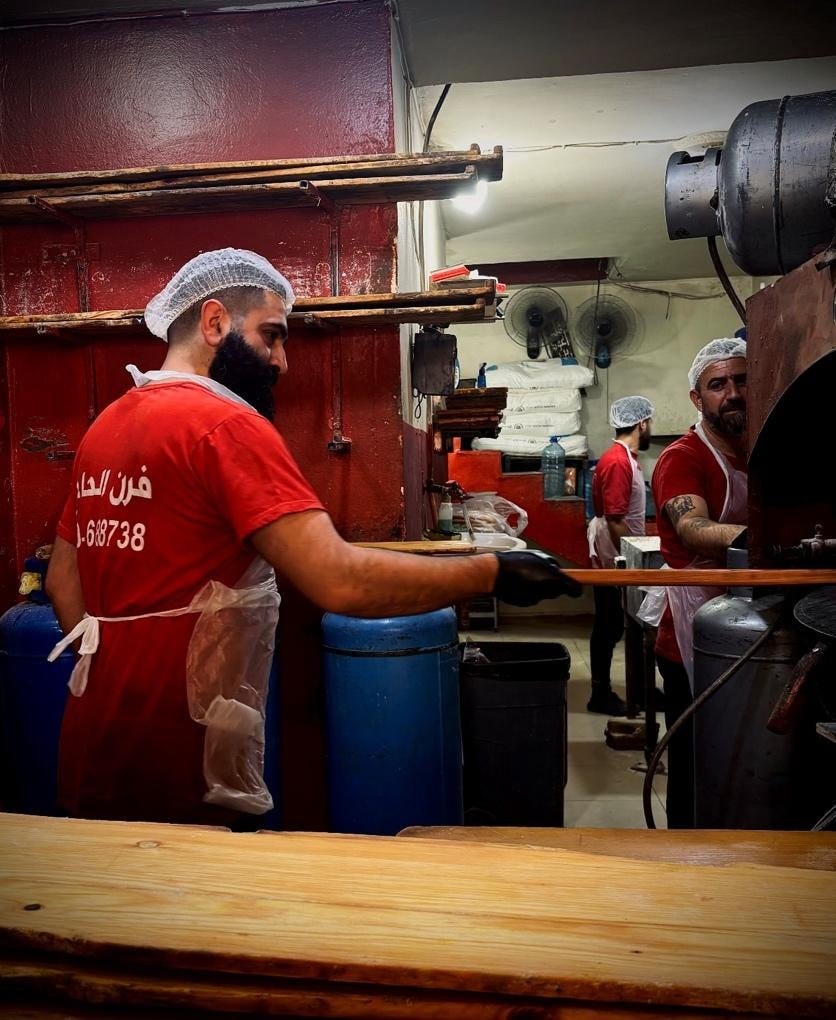
He takes out a manouche, steaming with melted cheese, and places it on the counter.
“I want peace. And I want to be able to defend myself.”
Support for Hezbollah remains strongest among Lebanon’s Shiite community, although opinions have become more divided since the latest war, according to experts. Even in Dahiyeh, residents disagree over many of the movement’s decisions, but many also feel outsiders rarely ask how their views were shaped.
From the tenth-floor balcony of his apartment, Ahmad lights a cigarette while he looks out on what used to be a display of the neighborhood’s many apartment blocks.
Now, the view is one of destruction.
His family’s apartment survived with only minor damage.


The dust of war has been wiped from the blankets, but two months after they returned, the backseat of their car is still packed with clothes, documents, and flip-flops. They’re ready to leave again. Not because they plan to, but because experience has taught them that they might have to.
“Since I was a child, there has always been a war. I don’t even know what life without one looks like. What would I even talk about? Cats and dogs?”
Thirty-year-old Ahmad has spent much of his life fleeing from one crisis to the next. Over the past two years alone, he has been displaced repeatedly from both Beirut and his hometown of Markaba near the Israeli border. In the recent war, an estimated one million people were internally displaced.
Many Lebanese blame Hezbollah for drawing the country into repeated wars with Israel. Asked if he understands them, he pauses for a second while the whine from the drone takes over the silence.
“I see myself as neutral. I am not a supporter. I am not against them. I think both Hezbollah and Israel are wrong for this,” he says and expresses what people in Dahiyeh are often hesitant to—despite thinking it. That is why Ahmad prefers not to have his last name used.
There is destruction all around us. Critics will say that without Hezbollah it wouldn’t be here. Why don’t you and the people here see it like that?
“People stick to the people who defend them. That’s why people follow them. They want someone to save their houses. They want to live there. Eat there. They don’t want to be displaced from their lands,” he says.
“In the headlines, it’s always about Hezbollah going against Israel and trying to protect the Lebanese. Not the government.”
That perception is rooted in history. For decades, southern Lebanon was among the country’s poorest regions with limited public investment and weak state services. Hezbollah emerged during that period, combining armed resistance with schools, clinics, and welfare programs that became deeply rooted in many Shiite communities.
The movement has also consistently portrayed itself as the “defender” of southern Lebanon. Over time, critics and experts have argued that this has reinforced the belief that the movement alone can protect the south, while supporters point to repeated conflicts with Israel as evidence that the threat is real.
A few kilometers from Ahmad, Zeinab Jawad is looking through a photo album. She gently flips the page and points to a picture of a small boy smiling.
“It’s Hadi,” she says with a tight smile.
Next to her is a painting more than a meter tall. The background is bright yellow. On it is her son, Hadi.


He was killed in April while fighting for Hezbollah. Traditionally, he is supposed to be buried in their hometown. But even despite the ceasefire, they still can’t go there. So, while she is waiting to bury him, his body has been placed in a temporary grave.
She speaks softly. Not about politics, but about her son.
“He was gentle, caring and educated, with a university degree. He loved the south. He adored the plants in the south and the olive trees,” she says.
She smiles as her eyes redden and grow glossy.
I ask why, after losing her son, she still supports Hezbollah.
“No mother can take the pain from losing her son. But we are offering our most precious thing for safety. I want safety. I want to live.”
She speaks about growing up under Israeli occupation. About hearing of torture from the Khiam prison in the South. About stories passed down through her family. About a childhood shaped by conflict and believing that someone had to defend the south.
“It’s our right to fight for what is ours. It’s my land. My home,” she says.
Those experiences are the lens through which she and many Shiites see the movement.
Back in the bakery, customers continue to arrive.
Outside, another excavator tears into what remains of a collapsed building. Above it, the drone is still circling. The yellow flags are still waving in the wind too.
To many outside Lebanon, they symbolize a militant terrorist movement. To many people here, they represent memories, belonging, and survival.
Ali Jaber points towards photographs of young men hanging on the bakery wall.
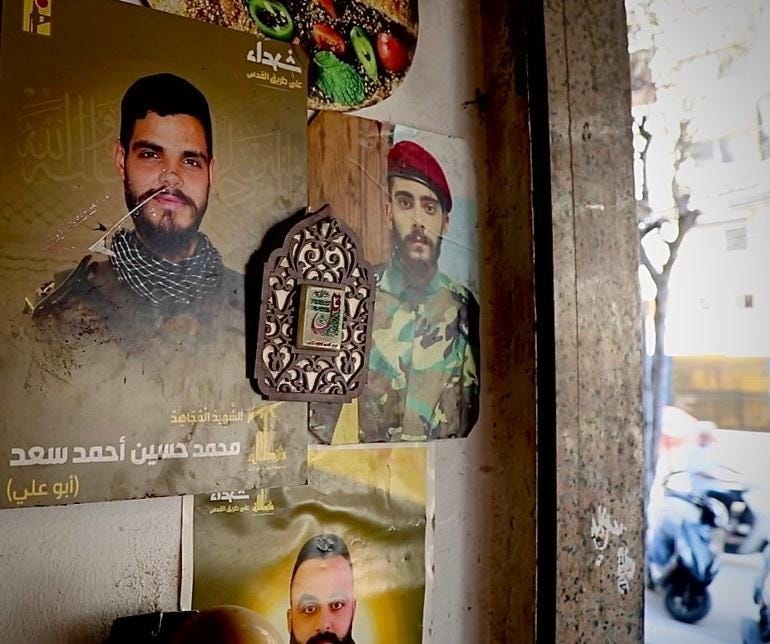
“We have lost a lot. Friends, family. But it’s because of them that we are here now,” he says.
Some people believe that Lebanon could have been spared the suffering if Hezbollah had given up their weapons. Why don’t you agree?
He answers without hesitation.
“If they didn’t fight, we would all have been wiped out. We never really had a choice to begin with. For us, the only option was to defend ourselves, to go through wars and keep going. It’s not like we enjoy this. We have no choice.”
It is easy to reduce places like Dahiyeh to its yellow flags, but harder to sit with and really listen to the people who live under them. Their stories do not settle the issue of Hezbollah, and they don’t ask anyone to. But they do remind us that movements don’t often survive for decades on ideology alone. They endure because they become woven into the lives of people who believe they have few other places to turn.
Long after the cameras leave, those people will still be here, rebuilding homes, burying loved ones, baking bread, and hoping their children inherit something other than the next war. They are part of Lebanon’s story too.
Middle East Uncovered is powered by Ideas Beyond Borders. The views expressed in Middle East Uncovered are those of the authors and do not necessarily reflect the views of Ideas Beyond Borders.

I get that you are trying to humanize folks and I get that the people here are genuinely suffering, but this is absolutely no different in my mind than Germans saying they joined the Nazis so they wouldn’t be wiped out by the Communists after WWI’s trauma.
The lady says “It’s our right to fight for what is ours” and she has no understanding that Israel, since 2000, would have left them the hell alone if they left Israel alone and didn’t “fight” them. By fighting, they have lost southern Lebanon completely.
I get that she has lost a lot, but I genuinely do not understand how people continue to push the “resistance” line as if it has done anything but destroy them. It is incumbent on others in Lebanon to point out that this “resistance” pathway is a complete dead end for the Lebanese Shia.
This is the kind of belief that will drag Lebanon into yet another brutal war that they will lose and will spread suffering among their people even more, and no one seems to want to correct them.
What these people are saying is true. But the missing piece of information in their thought process is the reason why Hezbollah needs to defend... Israel wouldn't be attacking into Lebanon at all if Hezbollah didn't use it as a base to continuously attack Israel in the first place. Like Hamas and their mutual sponsor Iran, they do not recognize Israel's right to exist and thrive in the middle east on any piece of land there including the borders originally assigned by the UN. So, they keep attacking Israel, and Israel fights back. Because of a smart and powerful US-backed military, Israel tends to win even more land to use as a buffer.