


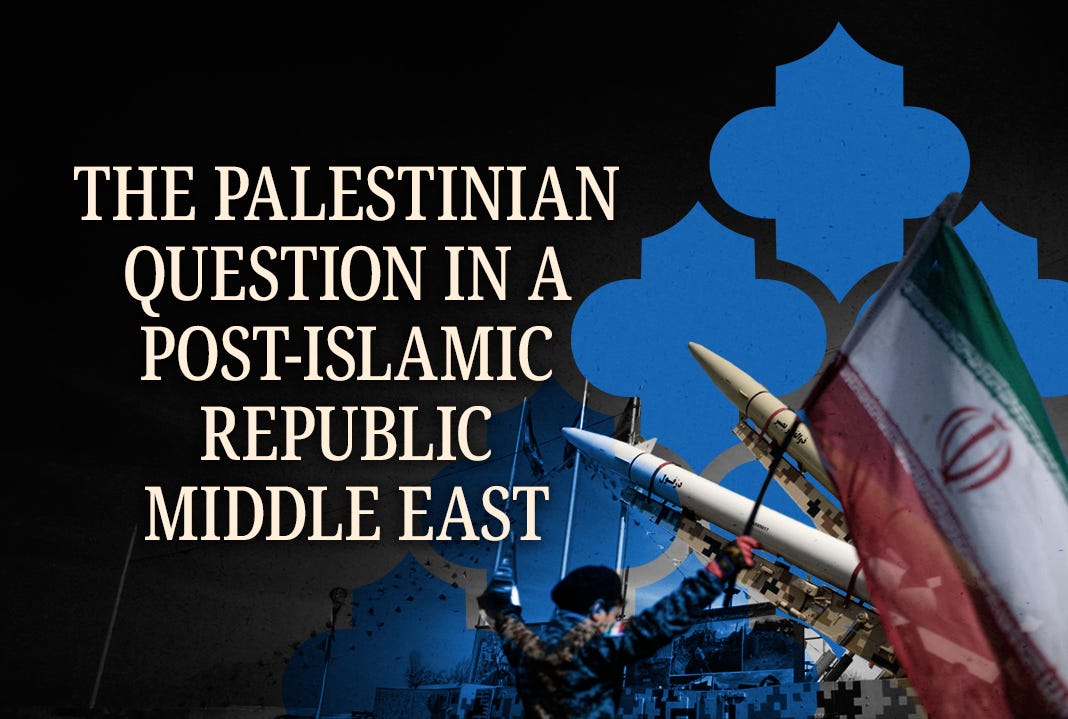
Over the past two weeks, hundreds of thousands—possibly millions—of Iranians have poured into the streets in protests that have spread to all 31 provinces. Whether this uprising ultimately deposes the Islamic Republic—still uncertain given the regime’s deeply entrenched security and patronage networks—or merely weakens it, the consequences for Palestinian politics are likely to be profound.
As statues of Qassem Soleimani were toppled in provincial cities and chants of “Neither Gaza nor Lebanon, my life only for Iran” echoed from the Grand Bazaar to university campuses, the regime entered one of the most precarious moments of Ali Khamenei’s decades-long rule.
The question is no longer just “Will the regime fall?” but rather: If the financial and ideological umbilical cord to Tehran is cut, does the Palestinian cause survive, or is it forced into a radical, perhaps painful, transformation? To understand the future of Jerusalem, we must first look at the crumbling foundations of the “House that Khomeini Built” in Tehran.
Since the Iranian revolution in 1978-79, which resulted in the toppling of the monarchy and the establishment of the Islamic Republic, it has rejected Israel’s right to exist, promoting the so-called “one-state referendum” over all of historic Palestine — but only for those it defines as original inhabitants and their descendants, which explicitly excludes most Israeli Jews.
Even as the Palestinian Liberation Organization (PLO) signed its first peace agreement with Israel in 1993 and formally embraced a two-state solution, Tehran rejected the Oslo Accords framework outright. Instead, the Islamic Republic backed Islamist factions such as Palestinian Islamic Jihad and Hamas, which opposed negotiations in favor of “armed resistance,” effectively granting Iran a veto over any moderate course pursued by the Palestinian Authority (PA).
Whenever the PA edged toward compromise, Tehran raised the “resistance” temperature in Gaza or the West Bank, effectively sabotaging any diplomatic opening. If the Islamic Republic Revolutionary Guard Corps’s (IRGC) command structure collapses or is seriously degraded, that veto power may evaporate—though a weakened regime could still retain limited influence. In that scenario, Palestinian leaders would be freed from the pressure of an external patron that treated the conflict as an instrument of regional hegemony, opening space for a re-nationalization of the Palestinian question.
Even the current talks on Hamas’s disarmament in Gaza may be affected by the process. The Quds Force (one of five branches of the IRGC) was the “technical spine” of the military wings; they provided the engineers for indigenous rocket production and the smuggling logistics that circumvented Israeli and Egyptian blockades.
Without this “special operations” mentorship, sustaining a high-intensity military wing becomes prohibitively expensive. The Izz ad-Din al-Qassam Brigades (the largest and best-equipped militant organization operating within the Gaza Strip in recent years) would effectively lose its research-and-development arm, forcing Hamas—deprived of reliable military replenishment—to pivot toward its political and social institutions to preserve relevance.
The financial logic of the so-called “Axis of Resistance” rests on Iran’s shadow fleet: hundreds of illicit tankers laundering oil revenues to bankroll regional proxies. As that fleet is seized or immobilized amid the turbulence of 2026, Palestinian militant budgets would shrink dramatically.
Filling that gap would require turning to the Arab Quartet—Saudi Arabia, the UAE, Egypt, and Jordan—whose support, unlike Tehran’s no-strings-attached funding for militancy, comes with strict conditions: the full integration of all armed factions into a reformed Palestinian Authority and the permanent dismantling of the tunnel economy.
The chant “Neither Gaza nor Lebanon” is a declaration of strategic insolvency. For any successor government in Tehran, the Palestinian question is likely to be treated as the ultimate sunk cost of the clerical era. A leadership seeking sanctions relief, international legitimacy, and domestic stability would almost certainly pivot toward a nationalist, Iran-centric foreign policy.
This would not make Iran pro-Israel overnight. It would, however, demote the Palestinian issue from a sacred revolutionary pillar to a routine diplomatic file. That shift would severely weaken Palestinian hardliners who have long relied on Tehran’s ideological fervor to justify their refusal to negotiate. Absent Iran’s revolutionary sponsorship, the conflict is more likely to be framed as a territorial dispute than as an existential religious crusade.
Iran’s retreat would also trigger a scramble for influence between the Arab Quartet—Riyadh, Cairo, Abu Dhabi, and Amman—and the Turkey-Qatar axis. Yet the contest would be defined less by revolutionary patronage than by conditional support aimed at stabilization rather than disruption.
Where Tehran offered “revolutionary” patronage designed to disrupt, the Arab Quartet offers “status quo” support aimed at regional stabilization. Any post-2026 funding from Riyadh or Abu Dhabi would come as conditional aid—tied to transparency, the centralization of authority under a reformed Palestinian Authority, and zero tolerance for independent militias.
This shift, however, should not be romanticized. The Palestinian Authority’s crisis of legitimacy, combined with Arab regimes’ preference for managed stability over genuine political renewal, is likely to limit how transformative a post-Iranian moment can truly be.
For four decades, the Palestinian cause was effectively subsumed by Tehran’s revolutionary branding, allowing critics to cast it primarily as a vehicle for regional militancy. The deposition of the Islamic Republic would offer an opportunity for strategic rebranding—reframing the Palestinian struggle as a national political question rather than an extension of Iran’s ideological project.
By losing the “Axis of Resistance” label, the Palestinian leadership in Ramallah will have the opportunity to finally present the cause as a standard national liberation movement. This would render it much harder for international actors to ignore and much easier for Western powers to support. In short, the fall of the regime wouldn’t kill the Palestine cause; it would liberate it from the stigma of being an Iranian proxy, forcing both Israel and the international community to deal with the Palestinian people’s national aspirations on their own merits.
The fall of the Islamic Republic would be the end of the Palestinian cause as we have known it since 1979. Deprived of its most militant benefactor, the “resistance” must choose between becoming a relic of a collapsed revolutionary era or evolving into a pragmatic partner in a new, Iran-independent Middle East. In such a scenario, the road to Jerusalem would no longer run through Tehran, but through the cold, hard realities of regional diplomacy.
Middle East Uncovered is powered by Ideas Beyond Borders. The views expressed in Middle East Uncovered are those of the authors and do not necessarily reflect the views of Ideas Beyond Borders.

You nail a weird paradox: if Iran’s grip on the “resistance” narrative dissolves, it could actually clarify what the Palestinian cause is about instead of keeping it stuck as a proxy label. Stripping away Tehran’s ideological weight might make real diplomacy and negotiation harder but also more honest.
Sad and true in a way.