


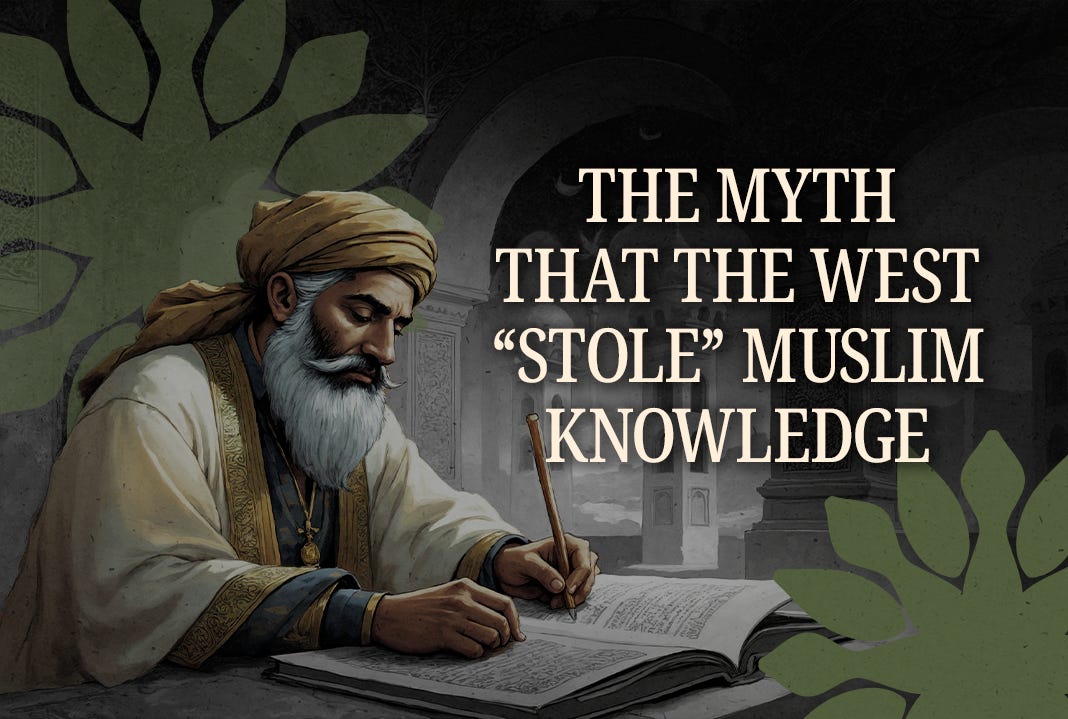
When scholars point out that modern terms like algebra and algorithm, or inventions such as the camera, originate from Muslim scholars who lived in Baghdad, Samarkand, and Córdoba centuries ago, they are not claiming that those scholars invented the modern world as we know it. Instead, they should be making a more important point: knowledge accumulates. It travels. It is translated, absorbed, challenged, refined, and transformed. Civilizations inherit, adapt, and extend knowledge, continuously discovering the world.
The great intellectual achievements of the medieval Muslim world were themselves made possible by this cross-pollination. Much of the intellectual flowering associated with Islamic civilization was triggered by the translation and study of Greek, Indian, Syriac, and Persian works. Muslim scholars did not merely copy these traditions; they built upon them. This was not theft, but inheritance turned into innovation.
Yet in the imagination of many Muslims today, this connection with medieval Muslim scholars often produces a fantastical belief that “we” somehow invented everything modern, and that the West simply stole it from us.
This sentiment did not emerge from nowhere. Serious scholars have long challenged Eurocentric histories of modernity. George Saliba, for example, has shown how European Renaissance science, including Copernican astronomy, cannot be understood apart from earlier Arabic-Islamic scientific traditions. Jack Goody, from a different angle, wrote of “the theft of history,” criticizing the way Western historiography claimed as uniquely European many developments that were in fact more widely human. These are serious arguments, and they deserve to be taken seriously, especially when they challenge lazy myths of Western self-creation. But in popular discourse, and under the influence of populist appropriation of postcolonial narratives, they are often flattened into a much cruder accusation: they stole our knowledge.
The young Berlin-based Syrian rapper Siba Alkhiami captures this sentiment in her by now-infamous song, Dounana (“without us”):
“Eradicate our roots. Demolish our homes. Criminalize our existence. Falsify our origins. Separate our loved ones. And slaughter our children. Take our blood for granted. And demonize our revolutionaries. Steal our knowledge… But who would you be without us?”
I have addressed the main claims in this song in my previous essay “The Fiction of Collective Innocence,” but the embrace of the notion that the West “stole our knowledge” raises an obvious question that merits separate treatment.
If the West “stole” Muslim knowledge by studying, translating, and building upon it, did Muslims “steal” Greek, Indian, Syriac, and Persian knowledge before that? Are we stealing Western knowledge today when we study at Western universities, or at Western-style universities at home? Are we stealing when we import Western technology, medical systems, legal concepts, musical instruments, industrial processes, and even the machines that manufacture the clothes we wear?
The problem is not pride in one’s ancestors' achievements, as that pride can be healthy. The problem begins when pride becomes myth, and myth becomes grievance, and grievance becomes a moral worldview.
The idea that knowledge belongs permanently to one civilization, and that its use by others constitutes theft, is historically false and morally corrosive. It teaches us to see history not as a shared human process but as a ledger of stolen property. It encourages us to believe that progress is something others possess only because they robbed it from others. And this, in turn, becomes an impediment to progress—not merely in the technological sense, but in the moral sense.
When certain acts are not condemned because they are wrong in themselves, but because we were their victims, then we have not rejected injustice; we have resented being on the wrong side of it. The danger begins when injustice is condemned only from the victim’s seat. In that case, the object of resentment is not the structure of domination itself, but one’s exclusion from the dominant position. The moral imagination remains trapped inside the very hierarchy it claims to oppose. Justice becomes a matter of reversal rather than transformation: the oppressed dream not of ending oppression but of occupying the oppressor's place. Grievance may still speak the language of liberation, but it quietly preserves the architecture of domination.
This is where grievance politics becomes dangerous. If the West’s progress is explained primarily as the result of pillaging other peoples’ knowledge, resources, and labor—rather than also as the outcome of internal struggles for rights, representation, transparency, and accountable institutions—then the lesson drawn is not that pillaging is wrong. The lesson becomes that pillaging breeds success. If pillaging works, why condemn it when practiced by Russia, China, Iran, or anyone else? Why not aspire to become the pillager?
This does not mean denying that Western powers did pillage, colonize, enslave, and exploit. They did. These crimes contributed to material advantages that served as the foundation of Western societal development. In some cases, imperial wealth and global dominance may have helped cushion domestic tensions, finance state capacity, and make liberal compromises easier at home, even as coercion and domination were practiced abroad. The paradox is not that liberal ideas were fake, but that societies capable of developing rights-based institutions internally were often willing to deny those same rights externally. This paradox must be faced honestly, but if we reduce Western development entirely to theft, we blind ourselves to the institutional, intellectual, and moral struggles that also shaped it. We end up learning the wrong lesson from history.
The deeper human paradox is this: when a civilization develops concepts such as liberty, equality, and fraternity, then treats those concepts as proof of its superiority and as justification for dominating others, it violates its own principles. It confuses the responsibility to share knowledge with the impulse to rule. But, the opposite error is just as destructive: when the victims of domination define justice as trading places with their former oppressors rather than ending the structures of oppression themselves, they perpetuate the same cycle under a different banner.
In both cases, claims of moral superiority become hollow. External actors may cloak their interventions in the language of justice, solidarity, liberation, or resistance, but beneath the rhetoric, they are no different. Each side tells itself a flattering story that edits history to preserve its innocence. Each side shrinks time, produces a self-serving narrative, dismisses inconvenient facts, and turns memory into a weapon.
Knowledge was never the possession of one people; rather, it has always belonged to the human journey. Civilizations rise when they participate in that journey with confidence, discipline, and openness, but decline when they turn to entitlement, grievances, and revenge.
The question, then, is not “Who are you without us?” Nor is it “Who are we without you?” The better question is: how can we build upon the knowledge we have inherited from history for centuries to come?
Middle East Uncovered is powered by Ideas Beyond Borders. The views expressed in Middle East Uncovered are those of the authors and do not necessarily reflect the views of Ideas Beyond Borders.
So to say I have learned this from my mentor and add your own experience is different from claiming that all what you did was yours
There is another point in this article that is actually disturbing to me or anyone who believe that humanity should work together and that is about the rapper
You are equating the victim with the one victimizing him
Are you saying the victims of oppression should live their oppressors and not defend their rights ?
If so that is very disturbing
No one argues against the premise that civilizations build on previous knowledge
But The premise of this article is false
Intellectual theft is a fact not a fallacy
The problem is not building on other civilizations and advance knowledge, but in ascribing those ideas and advances you learned from someone else to yourself
The medieval Muslims acknowledged the existence of previous knowledge of previous civilizations and built on it
The westerners stole the advances that the Muslims did and ascribed it to themselves
That is what the intellectual theft is
Taking someone else ideas and saying these are my ideas
It is different to say I learned this from someone and add to it your own achievements than to take the ideas from someone else and say these are my ideas
Hope this differentiate between what the Muslims did and what westerners did