


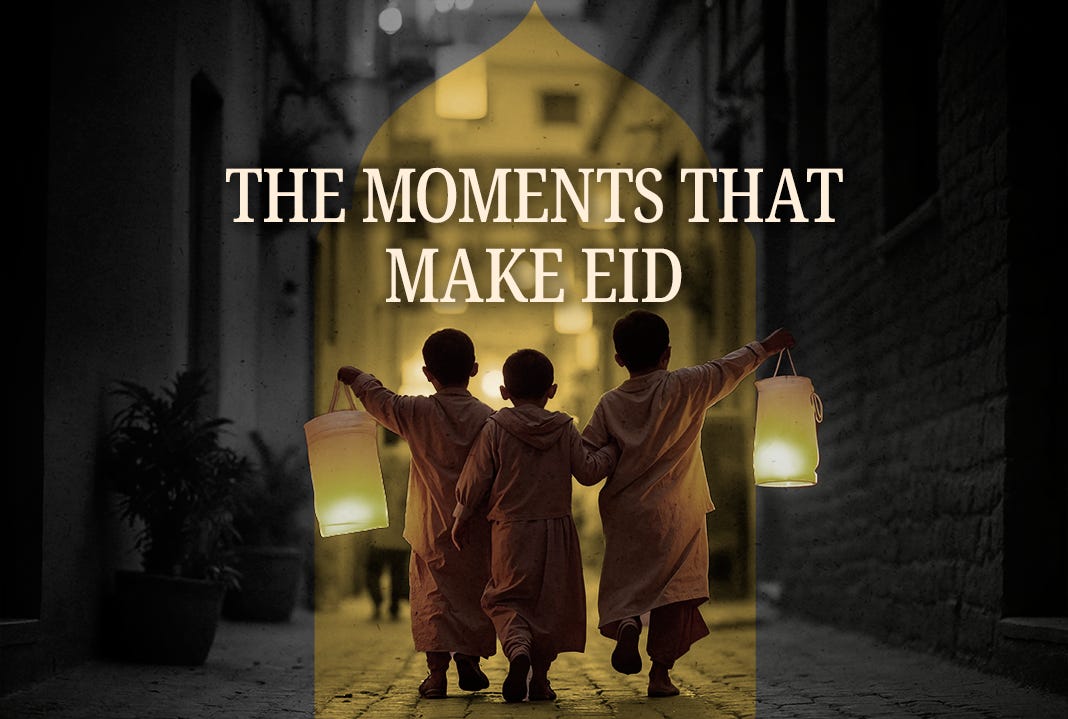
Kunafa breakfast sandwiches, folded banknotes, clothes swaps, and communal cooking sessions. For the team, the magic of Eid comes from the warmth of childhood memories mingling with family traditions, even those they would rather let go.
It is a time when people reconnect with relatives, visit neighbors, share meals, help those in need, and temporarily set aside disagreements. Rooted in Islamic faith, Eid is a moment of reflection and prayer, when Muslims remember the Prophet Ibrahim’s willingness to sacrifice his son Ismail in an act of obedience to God.
It is also, like Christmas, Diwali and many major festivals around the world, a lot of work. Houses grow noisy and people crowd in. There are endless rounds of hugging relatives and children tear from room to room, hyped up on sweets. It is, as Hussein Ibrahim describes, “exhausting and beautiful at the same time.”
Growing up, Eid meant gifts and sweets, the excitement enhanced by mischief-making with cousins as indulgent parents turned a blind eye. For adults, the meaning shifts as they take on the pressures and pleasures of creating the Eid magic in turn.
Planning, hosting, and cooking replace the carefree Eids of childhood but bring a different kind of joy that comes from caring for others. Family rituals take on a deeper significance, connecting loved ones across generations.
“Even the simplest traditions carry emotional meaning,” says Rafal Al Adilee, describing the comfort of familiar voices, the return of childhood memories, and the smell of homemade sweets. Above all, she cherishes the opportunity to bring family together, suspending the demands of everyday life long enough to reconnect and remember the bonds that matter most.
Faisal Saeed Al Mutar: Eid in Berlin
President and CEO, Ideas Beyond Borders
I spent Eid in Berlin this year and enjoyed a celebratory meal with our Bayt al-Hikma Editor, Ahmed Reda. In some ways, it felt close to the atmosphere of Eid in Iraq, where I grew up. The Berlin neighborhood of Wedding has a large Arab community, with strong Syrian, Iraqi and Turkish influences. Many of the restaurants were decorated with balloons and families were out in the streets celebrating. Living in New York, I often feel furthest from the Middle East at Eid, when the communal atmosphere we enjoyed in Iraq seems very remote. But walking around this Berlin neighborhood, wishing people “Eid Mubarak,” we found something of the spirit that makes Eid special and reminds me how it felt back home.
Issam Fawaz: Eid in Lebanon
Communications Manager, Bayt al-Hikma, Contributor, Middle East Uncovered
For me, Eid has always been tied to food, family, and the feeling of everyone slowing down to be together. My strongest Eid memories are starting the morning with a warm kunafa sandwich for breakfast—yes we eat kunafa as a sandwich for breakfast—then spending the whole day waiting for those delicious warak enab (stuffed vine leaves) that takes hours to prepare. By lunchtime, the entire family would gather at my grandmother’s house around one table.
As a child, Eid meant excitement, new clothes, sweets and toys. As an adult, I don’t get toys anymore, but Eid symbolizes continuity—the comfort of traditions that remain unchanged even as life around us changes. The meals themselves became symbols of care, patience, and family effort. That is what Eid feels like to me: not just celebration, but belonging.
Hussein Ibrahim: Eid in the Kurdistan Region of Iraq
MENA Director, Ideas Beyond Borders
Growing up in the Kurdistan Region of Iraq, Eid was never simply a holiday. It was filled with anticipation, noise, family, generosity, and a temporary suspension of everyday worries. Even today, despite the responsibilities and pressures of adulthood, Eid still carries the emotional warmth of childhood memories that refuse to fade.
As children, the excitement of Eid often began the night before. One of my favorite memories is placing my new clothes neatly folded beside my pillow at bedtime. It felt impossible to sleep with all the excitement. We knew that the next morning would bring joy in every form imaginable: new clothes, visits from relatives, candies collected from house to house, and folded banknotes given to us by parents and relatives during visits. To a child, that money felt like a fortune. We would spend it on video games, playgrounds, sweets, or small toys that seemed incredibly important at the time.
Eid, during childhood, meant freedom from worry. My world revolved around collecting candies and playing with cousins, neighbors, and visiting relatives. The atmosphere itself felt kinder. Even our mischievousness was tolerated more than usual. During Eid, adults seemed more forgiving, more patient, and more generous. The holiday carried a sense of mercy that extended even to children’s endless chaos and noise.
As an adult, the meaning of Eid has changed significantly. Today, I find myself on the receiving end of responsibility rather than generosity. Instead of waiting for gifts, I think about preparations, expenses, hospitality, and ensuring that others enjoy the holiday. The financial and emotional responsibilities attached to Eid can sometimes feel exhausting and make the holiday less carefree than it once was. Yet adulthood also reveals something deeper about Eid: it is ultimately about caring for others, preserving family bonds, and creating joy for the next generation in the same way our parents once did for us.
Family traditions are what make Eid especially meaningful in our home. In my hometown, we do not begin Eid with breakfast. Instead, an elaborate lunch is prepared early in the morning. By midday, my parents’ house transforms completely. My ten sisters and seven brothers gather with their children, and the house becomes something resembling a kindergarten—crowded, loud, chaotic, and alive. Every room fills with conversations, laughter, crying children, and endless movement. It is exhausting and beautiful at the same time. The noise is part of our Eid.
Some of my most memorable Eid moments took place during one of the most difficult periods in Iraq’s modern history. During the aftermath of the First Gulf War, Iraq was suffering under international sanctions, while the Kurdistan Region was simultaneously facing an additional embargo imposed by Saddam Hussein’s government. Poverty was widespread, and even basic food items were difficult for many families to afford.
At one point during Eid, my mother’s uncle arrived at our home with his family, along with three other families from Mosul. Nearly fifty people ended up living together in our house for almost three months. Space, food, and comfort were all limited, but families survived through togetherness.
Then came one unforgettable Eid moment. My mother’s uncle suddenly began screaming dramatically and clutching his stomach in apparent agony. Everyone believed he was seriously ill. My mother, grandparents, and aunts began crying, fearing he might be dying from severe abdominal pain. In the middle of the panic, he weakly requested Coca-Cola. My eldest brother rushed to the small shop behind our house and bought a few boxes of Coca-Cola bottles—something considered a luxury at the time.
My uncle immediately began drinking one bottle after another while my brother distributed the rest among the crowded household. Then, suddenly, my uncle burst into laughter and announced proudly, “Bon appétit! Drink the amazing Coca-Cola because of me. I am the reason you are all drinking Coca-Cola now!”
The room instantly shifted from fear to outrage and laughter. My grandparents and father began shouting at him, furious that he had pretended to be dying simply to justify buying Coca-Cola for everyone. Yet years later, that absurd moment remains one of the clearest memories of Eid in our family—not because of hardship, but because humor and togetherness somehow survived despite it.
That, perhaps, is what Eid truly represents: the ability of families to create joy, laughter, and unforgettable memories even during the hardest times.
Rafal Al Adilee: Eid in Turkey
MENA Project Manager, Ideas Beyond Borders
The moment I hear the sound of the mosques reciting the Eid takbeer (call to prayer) at dawn, I still get the exact same feeling I had as a little girl: a shiver of happiness and comfort, realizing that Eid has finally arrived. It is a reminder of family, gratitude, faith, and how blessed we are to have people to share these moments with.
In our family, Eid is made special by the little traditions that repeat every year and somehow never lose their magic. The early morning takbeer from the mosques, the trays of Eid sweets prepared for guests, visiting relatives first thing in the morning, and gathering around breakfast together all create an atmosphere that feels uniquely comforting.
This Eid, my husband and I decided to step away from the noise and pressure of everyday life and spend the holiday somewhere peaceful. We booked a farmhouse in the countryside to enjoy quality time with family, away from the rush of the city. As life becomes busier and more demanding, Eid starts to feel less about grand celebrations and more about slowing down, reconnecting, and appreciating the people closest to us. For me, the true spirit of Eid has always been found in those quiet moments shared with loved ones.
Some of my most cherished Eid memories come from growing up in Iraq. They may seem simple, but they carry a warmth and intimacy that stays with you forever.
One tradition I remember vividly was gathering with the family the night before Eid to make kleicha—traditional Iraqi pastries filled with dates, nuts, and sweet spices. The whole house would come alive with activity: kneading dough, preparing fillings, shaping the pastries together, and filling the kitchen with unforgettable aromas. It wasn’t just about the food itself; it was the feeling of togetherness that made it special.
And of course, no childhood Eid memory would be complete without Eidiya—the small amounts of money gifted from parents and relatives to children. As kids, it felt magical. It meant new clothes, family visits, sweets, and the anticipation of celebrations.
Now, as adults, there is something equally beautiful about being able to give back to parents and younger family members and continue the tradition ourselves. Life changes, responsibilities grow, and relationships evolve with time. It becomes harder to gather everyone together as often as before, and people become consumed by work and daily routines. I cannot honestly say Eid feels exactly the same as it did in childhood—but somehow, the emotion still returns every year.
There is also a funny side to it. In many Middle Eastern families, we are not always overly expressive with affection in daily life, so on Eid morning everyone suddenly becomes emotional and affectionate at once. You end up hugging every sibling and relative, exchanging heartfelt wishes, and pretending you are not embarrassed while doing it. Somehow, that awkwardness is part of the charm.
John Aziz: Eid in London
Contributor, Middle East Uncovered
Eid contains a strange tension for me. At its root, Eid al-Adha is inspired by a story about the biblical patriarch Abraham’s willingness out of blind faith to sacrifice his own son Isaac. It’s a powerful story. It carries emotion. But this mentality of blind faith can be dangerous. There are many extremists in the world who seek to convince us to sacrifice ourselves and our families for their ideological goals. This, more or less, is what the leaders of Hamas asked of the people of Gaza in 2023 until now.
As a child from a Muslim family when I was growing up, I understood none of that complexity. Eid simply meant a feast of delicious Palestinian food, family gathering, noise, warmth.
As an adult, I still feel a kind of reverence for the way ancient religious traditions and festivities carry memories, bind families together, and connect us to people and places. But I also see this festival as a warning. Faith in God is one thing. Faith in religious or political extremists who claim to speak on behalf of God? That’s quite another thing.
As Eid unfolds in London, I find myself caught between gratitude for the beauty of these ancient religious inheritances, and concern about those who choose to channel religion into violent ideology, and then demand sacrifices of everybody around them.
Lana al Jaf: Eid in Erbil
Graphic Designer, Ideas Beyond Borders and Middle East Uncovered
When I was a child and during the late nineties, I looked forward to Eid like every other kid. Due to the economic state of Iraq, almost everyone was living paycheck to paycheck, so buying new clothes and shoes was a rare treat. But for Eid, parents had to get their children brand new everything. I remember gathering with my cousins to strategically decide who was buying what so we could trade clothes later and avoid repetition.
On the first day of Eid, we would all gather in our grandparents’ house. After we finished eating, the race would begin to gather as much money as we could from the adults. A rich uncle that lives abroad and doesn’t see us much would give generously to compensate for his absence, while the aunt we see every weekend had little cause to impress us—she already did that by making us food and letting us stay over all the time. After squeezing the adults for every last penny, we’d gather to see who got the most. One time we managed to convince our youngest cousin that larger bills were worth less and swap. He still hasn’t forgiven us for that trick.
As years passed and the security situation made moving around the city more dangerous, it became easier to just call everyone and say “Eid Mubarak!” As a result, those strong bonds and traditions slowly faded in my family. It even became annoying, to the point where we would fake being sleep till noon to avoid the awkward phone call to a distant relative who wishes you the same thing every year—to succeed in school, or to marry well, or to stay healthy and keep your parents safe.
As an adult, living miles away from my relatives, all I can do is call people with well-tailored wishes and send money to nieces and nephews. It’s fair to say that I liked Eid much more as a child.
Ahmad Mansoor Ramizy: Eid in Toronto
Afghanistan Country Director, Ideas Beyond Borders, Reporter, Middle East Uncovered
Eid feels a bit different this year, but in the best way. My aunt and her two grandchildren are visiting from France, and some of us haven’t seen them in more than five years. More than anything, Eid is about coming together and having them here makes this one especially meaningful.
My favorite Eid memory is from the last few years of my life in Afghanistan. Our family had a garden on the outskirts of Kabul, with a beautiful villa surrounded by greenery, fruit trees, and open space. That was where we would gather for the sacrifice and to spend time as a family.
At its busiest, there would be fifty or sixty people feasting, laughing, and enjoying each other’s company. Those afternoons in the garden are some of my most cherished family memories. They were among the last times I remember all of us truly together before circumstances put oceans between us.
When I was growing up, Eid also meant the arrival of “Eidi,” or cash gifted to the younger generation from elders. As a kid, that meant everything to me. It was the highlight of the holiday.
Now that I am an adult, Eid is less of a religious obligation and more of a tradition centered around family and coming together. It is less about what you receive or what you wish from god, and more about who is with you and physically present. This year, with family traveling from far away to celebrate together, that feeling is stronger than ever.
Middle East Uncovered is powered by Ideas Beyond Borders. The views expressed in Middle East Uncovered are those of the authors and do not necessarily reflect the views of Ideas Beyond Borders.
Eid Mubarak!