


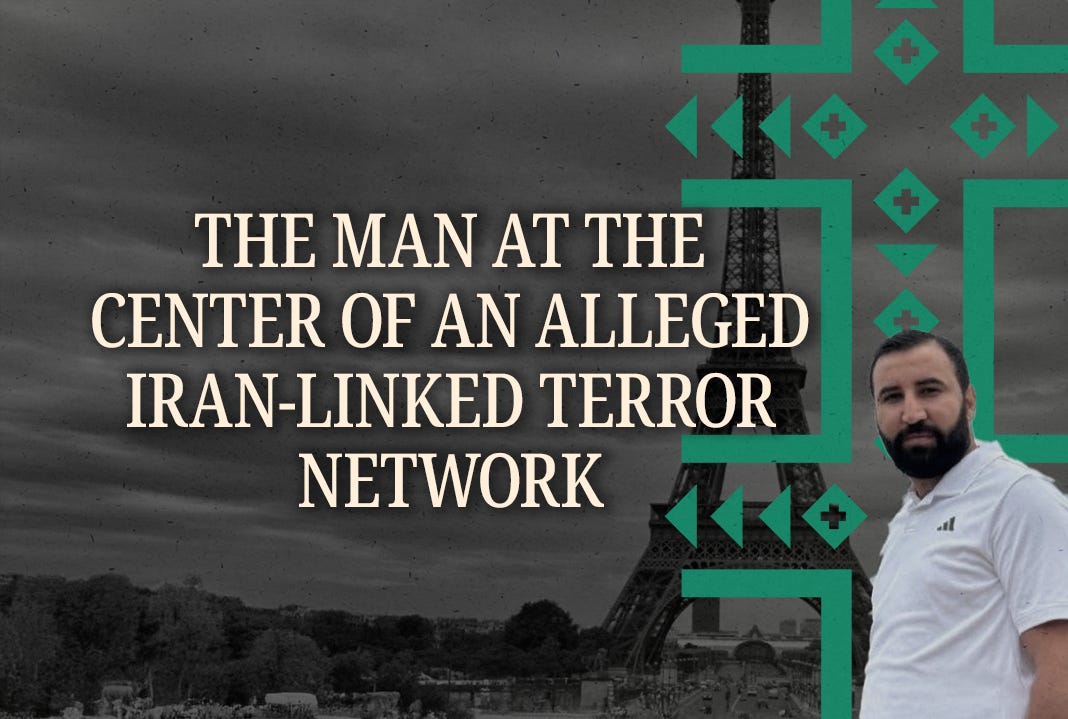
If a picture can paint a thousand words, certain photographs raise more questions than answers.
Wearing a cap and military-style clothing, Mohammad Baqer Saad Dawood al-Saadi sits beside a smiling Qasem Soleimani, the Iranian general killed in 2020 by a U.S. drone strike. Soleimani was a hero among the Iranian Revolutionary Guard Corps (IRGC) and its regional Shia militias. On the wall behind them appears to be an operational-style map covered in markings and annotations.
In another snap, al-Saadi and Soleimani are smiling, their arms around one another:


For American prosecutors, the photographs are part of the evidence of Iran-linked proxies operating in Europe and North America.
In May, 32-year-old al-Saadi—an Iraqi-Iranian dual national—was arrested for allegedly being the mastermind of a wave of antisemitic attacks in North America, Europe, and the UK.
Al-Saadi, who is charged with multiple terrorism-related counts, is allegedly a commander in Kata’ib Hezbollah (KH), a US-designated terrorist organization operating in Iraq with ties to Iran.
He was taken into custody before being turned over to the FBI and transported to the US, appearing in Manhattan federal court. He did not enter a plea and was detained pending trial.
“On the one hand, it should be very alarming to the people in this country that there are men around the world trying to exact this sort of terror. On the other hand, it shows the success of good law enforcement work and good police work, and working hard to protect our borders, which is what we do every single day,” acting US Attorney General Todd Blanche told Fox News.
But al-Saadi’s lawyers are arguing that it’s all politically motivated.
“Our position states that he’s a political prisoner and a prisoner of war,” al-Saadi’s attorney Andrew Dalack said after his court appearance. “He’s being punished for a perceived alleged connection with the late Qasem Soleimani.”
Al-Saadi has also been quoted as saying he was “like a son” to Soleimani. And according to a new report, he is believed to have met with Ayatollah Ali Khamenei three days before the Iranian supreme leader was killed at the start of the war with the US and Israel.
So, who exactly is al-Saadi, and how did he end up in US custody?
A profile of al-Saadi describes him as an Iraqi-linked operative with ties to IRGC-linked structures and Iraqi militia networks, situating him within a broader ecosystem of Iran-aligned proxy activity rather than as an isolated actor.
According to the authors, he appears to have grown up in a devout Shia Iraqi family that took part in the Iran-backed anti-Saddam resistance in the 1990s and 2000s.
They were expelled from Iraq before returning in 2003.
At the age of 20, al-Saadi reportedly traveled to Syria as a fighter in support of Bashar al-Assad’s regime, before returning to Iraq in 2014 to fight against the Islamic State in Diyala Governorate, in the northeast.
Images available online also show that al-Saadi traveled to Lebanon shortly after the October 7 attacks in Israel in 2023, although the extent of his activities is still unclear. Taken together, these movements place him within a pattern of regional conflicts in which Iraqi Shia militias have operated across Syria, Iraq, and Lebanon over the past decade.
CNN reported a link between KH and the group that claimed responsibility for the string of arson attacks, which targeted Jewish sites across Europe and the UK, including synagogues, schools, and ambulances.
Prosecutors allege KH has been operating under a pseudonym—Harakat Ashab al-Yamin al-Islamiya (HAYI)—to carry out the attacks. A source close to KH told CNN that some members of HAYI are Iraqi and that the two groups are connected.
Jonathan Hackett—a US Marine Corps veteran specializing in counterintelligence and the author of Iran’s Shadow Weapons: Covert Action, Intelligence Operations, and Unconventional Warfare—notes the level of operational detail alleged in the indictment. “The real-time command and control over the attacks in Europe, substantiated with videos taken from al-Saadi’s devices, shows a level of direct operational oversight that we rarely observe in unclassified cases.”
Al-Saadi’s alleged operations span multiple jurisdictions, from the Middle East to Europe and the United States. This, Hackett argues, is consistent with patterns of Iran-aligned proxy operations.
“The IRGC unit specializing in such attacks, the Quds Force, trains its surrogate forces, including Kata’ib Hezbollah and Lebanon’s Hezbollah, to operate freely from third country locations while providing a level of deniability between the Islamic Republic and the target,” says Hackett. The Quds Force, he says, has conducted similar operations for years, including the AMIA Jewish center bombing, which killed 85 people, and Israeli embassy bombings in Argentina in the early 1990s
Quds Force officers were behind the failed assassination of the Saudi Ambassador to the U.S. in 2011, as well as several attempts to kidnap and kill the Iranian dissident Masih Alinejad.
Iran has denied involvement in any attacks.
The allegations in al-Saadi’s case also focus heavily on Jewish institutions and diaspora communities.
In March, a synagogue in Liège, Belgium, was attacked with explosives. Days later, there were arson attacks on synagogues in Rotterdam and Amsterdam, followed by an attack on a Jewish school and a Bank of New York Mellon office in the same city.
The attacks continued across March and April, with incidents reported in London, Antwerp, Paris, and Munich.
On April 29, two Jewish men were stabbed in Golders Green, London. HAYI claimed responsibility, but UK counter-terrorist police dispute this and believe it was an “opportunistic” claim.
Nevertheless, the US indictment claims that a copy of a “charter” for HAYI, dated March 2026, was found on al-Saadi’s phone after his capture. It stated: “From today, we declare clearly: the United States, the Israeli Zionist regime, and anyone who cooperates with them at any level will not be secure.”
Prosecutors say al-Saadi was also recorded on a phone call on April 1, asking how much it would cost to hire someone “to carry out a bombing operation” in the US.
“I mean, we provide him with a Jewish temple, a Jewish center,” the defendant allegedly said.
He also allegedly provided photos and maps of Jewish centers in Los Angeles and Scottsdale, asking if it was possible to “set the three locations on fire at the same time”.
The targeting raises a broader question of why diaspora Jewish communities are targeted.
Hackett suggests the objective is psychological as much as operational.
“The Islamic Republic and KH are attempting to sow fear in the target communities abroad,” Hackett says.
How exactly al-Saadi came into U.S. custody is unclear.
Public reporting suggests he was detained in Turkey after allegedly attempting to recruit an undercover FBI agent he believed to be a member of a Mexican drug cartel before being transferred to FBI control.
Flight records show that a Justice Department aircraft used for international transfers traveled to Turkey in mid-May, then returned via Morocco and landed in the New York area.
However, the exact route remains opaque.
“We will never know for sure how al-Saadi arrived in U.S. custody,” Hackett says. “But the two most likely explanations are: one, Turkey’s MİT [National Intelligence Organization] handed him over to the U.S. while he transited from Iraq through Turkey, or two: he was captured by a surrogate force inside Iran and handed over through Kurdish channels to the U.S.”
The US likely went after the Iraqi “because of the volume of information they had collected on him that would be verifiable and could stand up in court,” says Hackett, adding that revealing broader intelligence would risk exposing sources and methods. On interrogation, Hackett says al-Saadi’s legal decisions may already be shaping the case’s trajectory.
Al-Saadi reportedly waived his Miranda rights, which he likely did “while being interrogated by U.S. High Value Interrogation Group interrogators,” says Hackett. “He likely did not initially intend to do so.”
What’s more, al-Saadi has been described in reporting and allegations as engaging in media and “psychological warfare” activity.
“The Islamic Republic views the information domain as a domain of warfare commensurate with the physical domains of space, land, air, and ground,” Hackett says. “The intent is to use operations like the HAYI attacks in London to spread fear and allow regime messaging to live rent-free in the minds of audiences that would otherwise be difficult to reach.”
Then there are his ties to other leaders of US-designated foreign terrorist organizations, including Esmail Qaani, successor to Qasem Soleimani.
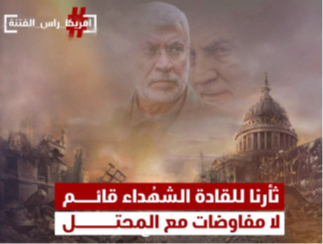
In July 2020, al-Saadi posted to his X account an image of the US Capitol in rubble along with the faces of fallen leaders like Soleimani, with the text “our revenge for the martyred leaders is ongoing. No negotiations with the occupier.”
With all this, al-Saadi’s defense strategy—framing himself as a political prisoner or prisoner of war—is unlikely to succeed in U.S. courts, Hackett notes.
“After 9/11, the U.S. instead opted to treat similarly situated detainees as unlawful enemy combatants,” he says.
For now, the case against Mohammad Baqer Saad Dawood al-Saadi sits within a wider pattern that Western authorities link to Iran-aligned proxies operating worldwide through militias and intermediaries.
The trial will ultimately determine how much of it holds.
Middle East Uncovered is powered by Ideas Beyond Borders. The views expressed in Middle East Uncovered are those of the authors and do not necessarily reflect the views of Ideas Beyond Borders.