


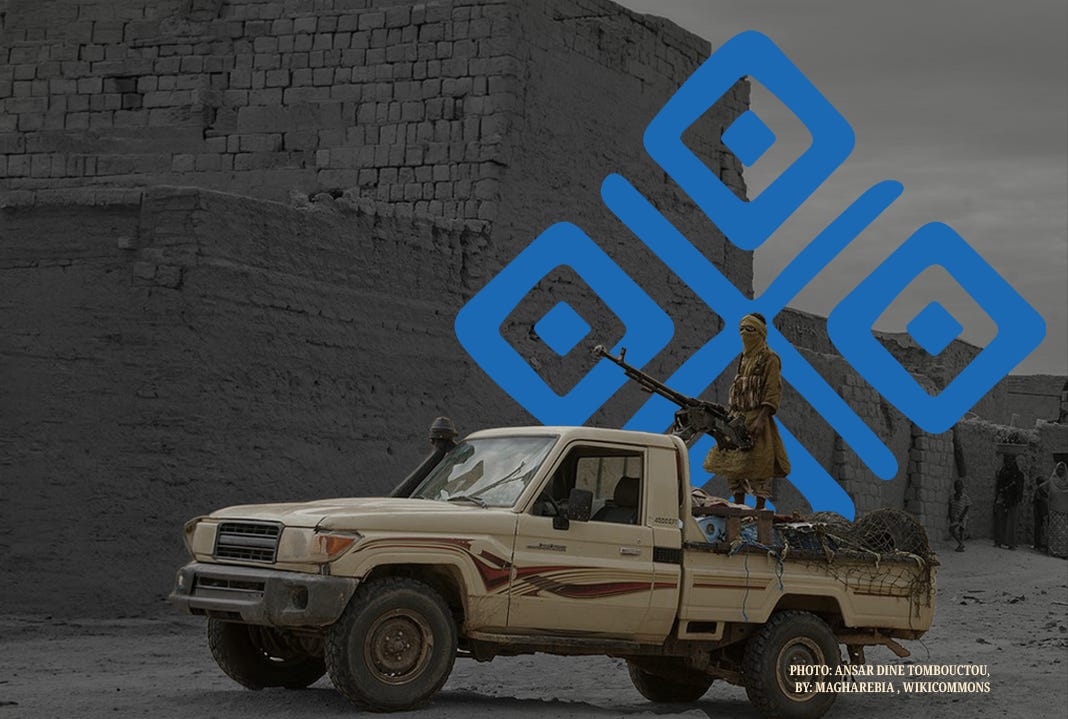
At least 48 civilians are dead in eastern Mali as a result of a spate of jihadist violence over the weekend. Some victims were shot. Others died in fires after their homes were set ablaze.
Across the arid and sparsely populated Ménaka region in the Sahel, Islamic State-affiliated gunmen descended on villages—many of them remote settlements where semi-nomadic tribespeople herd sheep, goats, and cattle. They set fire to houses. They stole livestock. In their wake, hundreds of civilians—predominantly Muslims—fled towards the regional capital.
Mali has suffered greatly from outbreaks of jihadist violence for more than a decade now. After a rebellion by Tuareg separatists in 2012, groups of al-Qaeda-linked militants began to seize control of large parts of the country’s north, including Mali’s most famous landmark, the ancient mud-brick city of Timbuktu.
The French government intervened in 2013, driving the opportunistic jihadists from the major cities. But this did not overturn the insurgency. Violence has continued across the country and has even spread into neighboring ones. Various organizations, including those affiliated with al-Qaeda and the Islamic State, have fought against the Malian government. But they have also fought amongst each other, as well as perpetrating attacks against civilian communities.
As a result of this continuing storm of violence, the country has been widely destabilized. Hundreds of thousands of Malians have been displaced. Massacres have become a recurring feature of life.
Across Africa, jihadist violence has claimed more than 165,000 lives in the past decade, according to the Africa Center for Strategic Studies.
In the neighboring countries of Burkina Faso and Niger, rural communities have been terrorized by militants affiliated with al-Qaeda and the Islamic State. Around northeastern Nigeria and Lake Chad, Boko Haram and another Islamic State-affiliated offshoot have been waging jihad for more than fifteen years. In Somalia, the jihadist piracy group al-Shabaab has continued a longstanding campaign against the Somali government.
And further south, militants who pledged allegiance to Islamic State have perpetrated massacres in both the Democratic Republic of Congo and Mozambique.
The problem, of course, is not contained to Africa. Islamic State insurgencies remain active across both Syria and Iraq, even after the destruction of the group’s so-called caliphate established in 2014.
In Yemen, al-Qaeda established a foothold as a result of years of civil war and political instability. Large parts of the country have been seized by the Houthis (Ansar Allah), a Shia militant group which controls both the country’s capital of Sana’a as well as parts of the north and the border with Saudi Arabia.
In Lebanon and Gaza, Islamist militant groups have fought repeated wars with Israel, too.
Yet international media attention differs sharply across these conflicts.
The wars involving Hamas, Hezbollah, and Israel have attracted enormous levels of global attention—as well as high degrees of sympathy for civilians. The Houthis also became a major subject of international news when their attacks on Red Sea shipping impacted global trade routes and resulted in military responses from the United States and Britain.
And yet, the victims of jihadist violence across Mali, Burkina Faso, Nigeria, Mozambique, and more go unheard. The atrocities committed in the Sahel have not captured widespread public attention. The suffering of the civilians in these regions is not widely commented upon or recognized. There are no mass demonstrations in the West calling for an end to these insurgencies. Celebrities rarely tweet about or talk about such events. Nobody is shouting “free Mali” or “free Mozambique” during their concerts.
The difference isn’t that journalists are making no effort to report on these events. International news agencies like Reuters and Associated Press, as well as local correspondents, file stories on these matters all of the time.
But such reports receive relatively little attention, especially globally. And it’s difficult to garner much attention unless the events in question directly affect the military, political, or economic interests of people in Western countries.
This is quite understandable. American audiences tend to be interested predominantly in American events. The same is true for European audiences.
But the proliferation of jihadist violence throughout Africa and the Middle East should not be something that is ignored. It is a symptom of a violent and virulent ideology spreading, festering, and metastasizing. And the ideologies driving this violence do not respect national borders.
Nor are they only a threat to one specific group. Jihadism has killed Muslims, Christians, Jews, and people of many different groups.
We have already seen the effects of militant Islamism in Western countries on many occasions. Obviously, on 9/11. But also in the Bataclan attacks in Paris in November 2015, and in the bombing of the Ariana Grande concert in Manchester Arena in 2017. And on many more occasions.
With the large-scale spread of calls to “globalize the Intifada” since 2023, the risk of such violence has only grown.
The riots in France—which also took place over the weekend—illustrated the growing trend towards outbursts of Islamist violence (some of it petty, some of it more serious) on European streets.
While some of the rioters were undoubtedly just ignorant non-ideological opportunists seeking a chance to break into shops to steal luxury goods, and while many others talked of economic grievances, in one widely circulated video, a woman wearing Algerian nationalist-branded clothing blamed France’s problems on “Zionists,” and subsequently appeared among the rioters shouting religious slogans and making threats of violence.
Popular commentators like Mohamad Safa went even further. In regard to the unrest sweeping France, Italy, Belgium and Albania, Safa declared that Europe was experiencing a “European Spring” against “Zionism.”
The spread of jihad across Africa and the Middle East should serve as a warning—and especially because it is being so widely ignored. In most places where Islamist violence took root, there were no Zionists there, or anything like that. There were no Israeli settlements.
While Zionism and the existence of Israel are often cited as a motivation for jihadist violence in Palestine by groups including Hamas and Palestinian Islamic Jihad, and in Lebanon by Hezbollah, this does not explain the spread of such violence in Mali, or Mozambique, or Nigeria, or Yemen, or Afghanistan, and so forth.
To do that, you need to pay heed to the jihadists’ ideology, instead. They claim absolute religious authority. They believe that the only legitimate government is one based on their interpretation of Islam. And they want power.
A Muslim villager in Mali does not need to be a Zionist, an American, or against Islam to become a target. It’s enough simply to resist their claim to rule, or to cooperate with the government of Mali, or even just belong to a community that the jihadists regard as hostile. Their ideology provides all the justification they need.
You might also like:
Why Is Al-Qaeda Citing Muslim Brotherhood Scholars on Gaza?

This article was produced in partnership with the Program on Extremism at The George Washington University, where Sergio Altuna is a Senior Research Fellow.
Middle East Uncovered is powered by Ideas Beyond Borders. The views expressed in Middle East Uncovered are those of the authors and do not necessarily reflect the views of Ideas Beyond Borders.
