


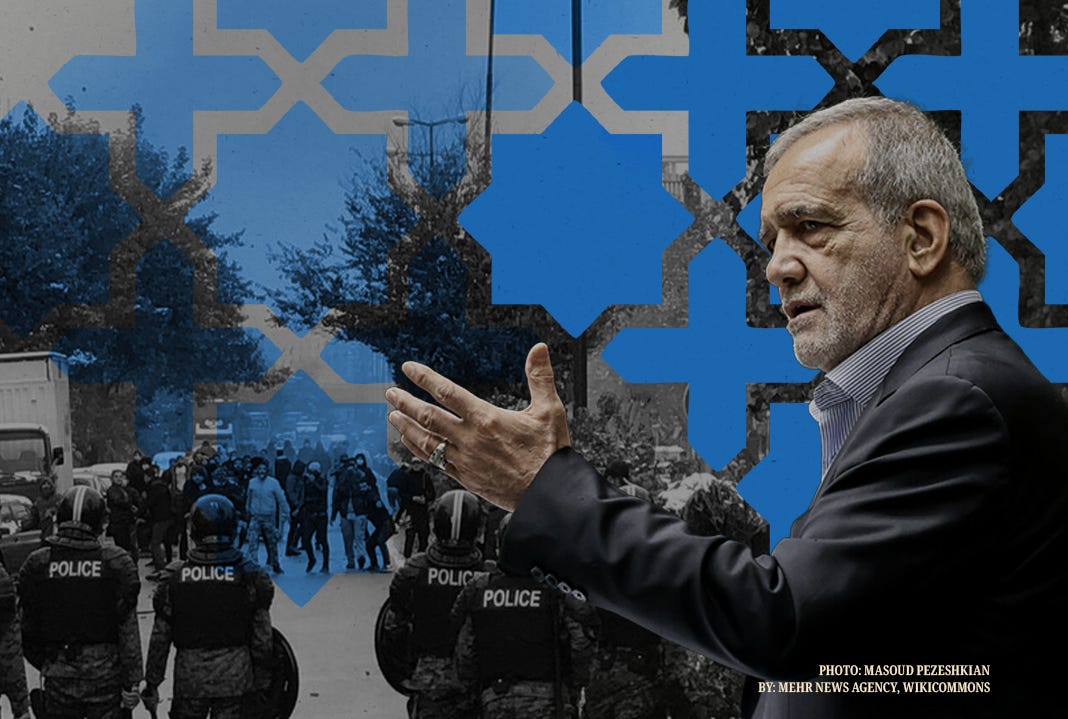
Last week, President Masoud Pezeshkian arrived at the United Nations carrying photographs of dead Iranian children.
He spoke of a school bombed in Minab and civilians killed by American and Israeli attacks, rejecting Donald Trump’s description of the Islamic Republic as a terrorist state and turning the accusation back on the accusers: “We have been the victims of terrorism.”
“We have only defended ourselves,” Pezeshkian said. He spoke of “our innocent people” and ended by declaring that Iran had been hit but had not “bent the knee.”
But who exactly is “we”?
Mere months ago, Iranians took to the streets not to defend the Islamic Republic, but to challenge it. Far from demonstrating against the United States or its allies, they were confronting the very political system Pezeshkian represents. At the 81st session of the United Nations General Assembly, he intentionally collapsed that distinction. Government, country, and people merged into the same pronouns: “we,” “us,” and “our people.”
Pezeshkian warned of a world in which military power overtakes politics and force becomes a substitute for diplomacy. Yet the political system he represents has allowed the Islamic Revolutionary Guard Corps (IRGC) to grow far beyond the role of a conventional military. The Guards wield enormous influence over Iran’s politics, economy, internal security, and foreign policy. The stunning irony is that Pezeshkian was warning against military power encroaching on politics while representing a system in which it already has.
For Iranians, the contradiction is familiar. The same government warning the world about the dangers of military force has repeatedly used its own security forces to crush dissent at home. And that use of force has not stopped at Iran’s borders.
Much of that activity has been carried out through the IRGC’s Quds Force and its network of armed groups in Iraq, Lebanon, Syria, Yemen, and elsewhere.
But the Islamic Republic has not always worked through proxies.
In June 2022, Turkish authorities arrested five Iranian nationals suspected of planning attacks against Israelis in Istanbul. Turkish media reported that police seized pistols and silencers from houses and hotels used by the suspects. The alleged targets were Israeli tourists and businesspeople. Iran did not immediately respond to the allegations.
This was not an isolated incident. In a 2024 investigation, Reuters identified at least 33 assassination or abduction attempts since 2020 in Europe and the United States that authorities alleged were connected in some way to Iran, Iranian operatives, or people closely linked to the country.
Despite that history, Pezeshkian told the General Assembly:
“No one in this region will enjoy security alone. Either we will build security together, or we will endure insecurity together.”
He chose his words carefully. The statement could be naively read as an appeal for collective security. But coming from the head of a state with a long history of projecting coercive power abroad, that interpretation falls flat.
Pezeshkian framed his message around diplomacy while making the underlying threat unmistakable. If Iran feels insecure, it is prepared to make that insecurity everyone else’s problem.
This is one of the central contradictions of the Islamic Republic’s foreign policy. It demands respect for Iran’s sovereignty while interfering in other countries through armed groups and its own security apparatus. It condemns military pressure while using military and paramilitary power to pursue its interests across the region.
The same double standard applies to how the Islamic Republic talks about the Iranian people. It now points to their resistance to foreign attacks as evidence of support for the state.
The Islamic Republic wants to have it both ways. When Iranians rise against it, they become rioters, terrorists, or agents of foreign powers. When Iran comes under attack from abroad, those same Iranians are suddenly folded back into the nation, their opposition erased so the state can speak on their behalf.
But a nation’s people and its government are not the same thing. To take the suffering of Iranians under foreign attack and use it as evidence of loyalty to the Islamic Republic is more than dishonest. It turns their pain into political propaganda and their refusal to abandon their country into an endorsement of the state that rules it.
For decades, Iranians have fought their own government for sovereignty over the most basic parts of their lives: their bodies, their clothing, their speech, what they read, what they learn, how they live, and who gets to govern them. That is what makes Pezeshkian casting the Islamic Republic as a defender of Iranian sovereignty so bitterly ironic.
War gives the Islamic Republic cover to redraw the line between loyalty to Iran and loyalty to the regime. Under foreign attack, dissent can be recast as disloyalty, and opponents as allies of the enemy.
But Pezeshkian’s portrait of “our people” conveniently omits the brave Iranians who have spent years demanding something different from the state that claims to represent them. It leaves out the women who took to the streets during the Woman, Life, Freedom movement, removing their hijabs and risking arrest, imprisonment, and worse for the right to control their own bodies and lives. It leaves out the protesters killed by security forces, the dissidents and protesters executed by the state, the political prisoners still behind bars, the journalists and activists punished for speaking openly, and the families who have spent years demanding answers for loved ones killed by the government.
These people are not somehow less Iranian because they oppose the Islamic Republic. Their courage, grief, and demands belong to Iran’s story just as much as the suffering Pezeshkian chose to display at the United Nations.
Any claim to speak for “our people” has to include them too.
I lived for decades under the political system Pezeshkian represents. So I hear his words differently than someone listening in New York, London, Paris, or Berlin might.
I understand why parts of his speech can be compelling abroad. Here is the president of a country at war, standing at the United Nations and denouncing American and Israeli power. He speaks of sovereignty and equality. He holds up photographs of dead children and condemns a world in which military force determines who gets heard. To some Western audiences, it can sound like the familiar language of resistance to imperial power.
But Iranians have heard these words before. We have heard the government speak of “resistance” while imprisoning and executing those who resist it. We have heard it defend Iranian sovereignty while denying its own citizens control over their bodies, speech, and lives. We have heard it condemn foreign violence after turning violence on its fellow Iranians, and denounce foreign interference while its own security apparatus wreaks havoc across the Middle East.
That is why the photographs Pezeshkian did not hold up at the United Nations matter as much as those he did.
The people killed in foreign attacks are Iranian. So were the protesters killed for challenging the Islamic Republic. So were those executed by the state. The political prisoners still behind bars are Iranian. So are the women who refused to cover their hair, the families demanding justice for their children, and the millions of people who want a different future for their country.
Iran is bigger than the Islamic Republic. Its people cannot be reduced to the government that rules them.
The Islamic Republic does not get to claim their suffering as proof of their loyalty. And it does not get to turn their love for their country into consent.
Middle East Uncovered is powered by Ideas Beyond Borders. The views expressed in Middle East Uncovered are those of the authors and do not necessarily reflect the views of Ideas Beyond Borders.

What have you to say about admissions by Trump, and on "israeli" TV, that USA and "israel" both armed Kurdish groups in Iran and well as protest leaders and agitators to engage Iranian security services?
Have you seen the videos of Iranian cops hacked to death?